This article is a continuation of my previous journal entry on using a memory palace as a computational system for basic arithmetic.
Prompt: Give me an image featuring 10 giant golden statues of Gilgamesh standing in a row.
-
The first statue is a soldier holding a rifle.
-
The second statue has both arms stretched straight out to the sides, with large eagle wings extending between its chest and arms, resembling a winged comic-book hero.
-
The third statue is forming an Illuminati triangle sign with its hands.
-
The fourth statue is performing an inverted yoga pose, with one leg straight upward and the other bent into an inverted “L” shape to resemble the number 4.
-
The fifth statue has its arms and legs stretched outward; together with its head, the pose forms the shape of the number 5.
-
The sixth statue is performing a yoga pose that resembles the number 6, with its belly touching the ground, legs raised in the air, and hands clasping its feet.
-
The seventh statue is in the raised position of a push-up, with its body arranged to resemble the number 7.
-
The eighth consists of two giant statues curled into a circular formation, with each statue holding the other’s foot to maintain the shape, together forming the number 8.
-
The ninth statue is bowing forward at a 90-degree angle with its hands resting on its knees.
-
The final figure is a giant golden snake eating its own tail, forming a perfect circle to represent the number 0.
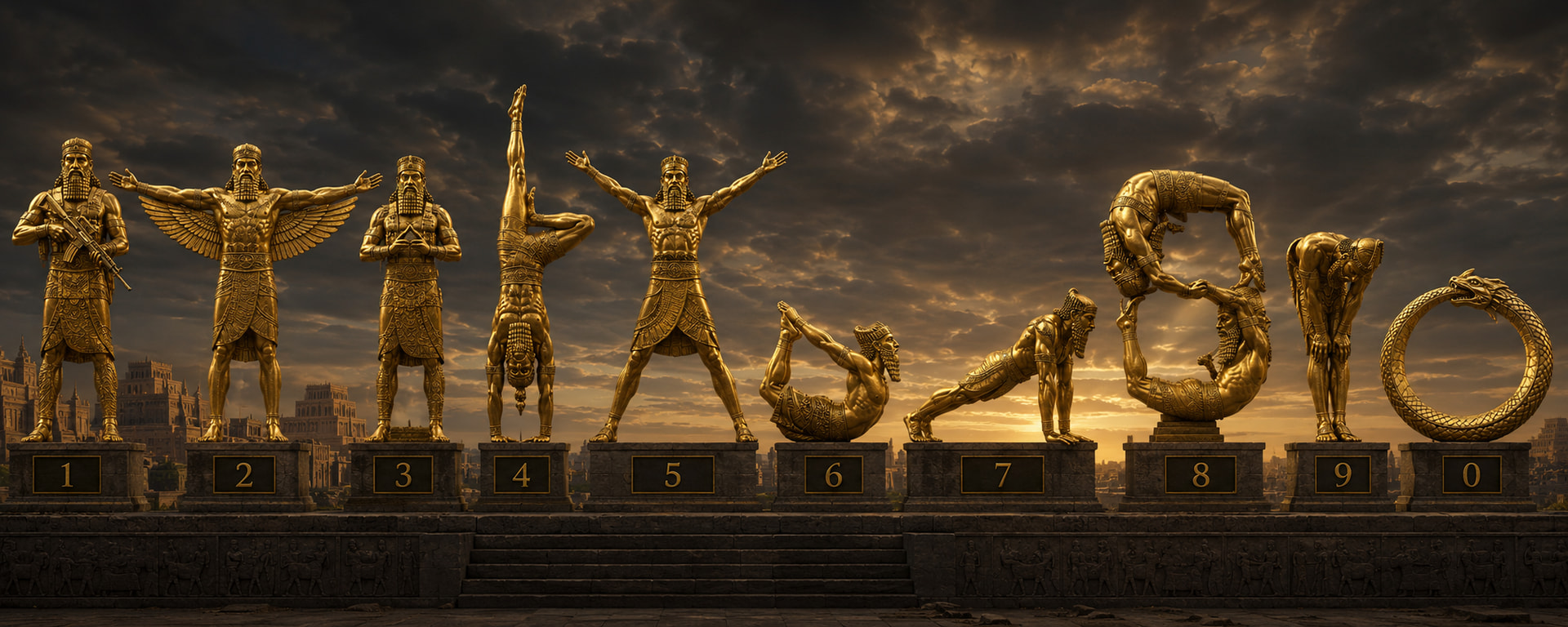
In Part 1, I focused on solving the problem of converting mathematical numbers into visual images. I have attached an image below that illustrates the concept. The image generated by ChatGPT is not completely accurate, but it provides a rough idea of the system.
In this article, I will address the next challenge: the limitation of working memory.
When performing calculations such as 24 × 93, we might break the problem into smaller steps, such as 24 × 3 and 24 × 9. However, while working on the second calculation, we may forget the result of the first one. This article focuses on solving that specific problem by reducing the load on active memory.
For this example, we will use the standard multiplication method without involving a memory palace during the calculation itself.
Suppose we calculate:
24 × 3 = 72
We now need a way to store 72 so that it remains available while we continue the larger calculation.
To do this, we first convert 72 into visual images using the digit-to-image system established in Part 1. We then apply the Universal Kinetic Link (UKL) or causal chain technique to create a persistent memory trace.
For example, the image representing 7 is a statue performing a push-up, while the image representing 2 is the Eagle-Man statue. To encode the number 72, the Eagle-Man shoots feathers into the back of the push-up statue. This creates a memorable interaction rather than two separate images.
The key idea is that each digit contains a link to the next digit. When we later recall one image, it naturally leads us to the next image in the chain.
For example, the sequence:
1234567890
can be represented as a single connected scene:
-
Statue 2 shoots Statue 1 with feathers.
-
Statue 2 is pierced by the trident of Statue 3.
-
Statue 3 is kicked by Statue 4.
-
Statue 4 is struck by the shuriken of Statue 5.
-
Statue 5 is struck by the knife of Statue 6.
-
Statue 6 is bitten by the cane with a golden lion head belonging to Statue 7.
-
Statue 7 has its foot chained by Statue 8.
-
Statue 8 stands on a black carpet that is being pulled away by Statue 9.
-
Statue 9 is bitten by the snake of Statue 0.
Each action is standardized. The character representing a particular digit always performs the same action regardless of the surrounding digits.
For example, if the character for 1 is assigned a gun, then it always shoots a gun, no matter which digit comes before or after it. These fixed actions form a universal kinetic language that connects digits into a chain.
This interconnected structure makes long numbers easier to remember because it transforms them into a miniature movie rather than a collection of isolated symbols.
Compressing an Entire 10-Digit Number into a Single Object
We can take this idea a step further.
Instead of using ten separate statues to represent the sequence 1234567890, we can use only the Statue 1 character as a base object and assign specific body locations to represent the remaining digits:
-
Right arm = 2nd digit
-
Left arm = 3rd digit
-
Left leg = 4th digit
-
Right leg = 5th digit
-
Head = 6th digit
-
Right shoulder = 7th digit
-
Left shoulder = 8th digit
-
Belly = 9th digit
-
Chest = 10th digit
Each body location is modified by the corresponding universal kinetic action discussed earlier.
In this way, a single object can encode an entire 10-digit number. Rather than remembering ten separate symbols, we remember one transformed object whose body contains all ten digits through a structured system of locations and interactions.