Curious to see how you guys would go about this. I think “linking” would be easy for the square numbers (44x44 = 1936 I’d probably link my pre-existing two-digit PAO + a major system object), but that won’t work for any other combination. It’s about 10,000 3- or 4-digit numbers to memorize.
I wouldnt want to suggest anything at the moment, but I will think about it. What I do know, is that you won’t have to memorize 10,000 numbers.
of the entire 9999 grid, you do have 9801 results, that part is true. But here is the trick:
99 of those are square numbers, leaving those out for a second.
that means you got 9702 non-square results. but when you look at it, it has both 4582 and 82*45, which are exactly the same. Meaning you could leave a lot of those out.
In fact, you can leave 4851 numbers out, leaving 4851 numbers to memorize. Plus the 99 squares, that makes for 4950 numbers.
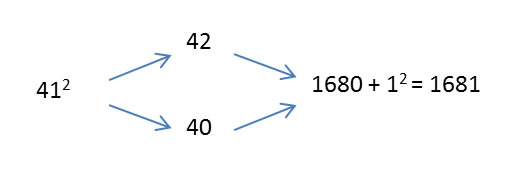
Actually you don’t need memorized that squares you can do it mentally very fast with practice just do this;
That means:
Round up or down to the nearest multiply of 10. (In the previuos example round down to 40 subtracting 1)
Add the same distance from the nearest 10 multiply to the original number (In the previous example add 1 to 41 and get 42)
Multiply the two number you get, don’t worry that multiplication is easy in all cases (In the previous example multiply 42 by 4 and attach a 0… 42x4 = 168… then attach a 0 and you get 1680)
Add the square of the distance you got in the previous steps. (It will a small number allways )
I know it seen complicated the first time but this method is very very fast believe me… Look in google “Mentally square a two digit number” and you’ll get a better explanation of this method, maybe you get confused because I don’t know how to explain it more clearly and my english doesn’t help hahaha
Yeah! I’m reading Secrets of Mental Math, so that’s how I’ve been squaring numbers mentally, too!
The author has all the two-digit squares memorized (probably by rote). Which helps with calculating 3-digit squares (you skip having to square a two-digit number to calculate what to add in the end underlined as such: [431 x 431 = 400 x 462 + (31x31) ). So since you’ll already know 31x31, you don’t have to break that down into 31 x 32 + (1 x 2).
So with the same logic, I was wondering about memorizing the 99x99 table, so that doing 3-digit by 3-digit multiplication (and 4 x 4 etc) becomes way easier
I agree, I started thinking like this when I first got into memory training, but with some experience now, I can wholeheartedly say…I would avoid the work of memorizing numbers that you can get by calculating them. Memorize the calculation method and practice that; your mind is already programmed to make calculations, it’s much less work to just practice this skill as opposed to spending the same amount of time memorizing data without any relationship to ‘how’ you got there. Memory Palaces and the like are for memorizing things that you can’t find with another method of brain usage. Like you don’t need to memorize in a Palace the different forms of smells that different foods give you because you already have other senses available for this.
My two cents: use memory techniques for assembling unrelated (playing cards order, shopping lists, dates+facts) items that aren’t memorable via other methods of brain function.
Cheers
I memorize as follows:
1x1
2x1 - 2x2
3x1 - 3x2 - 3x3
4x1 - 4x2 - 4x3 - 4x4
5x1 - 5x2 - 5x3 - 5x4 5x5
6x1 - 6x2 - 6x3 - 6x4 - 6x5 - 6x6
…
100x1 … 100x100
This method covers all of the multiplication problems 99x99.
A number of the problems are easy problems that no not need memorization.
I believe that with this method there are 4902 problems to memorize (pardon me if there is an error in the number, I calculated mentally).
However, of course if you know the common number patterns, such as the ones for 11,5,10. And skip the easy ones such as a number times 2. This will be greatly reduced.
I would probably use something memorable for the year 1936. Jesse Owens takes 4 Gold medals at Berlin Olympics. 44 x 44 = 1936. But another image using a Dominic PA method and the date of 1936, would be Donald Duck (Person for 44) Twerking Tail Feathers (Action for 44) on the Podium next to Jesse Owens. Either way works!
To disagree with others, knowing is faster and more reliable than calculating. Mental math puts extreme strain on the working memory and doing side calculations can push it over the limit. This is why we learn our tables up to 10x or 12x.
That said, there is a balance. Memorization is hard work. It’s not enough to just acquire the facts in memory, they must be fluent, on the tip of your tongue like spoken vocabulary and that is a lot of work.
I have been working on multiplication tables upto 20. The initial acquisition took me about a week, since then I have been drilling regularly for several months and only now am approaching the point where the knowledge is actually an asset in mental calculation.
I suppose if I were to undertake the exercise of just squaring two digit numbers i.e. 13 x 13, 14 x 14, 15 x 15 … 98 x 98, 99 x 99, I would just use the Person Peg for the two digit number and attach a story to accompany it. So I would still keep Donald Duck as my person for 44 (Dominic System) and thereafter I would encode the answer 1936 or whatever it be using Major Code into a memorable story. So I would have Donald Duck (as 44 squared), sitting in a TuB (19), lighting a MatCH (36).
I know the squares verbatim from 1 through to 13, so the exercise would start from 14 squared through to 99 squared for the numbers I don’t have off pat.
There are a lot of freebies in the squares up to 100. Even multiples of 10 are almost free. 40-60 can be calculated, by a special technique so fast and easily that IMO memorization is not worth the investment likewise 90-100. And numbers ending in 5 are trivial to calculate by a special method. Likely there’s also a few that you already know like 322.
Of course I hadn’t thought that through properly. There are many easy squares in that range that don’t need ‘images’ to remember them. 20 x 20 is obviously 400, 25 x 25 = 625 etc. Still I think for 44 x 44 = 1936 I would still go with this:
My scheme is similar. One word for the number and two for the square. I’ll use a single word for the square but mostly this is too difficult to find in the Major System.
472 RoCKy oNioN SouP 2209
Finding good choices for the mnemonics was a significant effort.
A good idea that works both ways round as squares of two digit numbers and as square roots of their answers. So if you were asked what the square root of 2 209 is, your image of oNioN SouP gets you straight back to RoCKy (47) as your answer. Is there any particular reason that mathematic calculations are of interest to you?
Zvuv which system do you think is better for recalling “Perfect Squares” the Major System or the Dominic System? I know that your answer may be swayed by the fact that you are a Major System user but I’m thinking possibly both systems would work well? Above are both my images ever ingrained in my long-term memory for “Forty-seven Squared” = 2209 using both Major System and Dominic Systems. The image for 47 (Major System) I borrowed from you.
I like your graphics. I’m a big fan of drawing images for mnemonics. I think it strengthens the attachment.
I don’t know the Dominic System. I started with the Major a while back and stuck with it. It takes some time and effort to become fluent with system and once invested, IMO, it’s usually not worth switching around.
The Major does have limitations. It can be surprisingly hard to find useful mnemonic words for certain numbers. Repeated digits are often tough, never mind triples which occasionally show up in calculation. I could not find a decent choice for 208 (13x16) in English. The whole forum was stumped on that one. Coming up with a list of good mnemonics for the squares and the X tables was a significant effort. Were I to consider an alternative system this is something I would look at carefully.
Edit: Some exception was taken to my characterisation of the mnemonics for 208. There are some options, none that I considered good. What’s an effective image for one person may not be so for another. That conversation can be found https://forum.artofmemory.com/t/major-system-for-208/75766
I thought I was being ambitious to memorize up to 1024. I guess not.
Of course, I was just using rote memorization with Anki—I hadn’t learned about any of the mnemonic tools taught here. I had figured out the difference of squares pattern
I sort of grouped all of the pairs that multiplied to the same product by using the product as the front of the Anki card and putting all of the factor pairs on the back. I still think this is a good idea, but it starts to get unwieldy as the numbers get bigger. I am glad I am learning new techniques.
I do love the feeling that comes from instantly knowing that 17×24=408.