i would like to memorize 500-1000 digits of PI, but i don’t know which technique to use;
And i would like the technique easy, not hours long to learn;
So does anyone know such a technique?
1 Like
People typically use a number memorization system like the major-system along with the method-of-loci. There are some alternatives to the major system mentioned in the articles below. It’s possible to learn the basics of the method quickly, but memorizing 500-1000 digits starting from scratch will still require work.
The fastest way to get started without spending hours memorizing a number system might be to learn the assignments for the major system (or whatever number system you choose — I think the 2-digit system I use is a little simpler than the major system, and I included sample images in that linked post).
Then print the first few hundred digits of pi and start memorizing them by placing them into locations in a memory palace. If you don’t already have memory palaces ready to go, you could create the first memory palace on the spot in whatever room you are sitting in by creating 10 locations according to this pattern:
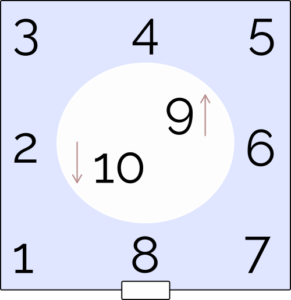
The first digits are 3.14159265.
3 is easy to remember, so you could start at 1415. Break the numbers into 2-digit chunks: 14-15.
Then look at your list of images in your number system. Find the images for 14 and 15. In my (newer) system, those would be “tar” and “tie-fighter”. I’d combine them into a story that I visualize from left-to-right or top-to-bottom: tar is being poured on a tie-fighter. Then I would place that image into the first location of my memory palace.
The next chunks are 92-65. Find the images for 92 and 65, make a little story from them and put them in the second location of the memory palace. In my system those would be “pool” and “bicycle”. To keep the images in order within each location I have to go from top-to-bottom or left-to-right, so I would picture a bicycle in the bottom of a pool so that the pool is “on top” of the bicycle.
If you do it that way, you could get started with memorization right away before memorizing all 100 images. You would learn the images for chunks like 14, 15, 92, 65 as you place them in the memory palace and review, instead of learning all the images in order from 00 to 99 before you start memorizing pi.
2 Likes
There is a give and take between up-front cost and long-term benefit.
A 1-digit system is easiest to learn. You could learn it in a day. But to apply to a 1000 digit sequence will require 1000 mnemonic elements and you’ll run into TONS of repeated elements, which magnifies possible confusion and swapping. If you use a memory palace sequence you’ll need a ton of loci. It will take a long time to work through to 1000 pi digits this way.
So least cost, least benefit.
A 3-digit system only requires 333 mnemonic elements to get you to 1000 digits, but will take a long time to build each one, even if you come up with the associations as you encounter them. It may take about the same time as a single digit system, but with that workload frontloaded in the build/prep stage.
So that has the biggest benefit, but also the highest startup cost.
I think a reasonable balance for this project would be to structure it via a 2-digit Person/Object system. With this, you can compress 4 digits per scene. You’ll also need a 250 loci sequence to associate those scenes with. This can be 25 palace areas with 10 loci each. That is probably pretty easily attainable.
So in total, your “prep” work is to determine your 200 numeric associations and 250 loci. You don’t need to drill these to fluency and have them all memorized, just be able to quickly reference your list somehow, even from an excel doc or something.
Then just take the decimal sequence and break it into sets of 4 as Josh explained.
When I did my 4000+ digit project, I created an excel doc that listed all of my loci (800+ of them), along with the digits stored at each one and their mnemomic elements.
Once you get in the groove of working with the layout, you can add 50-100 digits per day. Within about 2 weeks you should be at 1000 digits. This is a conservative estimate. If you dedicate more time, you could get there faster.
Definitely take a look at Josh’s resources and try that as a starting point for building your system.
Just remember, theres no magical zero effort memory system. You pretty much get out what you put in in terms of effort and result.
1 Like
While I don’t memorize playing cards, my approach to pi has some similarities to the PAO system some use for cards. I store pi in six-number groups, one group per location. I use the Major system, but for each six-number group, I turn the first two numbers into a person that then interacts with the other four numbers (which I store as 2-digit units).
Here’s an example. Pi starts like this: 3.141592653589… So my first locus has 141592 (ignoring the “3.”) and my second locus has 653589. To use the second, 65 is John Lennon, riding a mule (35) that is VaPing (89). Later scenes: Sarah McLachlan (03) is standing on a roof (48) singing “Noel” (25); Laurence Fishburne (58) has a nun (22) sitting on his shoulders, holding a Jack o’ Lantern (my non-Major image for 31); Kim Novak (72) is sitting on a llama (53) that is puckering its LiPs (59). The individual 6-number groups don’t interact with one another in any way; they are simply placed in specific locations, which triggers the recall.
I started with a larger memory palace (a public library where I used to work, along with the park surrounding it) and had my first 120 digits placed before even stepping inside. I’ve only recently started adding more numbers—30 a day—just to keep the exercise going.
Because I’m working in groups whose images are built on a xx-xx-xx scheme, this isn’t the ideal system if you want to be able to recite pi backwards, digit by digit. (it can be done, but I’d have to go through the images slowly to be able to break them down in reverse order.) Instead, when I’m practicing backwards recall, I’m moving backwards by group, not individual digits. (Hope that makes sense!)
Bob
3 Likes