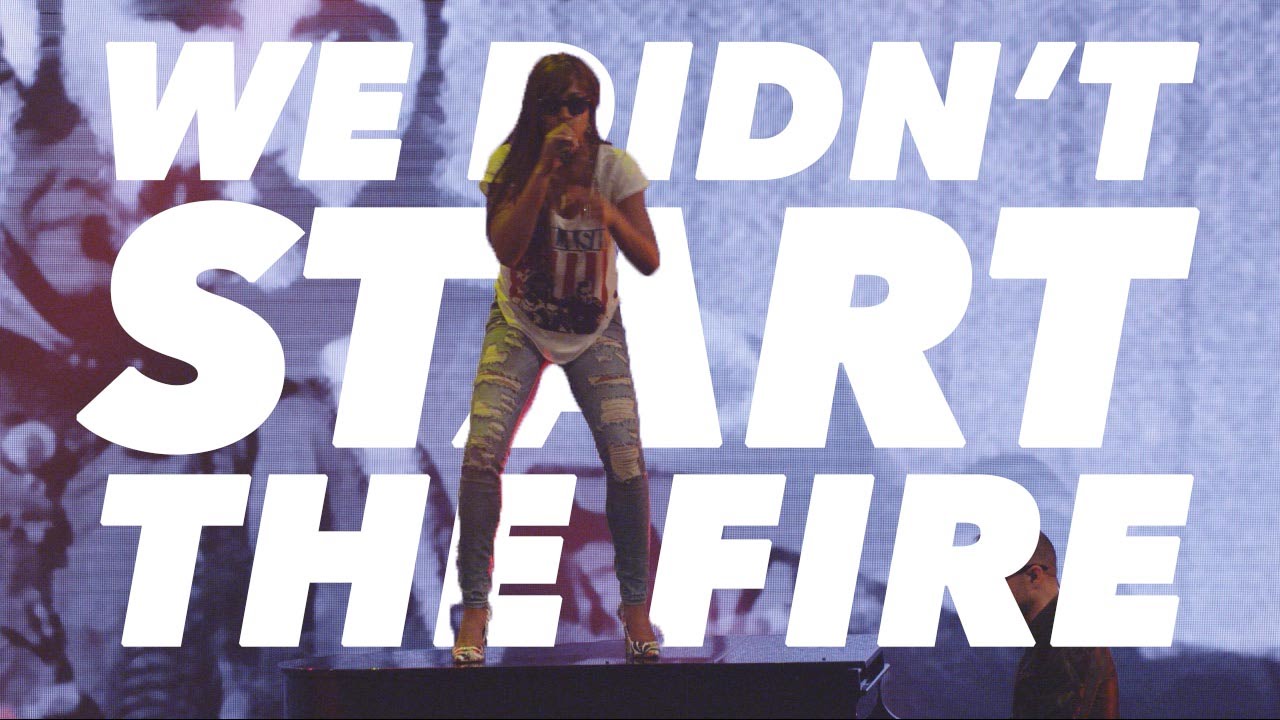
What would be the best way to learn Billy Joel’s Song: “We didn’t start the fire” (A copy version of the song is shown in the You-tube video below. I don’t think a memory palace would work to well as the song is sang at a cracking pace. One wouldn’t have time to go from one character in the song to another. Wish I could ask this accomplished singer in the You-tube clip how she managed to recite well over 100 characters without literally skipping a beat. I did notice that the singer is bouncing about in rhythm to the music so I’m guessing that has a large deal to do with it. Also she is moving from one place to another around the stage during the song so perhaps she is using the paino for instance as a “Memory Peg” when she comes to the bit of the song that doesn’t follow the familiar choruses. Any ideas especially from any accomplished musicians as to how it is done?
Memorizing song lyrics is very easy—singers do it all the time, even normal people can sing large parts of familiar songs without any effort.
Memorizing the lyrics after hearing them once (or e.g. unlimited replays in 10 minutes) would be much harder, and I’d also be curious if anyone has great techniques for doing that.
Someone posted some ideas for memorizing text verbatim (search the forum) but it relied on seeing the first letter of each word, so not really applicable here.
There is nothing special about musician’s brains, learning lyrics is the job and you have a great help with beat, tempo and especially melody to help you. No matter what type of music from high opera to Gregorian Chant to Rap or rock you can have that music written down, so you start on paper. But being a musician doesn’t really START until you put the paper down and that’s AFTER you have learned your lyrics or chrods or melody or what-ever. Orchestras and string quartets do have the parts in front of them, but they are not sight-reading (at first sight when you have never seen the music before) they are reading which is quite different. Genres which do not use reading are usually less complicated in terms of number of parts. So you learn from the paper, the lyrics and the chords or backing beat, you test away from the paper and when you have it you are then able to perform it. Rhythm is measured in “feet” (sometimes called iambs which are weak strong weak strong syllables but which can vary), but the point is you learn the song.
I do not know if you are interested in learning to sing and learn songs quickly, but believe me learning the lyrics is the least of your problems and solved by one method: Long practice. Timing is more difficult, and expression and dynamics but each builds up over the years.
My take on this is: Go into a room, with your lyric sheet or chords or backing tape, start at line one, when you have that, go to line two. And go on until you have the whole thing. Work for two hours maximum. You will start to forget then. Next day go into the room again, work again on the same thing. But this time only for an hour. Repeat. Five sessions of progressively shorter and shorter times should result in you knowing it.
Wow thank you for your insightfull answer. Key to what you are saying is practice, practice and more practice. I’m guessing in this day and age use is being made of tele-prompters (like the news readers have) or similiar. I can’t think of anything worse than an accomplished singer losing their lines which is probably what has given rise to the ‘lipsynching’ or having an earpiece in place for something that can’t afford to be fluffed (here for example I’m thinking of “National Anthems” sung at prestigious sporting events). All this being said I’m sure that the professional singers have served their 10 000 hours of service to masterry as it is called? The points you raise aboutexpression and dynamics etc. is probably why 8 year old girls can’t belt out passionate love song like a say Shirley Bassey can? The ‘feet’ iambs are key to driving the rhythm forward in any song and judging by the way the singer in the video clip is punching the air with her arms and tapping the table and piano with her shoes is definitely an aide memoir in my humble opinion in her pulling the song off so well. At the other end of the singing spectrum (karaoke) a lot of fun is had by mere mortals destroying songs that are read off of big screens but where the singers (usually drunk) just wreck songs much to the delight of their friends and others in the audience - anything for a good laugh. When I listened to the original Billy Joel version of “We didn’t start the Fire”, it is clearly evident that the cover version is also being sung in a different key to the original. So what I’m taking out from your reply in essence is there are no short cuts to learning the lyrics of difficult songs and to master them proficiently requires an immense about of practice.
Thanks for the reply.
One thing:
There are LOADS OF SHORTCUTS!!
Musicians - life long musicians - know every trick in the book, prime of which is imagining someone else singing or playing the thing and them virtually copying the imaginary perfect performance which they (I’ll even go as far as to say “we”) can run and rerun time after time in our mind’s eye.
Not easy for a beginner though. But that’s the key.
Good luck.
K
Great insight! Many thanks
I’m not sure if that is the most valid argument given that quite a few people have managed to memorize a deck of cards in 26 seconds or less, meaning two cards per second. Here we’re talking encoding as well. What you are looking at is only retrieving stored information which is much faster than placing new images in a location.
You wouldn’t go from character to character though and do a verbatim retrieval; rather, you’d be storing a bullet point to keep track of where you’re at in the lyrics. It’s more of a mental crutch and less like a teleprompter. You also wanna be smart about how you chunk the information.
Do you know what the song is about would be the first question. Is there a structure to it and can you think of a memory palace suitable from a meta structure point of view? This particular song is half a century of history condensed into roughly 5 minutes.
Let’s break it down further. We’re looking at events from 1949 to 1989 in order. Recorded a year later, it would have probably ended on “Berlin wall” rather than “Cola wars.” Did you pick up on that when listening to the song or do you need to familiarize yourself with the people and events in question? Hard to talk about something you don’t understand.
Personally, I’d use Manhattan from 49th to 89th street. If you walked on 5th Avenue, that’s basically from Rockefeller Center to the Guggenheim. Place a compound image per each year and you’re good to go.
Harry Truman, Doris Day, Red China, Johnnie Ray
South Pacific, Walter Winchell, Joe DiMaggio
Joe McCarthy, Richard Nixon, Studebaker, television, North Korea, South Korea, Marilyn Monroe
First line is 1949 and second line is 1950. Rockefeller center is on both 49th and 50th street. Joe DiMaggio and Marilyn Monroe were married at some point, so that’s my basic image at the first location. You can add more to the image if you want but it’s not necessary. We’re just building the skeleton with the memory palace.
The meat that goes on it, you have to bring into muscle memory, but you got Doris Day and Johnny Ray already rhyming, so that’s not going to be a big deal either. You also end 49 on Joe and start 50 on Joe… and “television” at Rockefeller Center is just dumb luck, but I’ll take it.
Thanks for your feedback Bjoern. The point you are making about understanding the context of what you are learning is indeed the most fundamental of principles in trying to commit anything to memory long-term. The context of the song is as you have identified it, clearly a historical recollection (through the eyes of Billy Joel) as to what significant world events have occurred from 1949 to 1989 which wasn’t lost on me, although not being an American, I was not familiar with some of the characters Billy Joel put into his lyrics, e.g. Walter Winchell (whom I Googled and found was an American newspaper columnist and radio reporter). The name Walter Winchell is an example of “alliteration” so the name sticks far better than say ‘Syngman Rhee’ does for me. By the way, I also needed to Google him too who I found was the Former President of South Korea. Although that being said, to your point the next bit… of “Payola and Kennedy” just rolls off the tongue as it rhymes with Syngman Rhee PERFECTLY (no pun intended). I think Billy Joel also carefully chooses characters and words he uses according to his intended “meter” in his composition. I.e. “Moonshot” as opposed to Neil Armstrong as it fits the rhythm of the song. To your point about ‘chunking’, the song is chunked into 5 sections by Billy Joel himself, each separated by the chorus of… “We didn’t start the Fire” being sung. If one has managed to master the song, a spin-off would be one would have a further ‘peglist’ of 118 significant political, cultural, scientific, and sporting events to hang further things to be remembered onto.
This might be an okay place to start…
…now, I don’t know why they start in 1948. It can be argued that Truman was elected in 1948 but inauguration day was of course in 1949 and it was the first one televised. So take the list with a grain of salt… it’s Wikipedia after all.
I dunno, maybe… not a big fan of peg lists considering memory palaces are way more efficient. To me they go hand in hand with a one digit rhyming system (gun, shoe, tree, etc.) and are useful to explain the concept to beginners but that’s about it. Personal opinion of course…
True, but I was referring to something smaller than that but bigger than your aforementioned 118 events/characters. Going by the year has about the right amount of information in it for me. Also fits nicely with my route from 49th St. to 89th St. matching the data. My chunking is to make it work with a memory palace in terms of speed and size.
The verbatim lyrics that each location is supposed to remind you of, I’d do like this…
I think this might be what @Daniel_360 meant by…
…not sure though. Anyways, like I said… I’d use a small reminder image like Joe DiMaggio with Marilyn Monroe (the skeleton) in the memory palace to remind me of the memorized line (the meat) following what Nelson explains in his video.
It’s a bit like PLL when solving a Rubik’s cube. I know that I need a T-perm for this pattern and I know I need a Y-perm for that pattern. But that’s all… I’m not memorizing R U R’ etc. because that’s muscle memory. (That’s also where I see an issue with your 118 pegs, that part of the information should just be muscle memory.)
Yes it was—thank you for recalling it!
I don’t know whether the technique is any good, but it might be useful for OP to consider.
Thank you Bjoern. That’s quite a deep rabbit hole to go through but it certainlt places all events in the song in their chronological perspective. Point taken too about chunking 2v lines of the song at a time. Not familiar with your Memory Palace though but MP are personal to everyone , so I’ll just go and amble and create a local MP in my neighbourhood that makes sense to me.