If you understand the following, you can make any chord without having to memorize much:
(Disclaimer: I haven’t played in years, so there may be mistakes – check with a chord construction chart.)
Chord Construction
A chord is just three notes: 1, 3, and 5.
If you make a 7th chord, you add the 7th: 1, 3, 5, 7.
If you are in the key of C, the notes are:
c, d, e, f, g, a, b
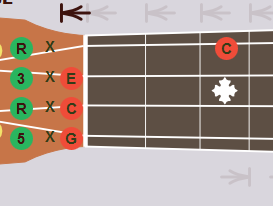
The basic chord (major) is the 1st, 3rd, and 5th note: c, e, g – with four string instrument, one note will be doubled.
For a basic 7th chord (major 7th), it’s the 1st, 3rd, 5th, and 7th: c, e, g, b – with a four string instrument, the fifth might be missing in some forms.
If you remember “fat cats give dogs and endless battle”, it gives you: f, c, g, d, a, e, b. That gives you the circle of fifths which tells you how many sharps and flats a key has.
Examples:
The key of F has one flat: b
The key of C has no sharps or flats.
The key of G has one sharp: f
The key of D has two sharps: f, c
The key of A has three sharps: f, c, g
The key of E has four sharps: f, c, g, d
The sharps are added in the same order: “fat cats give dogs an endless battle.” A mnemonic for going backwards is “by eight all dates get cold feet.”
So if you’re in the key of E, the notes are:
e, f#, g#, a, b, c#, d#
The basic chord is 1, 3, 5, so you just play: e, g#, b.
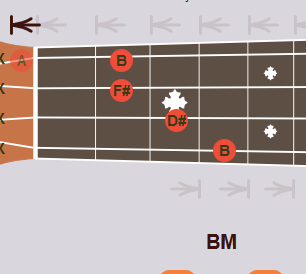
The basic (major) 7th chord is 1, 3, 5, 7, so you play e, g#, b, d#.
Once you have that concept down, you can learn what modifications each chord has:
A major chord is 1, 3, 5 (c, e, g).
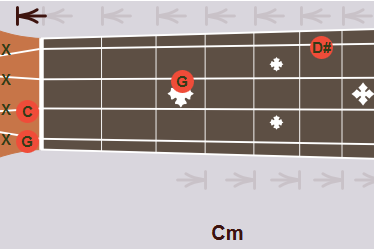
A minor chord has a flat 3rd, so just move the 3rd down one fret: 1, ♭3, 5 (c, e♭, g)
A major 7th chord is 1, 3, 5, 7 (c, e, g, b)
A minor 7th chord is 1, ♭3, 5, ♭7 (c, e♭, g, b♭)
A dominant 7th chord has a flat 7th: 1, 3, 5, ♭7 (c, e, g, a♭)
A diminished chord is 1, ♭3, ♭5 (c, e♭, g♭)
An augmented chord is 1, 3, #5 (c, e, g#)
Once you know how each chord is constructed, you can play any chord.
Chord Scales
Each key has a chord scale. In the key of c, it will be: c, d, e, f, g, a, b.
If you’re on a piano, start on the C note and build a chord (1, 3, 5). That will be c, e, g.
The next node of the scale after c is d. Build a chord (1, 3, 5) starting on d, only using notes in the C scale and you’ll get d, f, a.
d, f, a is a d chord, but the key of d has two sharps: f and c (see above). A d major chord would be d, f#, a. Since the chord you’re playing doesn’t have an f sharp as the third, it means that that the third was flatted which tells you that d, f, a is a minor chord according to the chord formulas above.
If you build a chord on each note of the c scale (c, d, e, f, g, a, b) using only notes in the c scale, you’ll get:
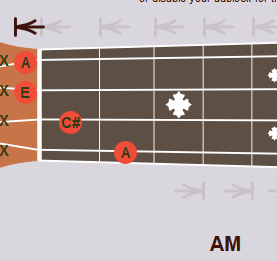
C Maj, d min, e min, f Maj, G7, a min, b diminished
A popular song in C will generally use those chords more than any other chords.
The above is for three-note chords. For 7th chords, it’s:
C maj 7, D min 7, E min 7, F maj 7, G7, A min 7, Bm7♭5, C Maj 7
When looking at bigger chord names like Bm7♭5, you can figure it out according to the basic rules: a minor 7th chord is 1, ♭3, 5, ♭7. The chord name says ♭5, so just flat the 5th and you’ll have the right chord. If the key is C, just take the 1, 3, 5, 7 and then flat the 3, the 5 and the 7 and you’ll have a Bm7♭5.
Chord Changes
Most songs follow just a few chord patterns.
Example: 1, 4, 5 is very common. In the key of C, the 1st, 4th, and 5th chords are C Maj, F Maj, G7.
2, 5, 1 is another common one. In C that would be: d min, G7, C Maj
Memorization
The chords for Somewhere Over the Rainbow are:
C, Em, F, G, Am
The chord scale for C is:
C, Dm, Em, F, G(7), Am, B dim
…so all the the chords for that song are right in the C scale: 1, 3, 4, 5, and 6.
Using the above information the entire song can now be memorized and played in any key with just this sequence of numbers:
1, 3, 4, 1
4, 1, 5, 6, 4