Memorizing a dictionary (partially) for language acquisition

Hi!

I had the idea of going through a dictionary of a language I am currently learning (Danish) and somehow improving my vocab while practicing memory techniques.

My final objective is not to memorize the full dictionary, just the thought of it overwhelms me. I only want to have fun, learn new words, some etymology, while practice memory.

I’ve stumbled upon some interesting forum threads and saw Dr. Yip Swee’s video that explains how he memorized 1774 pages of a dictionary.

I tried to replicate the way he describes memorizing a single page of a dictionary in the video.

Steps as I understood it:

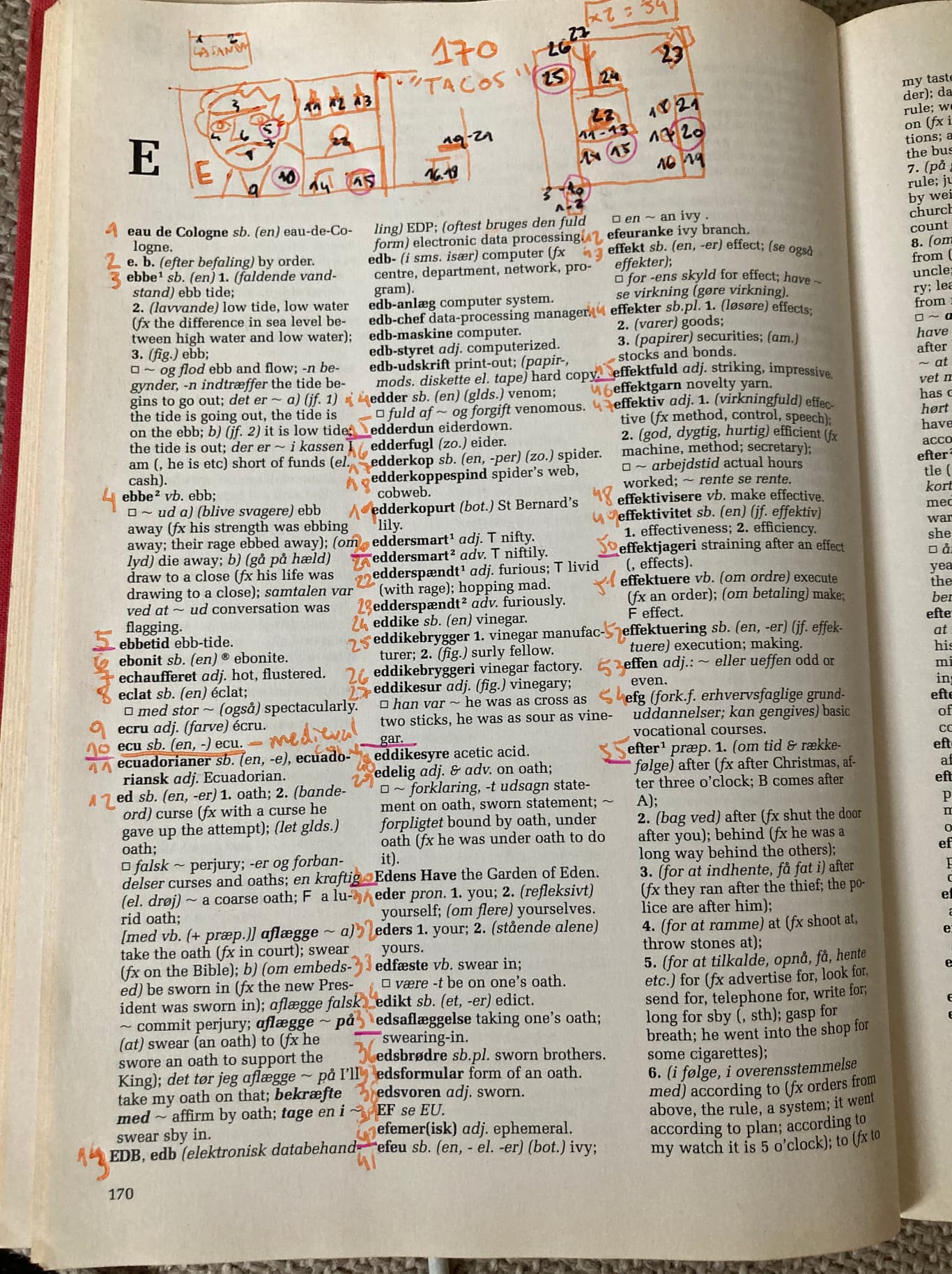
  1. Given a page number, use the Major System to find a peg word for it (page 170 = TaCoS)
  2. Create an associated Mind Palace, that related to that word (a taco place in my home-town)
  3. Use a pen/pencil to enumerate each word on the page (1 through 55)
  4. Associate each locus with a word, in sequence.

I also noticed Yip’s dictionary contains circa 20-30 words per page, while mine is a bit more “compact” with 50-70.

His description lacks explaining how to approach spaced repetition for a task like this. My initial idea is to put all memorized page numbers into some spaced-repetition app like Anki, and go through them every day with a lot of discipline.


Day 1 attempt, page 170 (took me approx 1.5 hour). Humble beginnings.

  1. I chose a random interesting page: The first page of letter E.
  2. Found that page 170 = TACOS in my 3-digit peg-list
  3. I chose a taco place I know somewhat well. I haven’t been there in 7 years, but somehow having a very triangular nacho stuck in my throat once while eating there makes this place quite remarkable. It had a nice Frida Khalo graffiti on the front wall, and that has given me lots of interesting loci.
  4. I looked up the place online for some refresher and ideas of potential locus
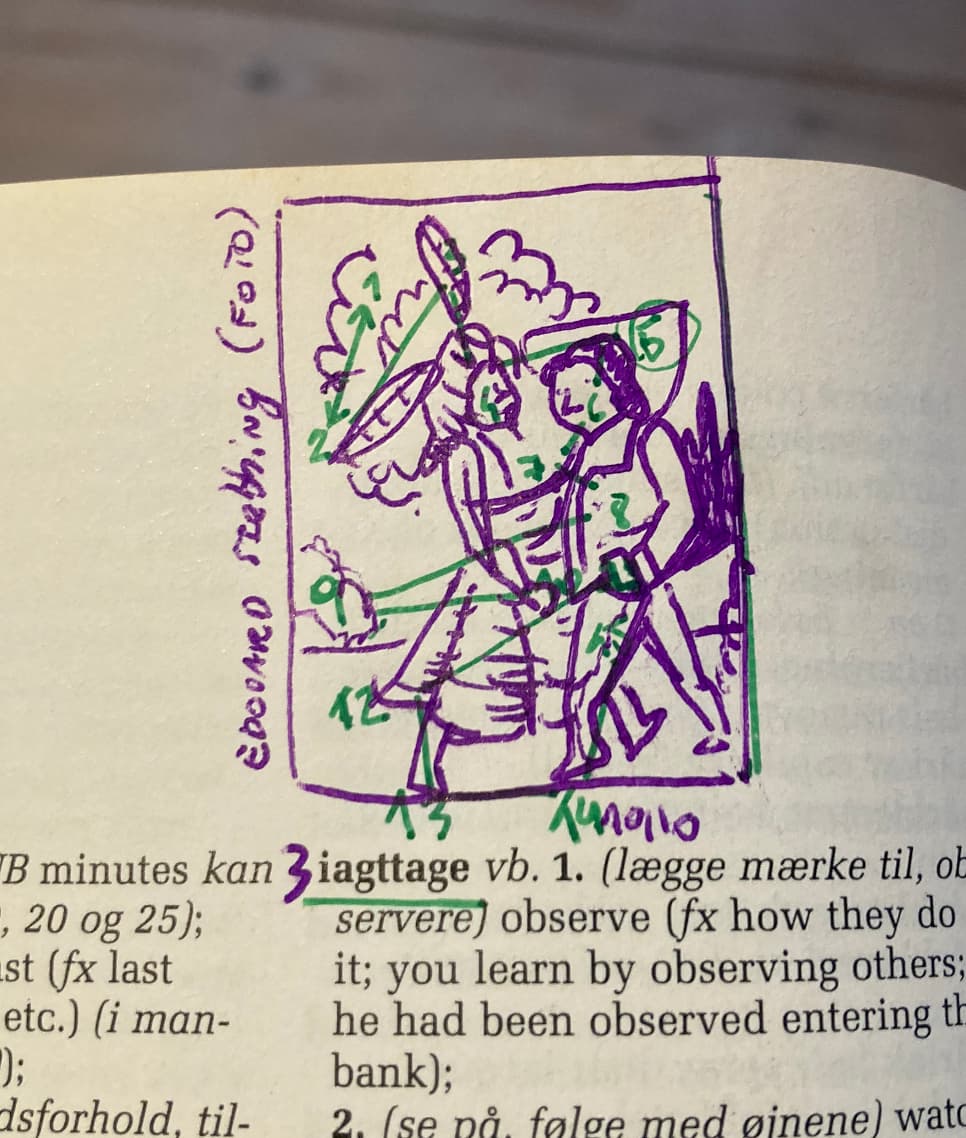
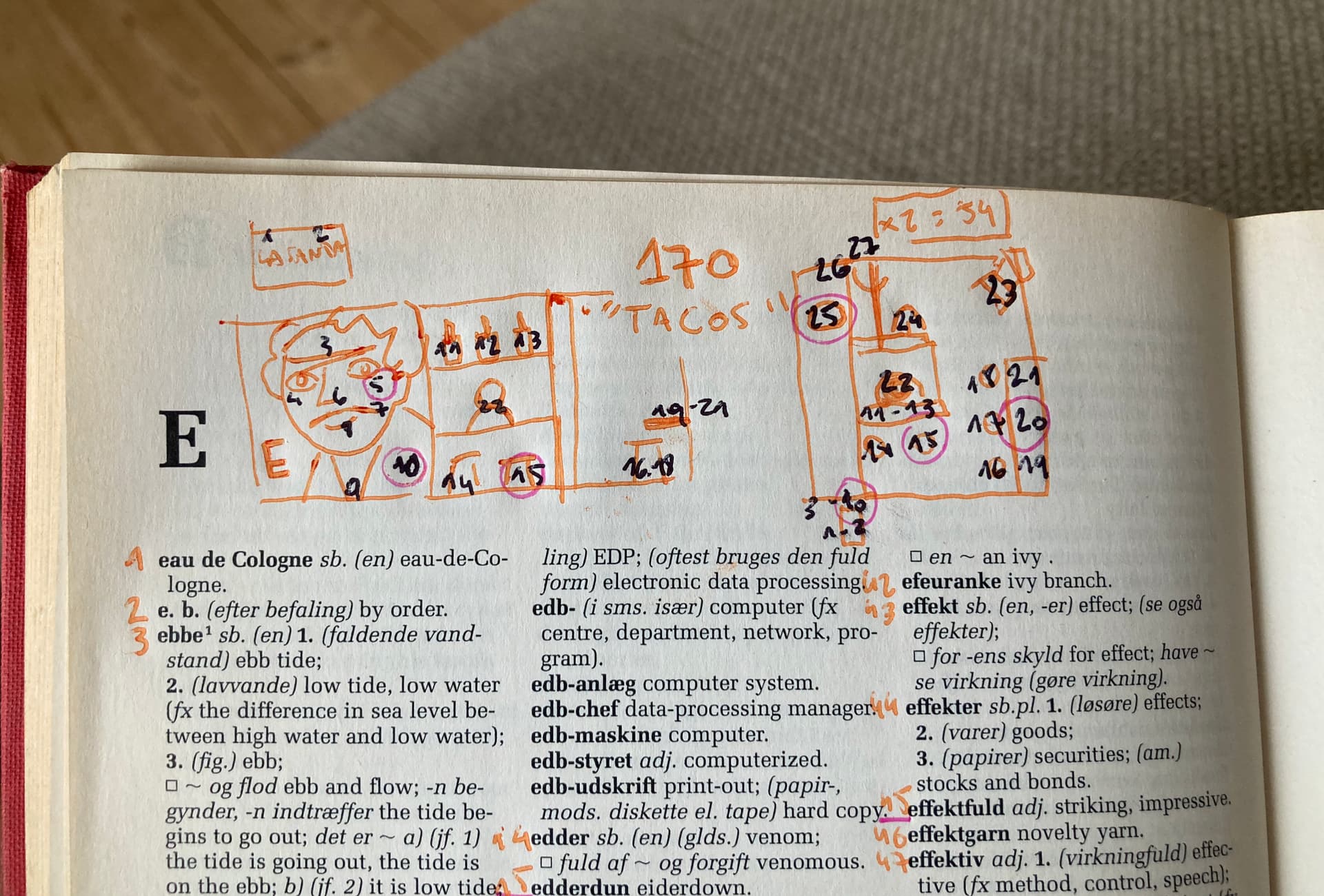
  5. I drew a diagram of the Mind Palace on the dictionary, with all 27 loci.
  6. I went word by word associating it with vivid images. Asked Claude for etymology breakdowns. Practiced pronunciation in Google Translate.
  7. Every 5th word/locus is special. In my case, the imagery animation is faster than the other. Underlined in Pink.
  8. I ran out of loci and had to figure out what to do (see 8). That’s where things began to fail.

When I couldn’t create a visual image easily, for example because of lack of etymological knowledge, I would research it a bit further. This wastes my time/takes the focus away from memorizing but gives me interesting insights. I used Claude and Google Translate to help me with etymology insights and pronunciation, respectively

  1. Not sure if I recommended When the Loci ran out, I decided to invent a “copy” of the same Mind Palace as a basement (same area, dislocated in the Z axis). I started again from Locus 1, but this time in the basement every image is more “firey”/“spicey”.
Notes and questions

  1. When I decided to create a “firey z-shifted copy” of the same palace, I noticed the recall got worse on words that shared a virtual locus. I need to either change technique or practice this idea of differentiating Mind Palaces with different “vibes”.

  2. Because the list is ordered alphabetically, the sequence has a natural extra “link” for sequencing. This makes recall a bit easier.

  3. I am a beginner in memory techniques, so any comments and ideas are appreciated.

  4. I honestly don’t know if I’ll continue this and memorize other pages. But decided to document my process here in case anyone finds it useful.
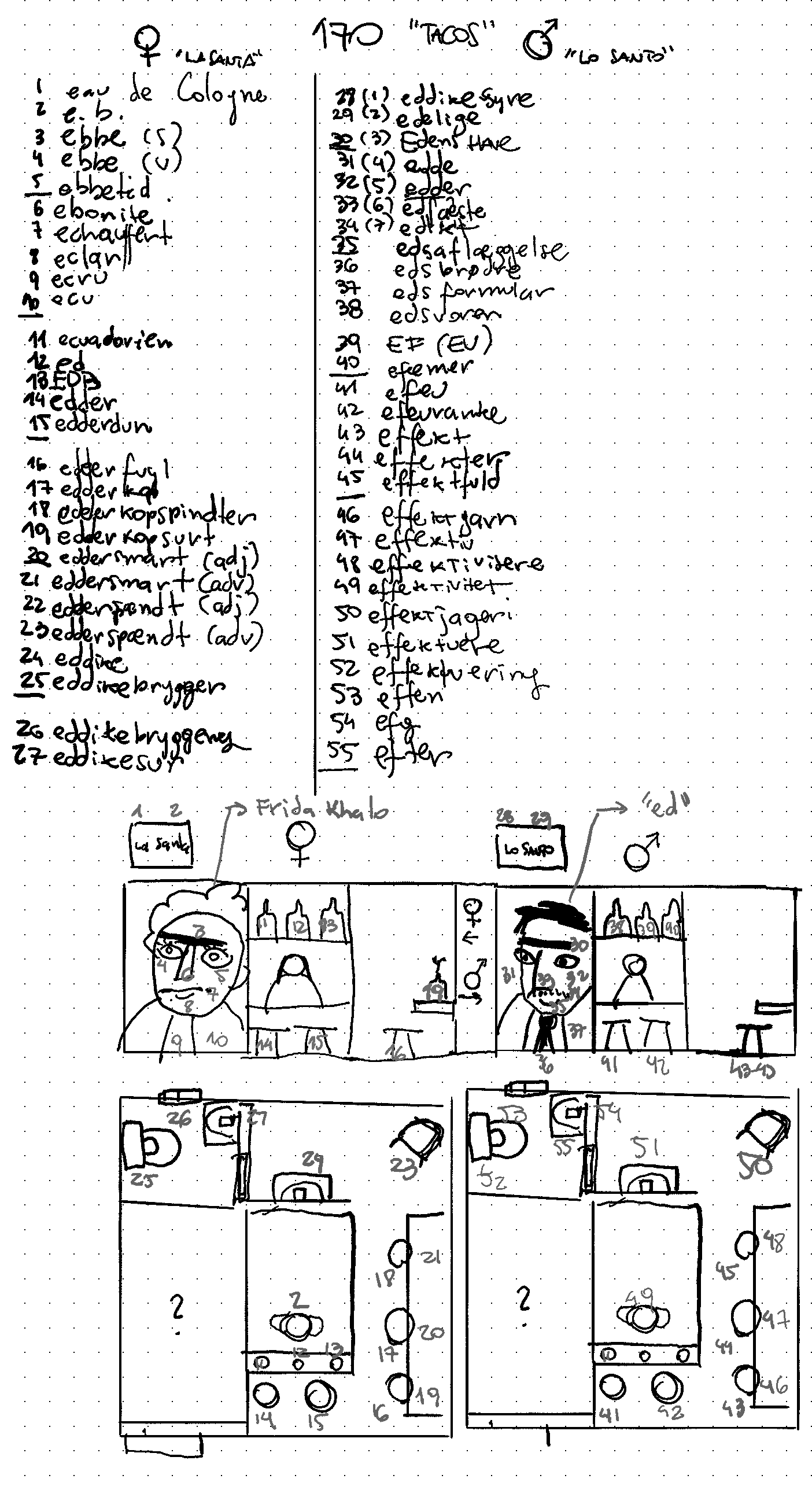
5 Likes

I’ve reworked my “copy” or “instance” of the Mind Palace because the basement strategy wasn’t working for me.

Before

  • A “spicy”/“firey” version, vertically positioned as a basement

After

  • Two Taco shops positioned side-by-side, as competitors
  • One has “Female” vibe, and another one has “Male” vibe, for example:
    • the left one has a grafitti of Frida Khalo, the one to the right has a grafitti of a Salvador Dali
    • left is called “La Santa”, right is called “Lo Santo”
    • left has a female waitress, right has a male waiter.

Now it feels like two different places.

  • A bit because it’s more natural to navigate horizontally
  • Also because of the story that they are competitors
  • And the fact that the concept of “masculine” vs “feminine” is a bit easier to memorize. My native language (pt-BR) gives genders to every object (uma mesa vs. um copo)

I’ve practiced the route and re-drew it for later reference.

3 Likes

This was interesting!

I never had any good results with “the same memory palace but in a different colour/atmosphere/etc.” And we regularly have people on the forum who have a project like “I created 100 pictures and I’ll put them on 100 different backdrops, which makes a 10000 memory palace!”… But then we never heard from them again, because I suppose it didn’t work.

But you “solved” in an elegant way I think. One factor may be that you imagined them side by side (and not the same one at the same place, with variations which create sort of ghosting), and what’s more you gave them a feeling of opposition (competitors).

My criteria is: if the difference between the memory palaces has no influence on their content (or if you could put an element in one or the other, it wouldn’t be important and change the scene), then it’s not distinct enough.

My advice would then be: when you encode information in one memory palace or the other, make sure that something happens that is unique to the scene and could not possibly happen in the other. Maybe the word interact with the painting, maybe the word makes a sexist remark what makes the female waiter slap him in the face. In short, it has to matter that the word is here, and not by the competitor.

4 Likes

Thank you for your response, @Hari-P!

I never had any good results with “the same memory palace but in a different colour/atmosphere/etc.” …

It’s reassuring to know it’s (probably) not just me.

I feel better about the side-by-side method, and I did intuitively some things you suggested, to reinforce the difference between the two places, so far I’m happy with the recall rates. I’ll incorporate other ideas you gave.

My recall seems to be better in places where those variations are pronounced. I still like the fact that the count and position of the loci are the same. So I’m trying to balance. For example, I decided that Salvador Dali should keep a distinctive Frida Khalo unibrow, and that “non-variation” makes it very memorable.

2 Likes

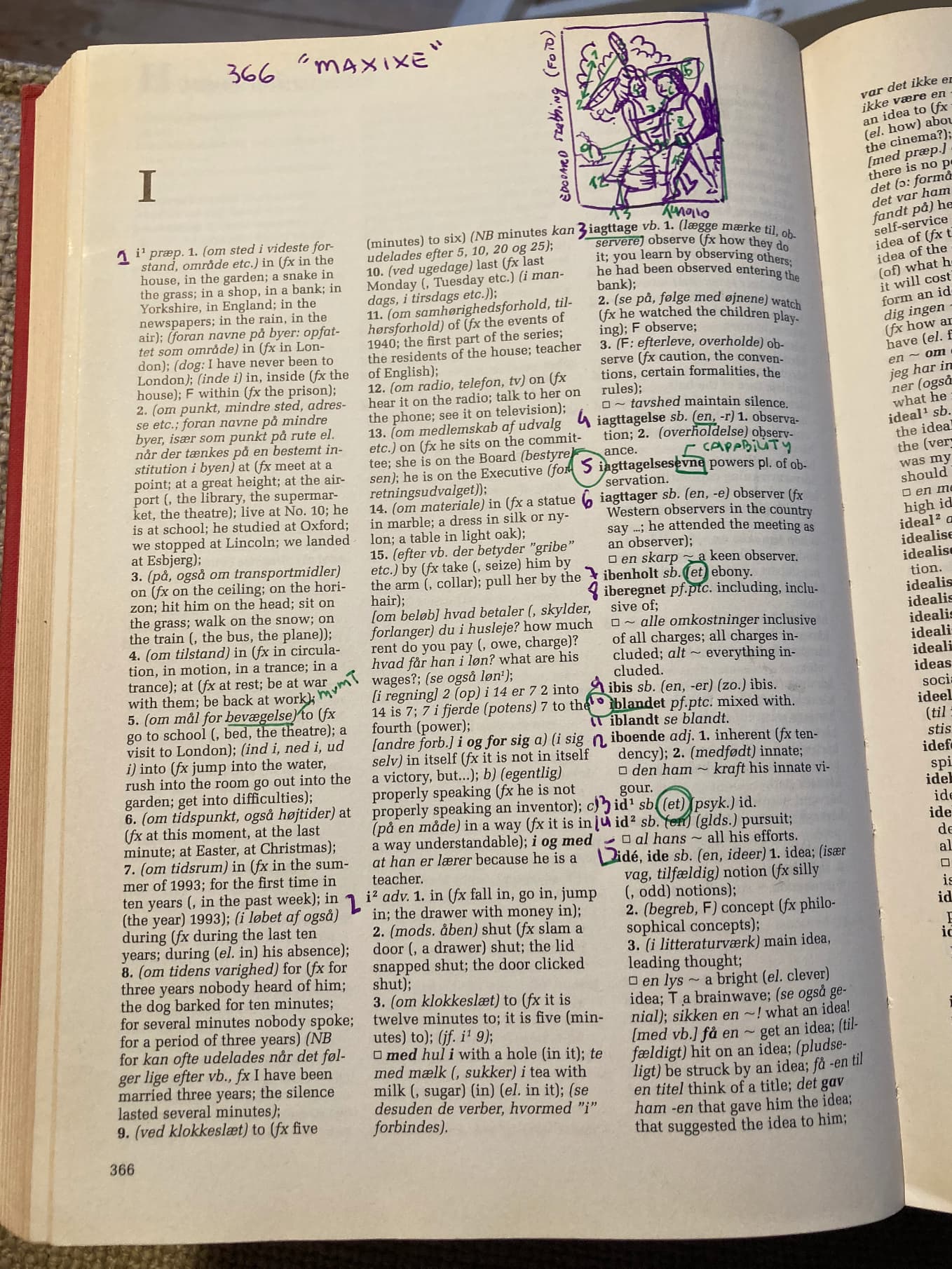
Day 2, page 366.

I chose another random page today. The start of letter I. It’s an easy one, only 15 words.

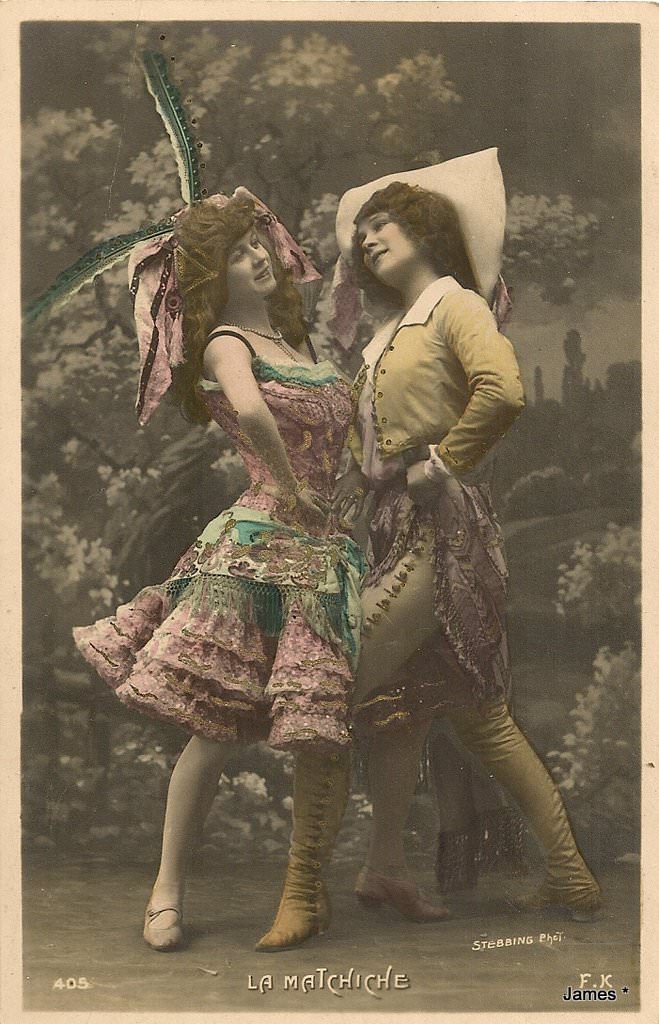
My peg-word on 3-digit is “Maxixe”, which is a type of Brazilian dance from the 1860’s, also known as “Brazilian Tango”.

I used this interesting old photo from the Wikipedia article above as my Mind Palace. The sequencing is improvised, based on points of interest I found natural to me (just how I would scan the image).


Now, I’ll add both pages to Anki and practice recall on both pages.

2 Likes

Yes, having the information organized is very powerful. Knowing that each room (or zone of a park, or segment of street…) has X words on it positioned a certain way, helps for review and in general. I feel that, in a way, it’s an additional spatial component, and spatiality is what our brains like best. It’s like my brain likes things to be organised “regularly” but the elements themselves have to be diverse.

It’s like this contrast: my brain likes things that are memorable (absurd), but there still needs to have a logic behind it (otherwise I’ll know it was something absurd but not anymore what it was).

Or otherwise said, the absurd things have to have “logical” causes and consequences otherwise they are just random things happening in a vacuum which isn’t very memorable. For example, if the mnemonic is a lady in a really weird dress (like Lady Gaga’s meat dress kind of weird) on a road crossing, I have to imagine: why is the person wearing that? (Is she protesting against something?) How are the people around her reacting to it? (They stop to look at her and it creates a traffic jam with lots of honking and swear words)

2 Likes

And I see that you are drawing/sketching your memory palaces by hand which is very good :+1:
I know that it helps me a lot for retention when I draw things first myself (even if I make anki cards on my phone with the sketches afterwards for the long term reviews).
Something about sensory input perhaps?

2 Likes

@cauli Very cool to read what you’re doing and how you’re going about it.

I really like this.

Keeping similar organization, but distinct and logically separated.

It’s different, but reminds me of techniques Dr Lynne Kelly [@LynneKelly] wrote about in her books (which have inspired me for years).

It’s been a bit since I did a read-through of my copy of Memory Craft, but to learn words with their correct genders I recall her even going to two different grocery stores. One was assigned for feminine gendered groceries/words, one store for masculine.

She also made what she termed “raspcallions,” which are little dolls (each distinct, one feminine and the other masculine) and would speak to them practicing the language, playing and conversing with them, and incorporating words based on what would and wouldn’t be appropriate (gendered terminology-wise).

“Memory Craft” is a gem of a book in terms of quantity and quality of both ideas and research.
Life changing knowledge, imo.
—well, it changed my life, so if it doesn’t change yours just flip the book over so that it’s right-side up and that should do it.

I’m interested to see how you continue with this effort @cauli

I like that you’re keeping it fun and interesting to yourself. I do the same thing. Keeping it always playful. If not, I’ll stop bothering with it.

Also:

Also, the “memorizing a dictionary” theme has a big part to play in my own mnemonic adventures this year.

You might dig this interview that Dr. Anthony Metivier [@metivier] did this past November with Australian Memory Champ, Anastasia Woolmer on the somewhat related topic of… how she was going about memorizing an entire dictionary. :man_shrugging:

I listened to it on a long drive heading east out of Abilene, Texas one quiet December evening.
—A 70 minute drive where the stars are pretty much the only street lights (unless it’s cloudy, god help ya).

At the end of the drive, inspired and feeling a strong sense of “Well I don’t see why the hell I can’t do something like that!”, I decided I’d go ahead and proceed with the often-advised-against idea of memorizing the Python Programming Documentation.

7-ish weeks later I hopped on the forum to share my experience and see if anyone else had dangerously taken fate into their own hands and walked a path eschewed by every professional programmer ever asked and simultaneously never actually attempted (google it). To see if anyone else had attempted a feat so useless, wasteful and most-likely “not worth the energy”.

Hoping that—maybe—oh—maybe—someone else had. And maybe we could chat about it and swap ideas?

Here’s the link so you can see how pointless I found memorizing all that documentation and how unhappy I was to waste so much time and energy doing it: I memorized huge chunks of Python’s documentation

  • TLDR; Spoiler <<<Actually I enjoyed it and think it's pretty cool to have this stuff just sitting in my noggin to think about and play around with on those long dark drives east out of Abilene. 10/10 would do again. It's all still there, 8 months later. Imagine that.

On the Memorizing a Dictionary interview:

One tidbit that sticks in my head from Anastasia Woolmer’s interview with Metivier was how simple and easy she explained it was to memorize the page numbers. Like “Oh, yeah, it’s just a number. That’s basically one little image every so many dozens of definitions. I can just do that last after everything else is down pat.” (that’s a terrible paraphrase, but it’s my terrible paraphrase).

Apologies for the long-windedness. I probably enjoyed myself too much writing this. But I also enjoyed reading your process and look forward to seeing how things develop for you, and what other ideas you come up with for your process. I dig what you’re working on. Exciting to read about.

Regards,
Beau

2 Likes

Hi @beau2am,

Thank you for your thoughtful response. I really appreciate all the info, references, and the encouragement.

I have a copy of Memory Craft here, it’s an incredible book that I have never finished reading because life got in the way. But I’ll get back to it now that I’m starting memory workouts.

I have listened to the Podcast. Very cool. I am taking a similar approach, both tactically (portals to other pages) and strategically (what matters is the journey and making it fun). There are some cool tips in there.

I don’t want to learn word definitions verbatim, it wasn’t clear to me if Anastasia does. I think I’ll prefer to use my “normal language memory” to remember broad definitions.

I’m storing a few core properties of the word. If it’s a verb, adverb, adjective, etc. e.g: Noun genders, if it’s an “en” or “et” word, for example. I cover “et” words imagery in gold, because they are a bit more rare it sounds like a fancy gender to me. “Et æble” would be “an apple”, but made of gold.

About your effort in memorizing Python docs: this is really cool. I am a software worker myself and was thinking of starting to memorize all the current CSS properties according to the Mozilla docs.

I think it might sound unnecessary in the age of LLMs, Copilots, and autocomplete, but this kind of “mastery work” serves multiple purposes, as you know. As I memorize, I am forced to resignify, reinforce, and re-explain to myself. Instant access means less context switching, less friction, etc.

About my project: I’m currently trying to figure out an ideal spaced repetition flow. Today I’m connecting my Obsidian Zettelkastl to Anki, in a way that I can create Anki cards directly from Obsidian. This will be used for storing everything I want to remember.

1 Like

Training day 3

For the first time, I encountered a word I memorized from the dictionary in real life. It felt good!

My dictionary has 1027 relevant pages, and I have currently memorized merely 3 of them.

What I wasn’t expecting was that I would start encountering words so early on this process

3 pages out of 1027 means that approximately for 342 words I encounter in real life, one will be in my Mind Palaces.


Today I memorized page 171 “Ticket”.

I’ve used the central station here in Copenhagen (Hovedbanegården) as my Mind Palace.

My main challenge was to create the Mind Palace loci. I needed 50 loci, and my memory of the place was fine but not sufficient, so I used Google Street View and was lucky to find that they have a tour inside the place.

It is one of the most chaotic places in Denmark, in my opinion, so it creates lots of opportunities for stories.


I have also set up my Obisidian → Anki integration. I create Notes for each page I memorized, and inside the note I can directly create Flash Cards. Then they get synchronized with Anki. My Obsidian data is also synced to the cloud.

I used the Obsidian Anki Sync Community Add-on for Obsidian

A note looks like this:

<!-- clozeblock-start deck='000-999-Peg' -->
171 stands for {{c1::Ticket}}
<!-- clozeblock-end -->

<!-- clozeblock-start deck='Dictionary' -->
Word 1 of page 171 of the dictionary is {{c1::efter (adv.)}}
<!-- clozeblock-end -->

<!-- clozeblock-start deck='Dictionary' -->
Page 171 of the dictionary has {{c1::50}} words
<!-- clozeblock-end -->

<!-- clozeblock-start deck='Dictionary' -->
page: 171
page image: Ticket
words count: 50

{{c1::
1. efter (adv.)
2. efterabe
3. efteraber
4. efterbehandling
5. **efterbetale***
6. efterbetaling (vb.)
7. ...
49. efterligning (sb.) (en.) an imitation
50. **efterlyse** 
<!-- clozeblock-end -->

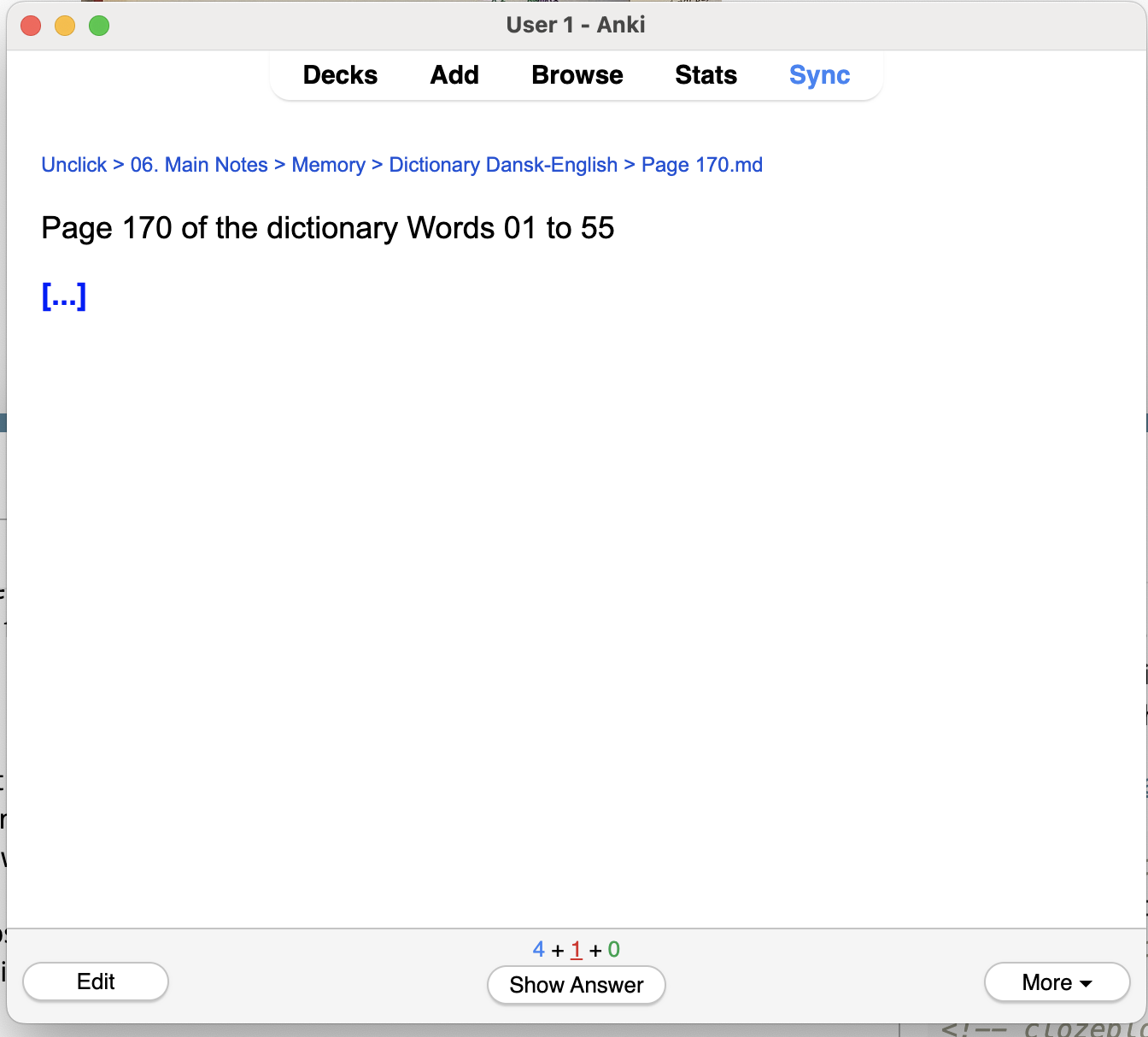
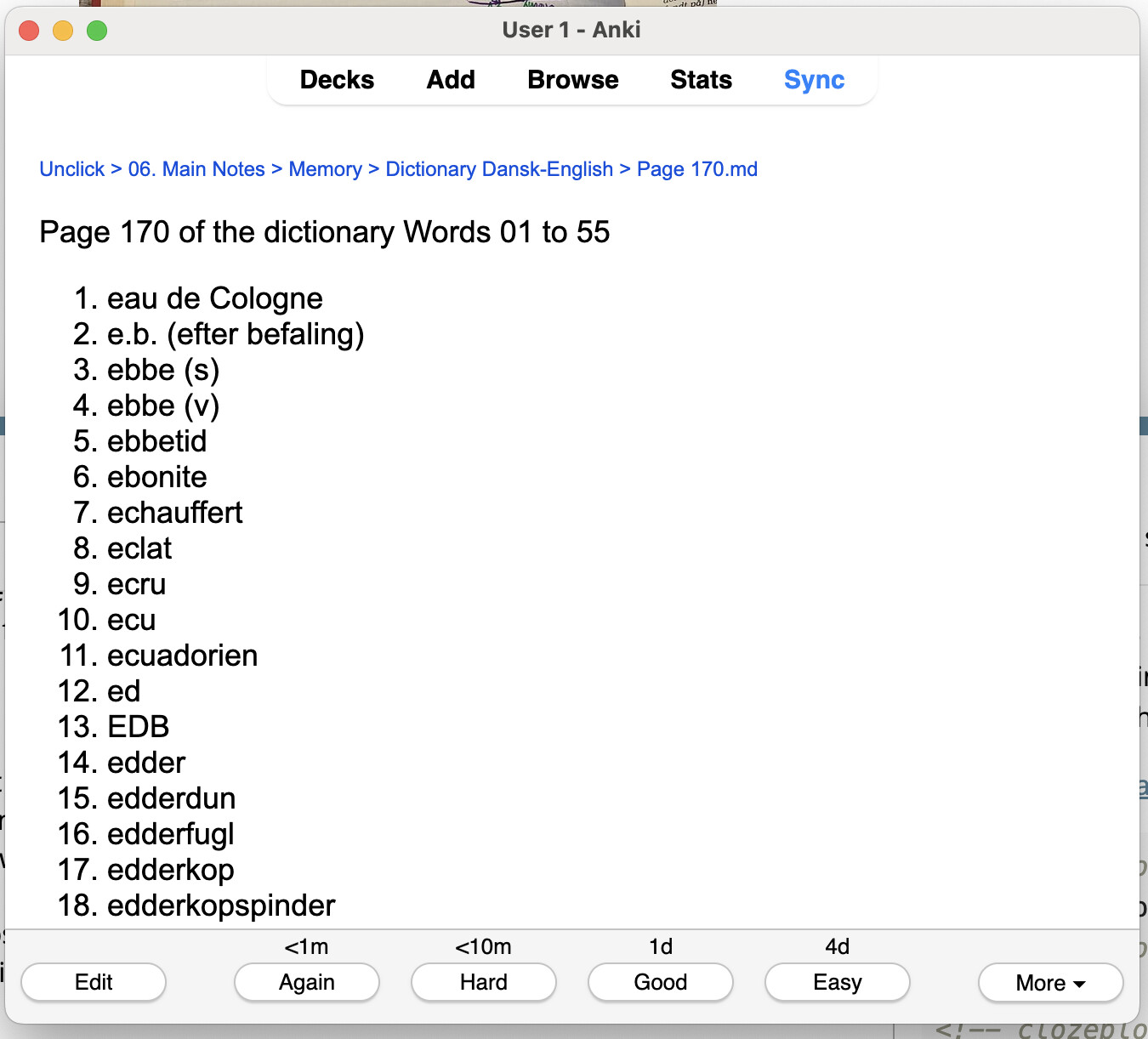
When synced to Anki will create multiple flash cards that look somewhat like this:


3 Likes

I just started using obsidian and anki. could you explain it in an easy way if you don’t mind? I am a beginner in these matters.

1 Like

Hi @fatihkaya.

I’m also new to it, so it’s important to try and find your own flow, something simple that doesn’t get in your way. You’ll learn more and quicker by trying things out.

Obsidian is just a good and free note-taking app. I’m only using it because I’m starting a Zettelkasten. This doesn’t have necessarily anything to do with memory training, it’s just a method of organizing notes, my daily journaling, and general knowledge in an interlinked and atomic way. I used this video to start mine. Maybe you don’t need a Zettelkasten, or even Obsidian.

anki is another (mostly) free app for Flash Cards. It allows you to create custom flash card decks to remember whatever you want to remember using spaced-repetition. There’s nothing complex here, just try it out and you’ll see.

1 Like

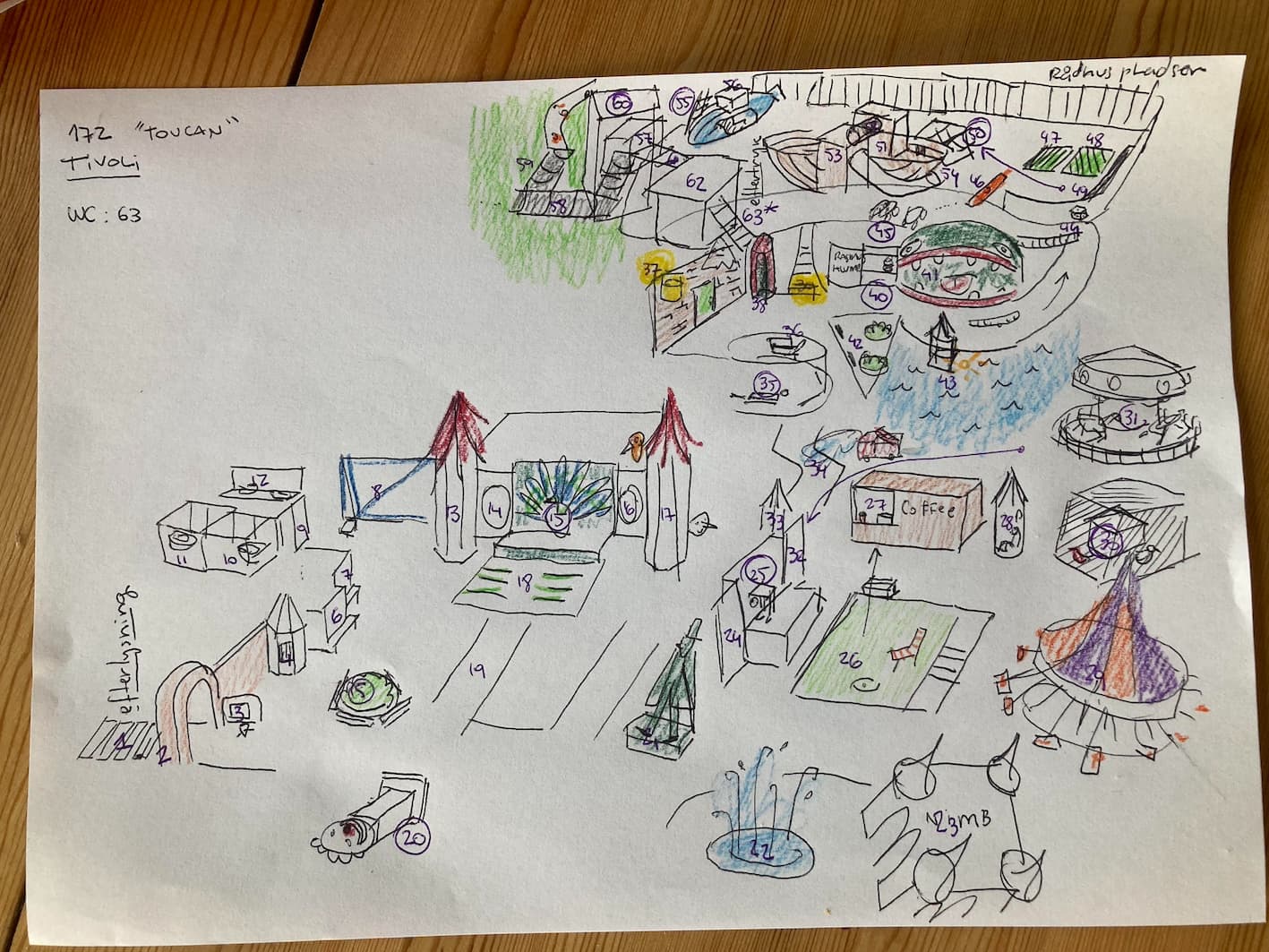
Training day 4

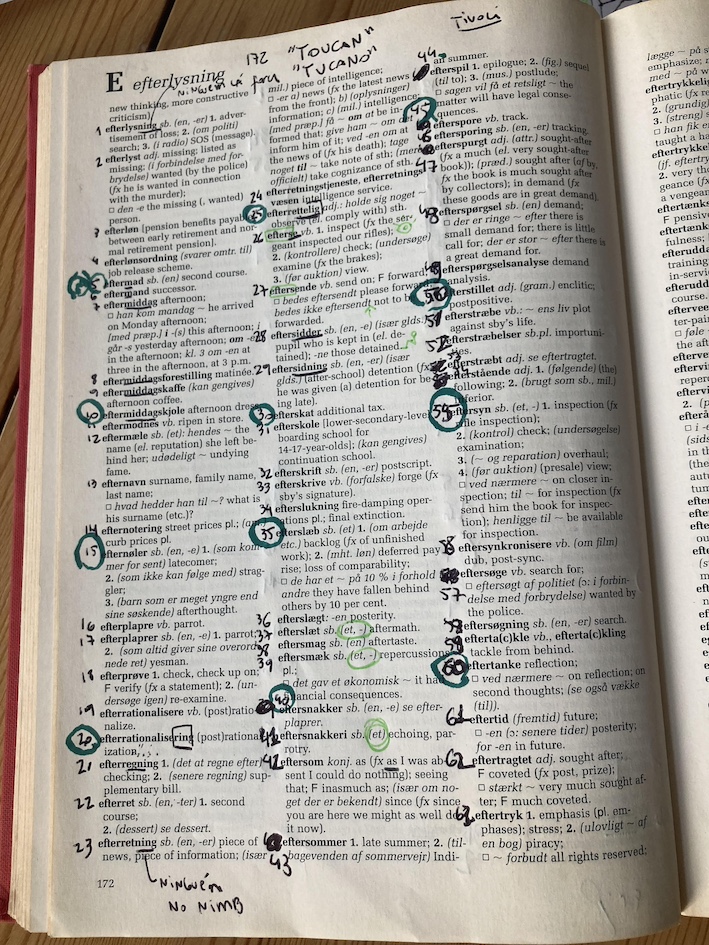
Moving on to page 172, “Toucan”.

63 words, all prefixed by “efter” (after). It’s interesting because there are a lot of root words to learn.

63 will require the largest memory palace so far, for me. With the major system word Toucan, I chose the equally flamboyant Tivoli.


Technical notes

  • With 63 loci, it’s difficult to do a run-through from 1-63. If I practice from the beginning, I might get stuck at ~40 and the last 23 words will be less trained. Just like training a musical instrument, you shouldn’t start at Bar 1 every time. The practice should start at different lines and cover different areas equally.
  • I started using a hand abacus technique to keep track of my current locus. I use Chisanbop - Wikipedia. It gives me extra sensorial input while keeping track of multiples of 5
4 Likes

What is your progress now ? have you concluded your project ?

I am a Dane and it is an interesting technique. The words in the book pics however are used very rarely in Danish. Some of them only in old written danish. I could imagine that you wont encounter many of the words that often.
I am learning german at the time, and it reminds a bit of danish in the consteuction of the words.

Example: There are many words in danish beginning with For. Some of them arw common. The For words could be placed in one mamory palace and then let them expand teom there so you only need to remember the part after For.
As FORresten (by the way), FORøvrigt (also by the way), FORnemme (to sense), ect.
So in this palace you only have to remember the words resten, reste, øvrigt (ø is like a mash of o and e, like oe) and nemme.

1 Like