Memorize books content

There are lots of memory techniques that I feel overwhelmed trying to pick one of them up for memorizing books.

Particularly, I am reading science fiction books or adventure books. In this case, the Invention of Morel and 20000 leagues under the sea. I want to memorize the content of each chapter verbatim if possible. To do that, I am highlighting key words. After finishing a chapter, I have a bunch of keywords (in average, 30).

Now what do I do with the key words collected in each chapter from the 2 books? I want to memorize more books eventually, but what structure should I follow to memorize every chapter from each book?

Using the example image of a biology textbook’s table of contents, chapter 27 might go in its own memory palace: “Bacteria and Archaea”. Within that palace would be seven rooms, one for the overview section, and six for the “concept” sections. Within each room, you would place mnemonic images that represent things that you’re learning in that section.

So in the room for Concept 27.1, you might have a few locations for “Cell-Surface Structures” and a few more for “Motility”. If a textbook section requires more than a few locations, you could expand it into its own room.

If you, can you explain the example above with detail to me, please?

Having a well defined motivation and a very clear expectation of the effort required for undertaking memory projects is very important.

Can I ask why you want to do this?

Also, how much time do you plan on committing to this project?

20000 Leagues has a wordcount of 151,960 according to Twenty Thousand Leagues Under the Sea | Jules Verne | Lit2Go ETC

If you were able to memorize each word on the first attempt, spending only 10 seconds working on encoding mnemonics for each word, it would take you 1,519,600 seconds… Which is 25,326 minutes… about 422 hours. That is a ton of time. Like 3 full playthroughs of Skyrim level time commitment, hehheh.

In all likelyhood though, you’ll need probably 10 times that amount of time (which is still only 100 seconds per word) so plan more like 4220 hours. If you “only” spend 12 hours per day working on this, maintaining max efficiency, it will take one year of literally nothing but working on this project just about the entire time you’re awake each day.

I’m not saying all this to discourage you. I just see people bite off waaaay more than they can realistically chew and then give up and never come back to these techniques (or this forum.)

Be honest and realistic with yourself and set small, attainable, and progressively more challenging goals. This will keep you engaged and limit burnout and frustration.

2 Likes

Mmmm… Thank you for your advice. Well, I just want to memorize the main points of each chapter. Having defined this, is it correct to create a memory palace for the entire book, use the loci for the chapters and link the loci and the keywords together with the link system?

Using the example image of a biology textbook’s table of contents, chapter 27 might go in its own memory palace: “Bacteria and Archaea”. Within that palace would be seven rooms, one for the overview section, and six for the “concept” sections. Within each room, you would place mnemonic images that represent things that you’re learning in that section.

So in the room for Concept 27.1, you might have a few locations for “Cell-Surface Structures” and a few more for “Motility”. If a textbook section requires more than a few locations, you could expand it into its own room.

Finally, what does it mean “rooms” and “place mnemonic images”? How can I create a room within a memory palace? How can I place mnemonic images in loci? If you can use a detailed example it would be awesome.

Thank you.

Sounds like you might be new to the memory palace technique. I’d recommend using the search function for some really helpful content about them and also check out the FAQ section.

Basically, a memory palace can be a mental representation of a location (real, fictitious, or completely imagined) that you picture traversing via a consistent and logical path. Along the way, you can pick out sub-locations which could be something like rooms within a house, or general areas or zones which contain individual points of interest (commonly referred to as loci.)

So for example, my house is the palace. The living room is one room or sub-area. The bathroom is another. The kitchen is another. The couch is a loci within the livingroom sub-area, within the house palace. The stove is a loci within the kitchen. The toilet is a loci within the bathroom.

By pre-planning the content to memorize, you’ll know how many loci or areas you’ll need to plan in your palace. If you designate a room for each chapter, you may need a larger palace with more areas, or multiple palaces connected in a logical way to get enough areas to work with.

Once you have your loci and pathway picked out, you can “place” images (by visualizing activity at the loci) that represent the content you want to memorize.

For example if the 10th chapter’s main points are the nautilus being attacked by a giant squid and captain nemo playing the organ (it’s been a looooong time since I’ve read it, so forgive the inaccuracies) you’d imagine your tenth area, say the stove in your kitchen, and on that stove you might imagine a boiling pot with a squid swimming inside, attacking you every time you go near it. All the while, organ music is playing and when you peek inside the oven you see a ship captain playing the organ.

This is what its meant by placing images.

Now when you go to review and recall the content, you’ll imagine getting to the stove, its your 10th area so its chapter 10, and hopefully the scene thats there is vivid enough that you’ll easily remember squid attack and organ playing.
3 Likes

Oh! Your explanation is perfect. But what about virtual locations? I am using pictures of art as memory palaces to avoid running out of memory palaces. When using such pictures, how can I construct rooms and within each room loci? Solving this would help me a lot.

Its a little bit different, but the idea of picking distinct features and using them as locations to stage scenes is basically the same.

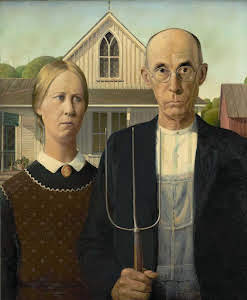
Take this as an example:
download (1)

Start in the top left and spiral through clockwise, picking some unique features along the path.

Maybe:

  1. Left side of the of the roof.
  2. Window in the top center building
  3. Man’s glasses
  4. Man’s left ear
  5. Man’s left shoulder
  6. Button in the center of man’s shirt
  7. Tines of the pitchfork
  8. Man’s fist
  9. Woman’s brooch necklace
  10. Woman’s nose.

Now create scenes using representational imagery for your key points in the chapters and imagine those scenes taking place and interacting with these locations, in that order.

Practice navigating around that path so that there is no confusion as to the order of the locations.

After just a few reviews, I bet the scenes will stick and you’ll be able to “decode” them and recall the key points of the chapters.

If you need more than 10, use an additional picture or pictures. Connect the pictures by thinking of little actions that could link the pictures. Example if you want to link American Gothic (the picture above) and the Mona Lisa, you may imagine the farmer guy stabbing the mona lisa lady with his pitchfork. Now you know that the mona lisa (and its loci) come after the America Gothic palace.

3 Likes

It is nearly done. Just one more question: consider I have 10 key points or main ideas from a chapter, using the last method you mentioned, how do I place them in a single loci? I didn’t understand properly the idea of placing them.

Do I use link method (loci → idea1 → idea2 → idea3 … → idea10) or do I imagine each key point happening at the location?

Try both ways!

If your images are vivid enough and the connecting actions strong enough, you could stage a scene that links a bunch at a single loci. If you’re just looking to condense broad key moments in each chapter, you may be able to get by with this. Or you give each chapter its own painting and space out the details so each point interacts with one loci.

Only you will be able to figure out what clicks best for your unique brain!

1 Like

@RonaldJohnson

Has done some bible memorizing verbatim. Maybe some similar techniques apply.

Let me throw this out because it’s related. I learned the major system and never heard of a memory palace until I came here. I can see benefits of a palace but still haven’t used one. My question is what is the main benefit of a palace over simply linking? Now, for chapters in a book I can see that different rooms would be great for identifying each chapter. However, why introduce the added complexity of loci when you could link each of the target items to each other? It seems more straightforward. Do loci add something that is missing with linking?

There may be a misconception here. A palace journey and the loci there shouldn’t feel “complex” at all.

Generally speaking, people are really good at spacial memory and basic navigation. Most of us can walk through a space once and then recall the main features and layout easily afterwards. Imagine going to someone’s house for the first time. They give you a quick tour and show you where the bathroom is and where the kitchen and livingroom are. If you were paying the barest minimum of attention, you would probably be able to walk directly to the bathroom again, you’d be able to recall if it had a tub or shower stall, if the toilet was on the left or right, and other spacial details. You likely wouldn’t walk to the kitchen by mistake, etc. This is a one time pass through a space you’ve never seen before. You could reasonably use it as a memory palace and probably pick out a dozen or so unique features to use as loci.

If you use more familiar locations, that spacial memory is incredibly strong and can be used to ground data in settings that you already know intimately.

Take a room that you are most familiar with, say your bedroom. Imagine standing in the center of the room and sweeping your gaze around it as you slowly turn clockwise. As you picture this, pick out just 5 distinct items in the room sequentially, as you see them, following the visual path. Maybe its something like a bed, a lamp, a dresser, a closet door, and a mirror.

Visualizing a familiar space in that way should take almost zero effort. Each of those spaces can now be used to set a scene and give context to representational imagery. By anchoring these images to spacial memory which most humans are very strong in, it gives added strength to those images as well and can provide stronger consistent recall.

You definitely CAN just use linking for everything, and it works great for small lists of data points, but the more you add, the muddier it can become.

Palaces can help organize your information as well, as you said, different settings for each chapter make it much easier to recall than having to try to pluck imagery out of the void when you need it.

1 Like

Great reply, thanks. So let’s say you want to memorize 4000 digits for pi :slightly_smiling_face:. Do you use a combination of palaces and linking. Seems like an awful lot of loci.

When I did my Pi project (4325 digits) I used a 2-digit Major System, in a Person/Action/Adjective/Object structure. This allowed me to code 8 digits into each scene. Each scene was set in a loci. The journey was spread over many large palaces that were connected in a logical way. All total it was 541 loci. This seems like a lot, but in a project like this, where speed memorizing wasnt the goal, I was able to take time to plan a route and decide on distinct loci ahead of time.

By setting each scene at a specific and distinct loci, I only had to visualize a simple scene for each chunk. The links came from the sensible path through the loci.

By isolating the scenes this way it also cut way down on possible confusion when the same digits appeared multiple times. For example, several sequences started with 49. So my person for all of those was RoB (gronkowski). Even though he appeared many times, I never got confused because the loci provided the context for the scene. I knew that when RoB was at the ticket turnstile of the stadium he was RoaRing at a LooPy gNoMe. When he was at the sink at the amusement park he was PooPing on a PePPy PuFF. The loci isolates and contextualizes the story.

Harry Lorayne talked about contextualizing links by setting everything on fire, or everything under water. I think the loci method is stronger.

Are you able to use any of those palaces for anything else or would you have to ditch pi in order to reuse them. Maybe you could set each loci on fire to reuse them ala Lorayne?

The terrain modification would work ok I suppose. For me though, its easier to just come up with new loci. I haven’t needed to re-use those, but I don’t see why it would be a problem if I used them for non-number stuff. And I suppose now that I’ve moved to a 3-digit number system it would work fine for that too since the images would all be totally different now.

Do you try to come up with new loci in the same palace, or come up with new palaces all the time. I can’t imagine having hundreds and hundreds of palaces.

With some practice, you can find palaces everywhere. You can use real places, fictitious ones like game maps or areas, or even just make them up completely from your imagination.

Takes practice, but everything does really.