Memorising genealogy / family trees

Hi, I’m thinking of learning something that is organised as a family tree, perhaps something like this: https://en.wikipedia.org/wiki/Family_tree_of_Muhammad

I did a few searches on the forum and couldn’t find anything that directly applies to this, so apologies if there is already a fully-formed discussion out there.

Ideally, whatever system I have should be flexible enough to accommodate additions / new data to be added in the future.

2 Likes

I used 2 approaches:

  1. King of level and history: it´s translating the tree into levels, and learning the king (nodo father) and all of his sons.
  2. Using a Matrix: you have to learn a Matrix first, after you link the position of the matrix with the one you want to link.

Typical Matrix you may know to use it:

  1. The table of a chess
  2. The periodic system of elements

If not, you can make one funny, it´s difficult to get, but it´s like major system, once you have it, you can use wardrobe or a lot of things to get the info you need.

My tree wasn´t too big , so I used the first approach with Loci, I made a list of level, and every level had a list of sons, every son was a history I sketchnoted.
It had 5 leves, those are, 5 hooks, with (2-4 histories), it means, 5 hooks for every level, 10-20 nested hooks, and 10-20 sketchnoted histories, it´s may sound difficult, but if you work with it, it´s 2 days working a bit, faster than try to remember everything by repetition.

1 Like

I am dragging up this older topic because I have been asked by a reader of Memory Craft how to memorise family trees and it is something which has eluded me.

I was thinking in terms of the way Australian Aboriginal cultures memorise vastly complicated relationships which include everyone in their tribe and related in other tribes. It is way too complicated for my poor brain. All I know is that it is more like a relational database - the person in the centre and everyone else in a relationship with them.

But I was thinking about whether a mandala or some other mind-map type layout with you at the centre might work.

Any new ideas on this topic?

Lynne

4 Likes

I would think that one would need to memorize the actual tree as a tree structure. Perhaps unique images (based on some defining characteristic of the couple?) created for each couple with progeny on the tree to mark generations.

The relational structure would then be given by the structure of the tree itself. So during recitation you could center the map on any individual, and trace their relationships.

Besides images for each generation, one would need images for the names of course, and probably interaction between the various characters of the tree who are close together such as sisters and brothers (friends of each could also be worked in to the mini-stories created by the interacting members of the tree).

To aid learning, I would also work on drawing the tree from memory (with images) as it is created. Review would consist of centering the tree on a person in your imagination and tracing their relationships, with occasional reviews for the entire tree.

Of course new information could be worked in to the mini-stories (which are local in nature), and therefore wouldn’t disrupt the entire tree.

2 Likes

For me, the idea of a family “tree” is so ingrained, I would have to stick with memorizing it as a tree, I think. In addition to providing a familiar—and, frankly, extremely functional—image, a tree also gives you some built-in limitations that could be helpful for keeping the memorizer focused. Branches/levels will be stable and will keep parents/children at the center of things.

If I were doing this, I would need to distinguish each “level” of the tree from the others, give each one some special kind of identifier, so I have a clearer idea of where I am in the history. Personally, I also find it helpful to keep track of how many total items have been memorized in any given level.

Bob

2 Likes

Really interesting. Thank you. I shall covey these answers to my reader. When I get a chance, I’d like to try both ways. But I can’t see either the centre-on-yourself or tree structure working very well for memory given the size these things can be. But I won’t know until I try it.

Thank you again!

2 Likes

Have you any more insights to share about who to conquer this Herculean task of coding/remembering family trees? This has also eluded me, and I am grinding on a clever way to do this. Maybe an elementary understanding of graph theory might be helpful?

@wanderingtraveller, thanks for raising this question again and to @LynneKelly and @ChopinLisztRavel for re-raising it.

Geneologies have always eluded a good mnemonic solution for me also. Even after collating and sorting out every useful mnemonic method in my book, I coudn’t figure out a style that fit. And I had to give up memory training for a spell while my health returned.

I tried all the data structures I knew from my computer science teaching, but I’ve found that visual mnemonic structures are more simple than the more complex relational database connections.

In reading this thread, I finally came up with a combination of mnemonic techniques that seem to work for me. I’d love for someone to try it and confirm that it has some relevance for them also.

My family relationships work off of several techniques that you should be familiar with. They are:

  • convert to substitute words
  • use a dictionary substitute word
  • merge images
  • use SEA-IT conversions (terrain to item or subject)
  • add associations
  • use items in terrains (Roman room)

The terse explanation is that I use a merged terrain image for the mother and father. The conversion of a child’s terrain to an object or person provides an item or subject in the merged terrain’s Roman room to associate its descendant relationship to the parents. An object like a golden ring can provide a legal marriage relationship.

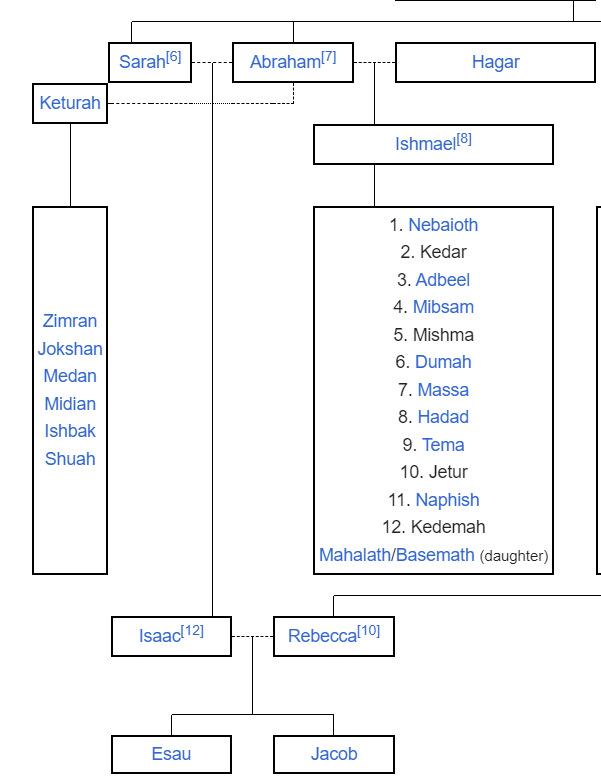
Here's a walkthrough example for you of some of Abraham's lineage.

  • Abraham = Abe Lincoln
  • Abe Lincoln converted to terrain is a log cabin.
  • Abraham had three wives - Keturah, Sarah, and Hagar
  • Keturah = caterpillar, converted to terrain as a gold mining operation with many Caterpillars
  • Sarah = saw, converted to terrain as a sawmill
  • Hagar = agar-agar, converted to terrain as a medical laboratory
  • wife relationships = log cabins with logs being moved by Caterpillars, back of the log cabin is a glass covered lab, and a sawmill next to the cabin sawing up the logs from the Caterpillars.
  • Keturah’s children - skipped, but her six children could be associated with six objects around the gold mining operation
  • Hagar’s children - Ishmael. The lab receives many packages in the mail containing petri dishes of agar-agar. Ishmael’s terrain is a post office so that his 12 children can be placed there.
  • Sarah’s children - Isaac. The sawmill is a dangerous place. Signs abound that read, "Use your eyes!"and video cameras send images to a control room where they are watched. Isaac’s terrain is an ophthamologist’s office.
  • Isaac’s wife - Rebecca. I’m a Jeopardy fan so I muight use the game show host Alex Trebek there. You might go for rib, beak, or my choice, David Beckham, the soccer player known for curving the ball. Rebecca’s terrain therefore is a soccer field and the eye doctor’s patients, dressed in soccer uniforms, are all there from collisions with another player or the ball.
  • Rebecca’s children - Esau and Jacob. One of the team’s goalies is a red-haired donkey who says “He-haw.” The other team is made up of policemen or cops.
  • Jacob’s children - Jacob had several wives, Leah, Zilpah, Bilhah and Rachel. And lots of children but you should get the idea by now. I’ll be extending the family tree by using the beautiful beach town of Walea on Oahu for Leah. Her five sons, along with the other tribes of Israel, have historic images associated with them that I would use for them somewhere on the beach.

Let me know if this works for you or if you have questions. This was really the last major mnemonic challenge I had so I’m glad it revealed itself finally.

Doug

4 Likes

Thank you for taking the time sharing this, Doug. I needed to read though it twice.

My motivation for learning this is learning Greek and Norse mythology genealogy. To me, an important part is to have a rough visual overview of the branches. Creating mnemonics for when branches split into n parts is fairly easy, the harder part is when lines are woven into one another, if you understand what I mean. I have been thinking about this problem a lot, often while laying in bed. I hope I can one day present my own solution to you and the rest in this forum.

@ChopinLisztRavel,

I had a hard time with tree structures in mnemonics mostly because I couldn’t traverse them. But let’s try working on the Greek mythology stuff and the problems it provides.

I’d create a merged terrain from the substitute words for Laius and Jocaste. Then there would be a merged terrain from Polybus and Meriope with action associating the the first terrain to the second to show a foster parent relationship.

Oedipus becomes an item in the Laius/Jocaste terrain and then Oedipus forms his own terrain with Jocaste for his four children items.

If you want to work out the details or have other wrenches to throw in the geneology, I’m happy to work them out. I really think this merged terrain and multi-state solution works well for any family structure. Instead of branches you visualize using Roman rooms.

Doug

Arrange a known place and number each object in that place based on the tree and if you need more places, place images or objects in the place for multiplication.

You can order it as a triangle A,B AND C… And from there connect your images from left to right from the root image.

On each object in the place you place the ones that follow it from left to right, a small example:

At the entrance door N1: Adam eats the apple given to him by Eve who has a snake on her neck and she carries Cain on her left and Abel on her right and Cain throws a rock at Abel who is marked after this fact, etc.

Although the scene is fictitious and is enlarged to a place with green grass under an apple tree, the door is understood to be in that place and the same door can be used by Cain, of course making differences… The imagination covers much more than What you think, the biggest problem is the order and there are already too many methods for it… Another problem is not seeing the images or a fleeting visualization of newly created images, it is not the same as observing an image of the larger system that you have very quickly remember that an image that you recently created and you don’t even observe it mentally, this is an abstract image, you think you created it but you didn’t, you inscribed symbols in the air.

You start from a real place connecting images as if you were observing a tree that has roots, stems, branches, leaves, flowers and fruits.

You use things that you already have in your memory so that the memory is strong, a well-known place for example, use the 5 senses to improve even more and do not despair with the images, take your time.

In the previous example you would observe Adam at the door with a red apple “emotions linked to the color red plus an added concept = a strong will to eat the red apple but with a terrible or threatening evil inside since everything that shines is not gold”… eva with an opaque green snake “green = of vile and envious nature” and its two children from left to right… etc… If I wanted I would continue adding emotions and images layer after layer to a single main image in this case Adam and Eve as For example, in the case of Adam biting the apple, the earth opens, but he would not forget who gave him the apple and that Eve carries 2 children from left to right.

THE IMAGE SHOULD NOT BE FEETING OR ADSTRACT SINCE YOU WILL NOT REMEMBER IT AND YOU WILL NOT TRUST THE METHOD… ALSO DO NOT GIVE THE IMAGE TOO MUCH MOTION AS IT CAN CONFUSE… FOCUS ON WHAT THE CHARACTERS OR OBJECTS DO AND THEIR CONNECTION. … YOU CAN USE KNOWN PEOPLE AS ACTORS OR REPRESENTATIVES OF THE ROOT OF YOUR TREE, SIMPLY CHANGE THEIR NAMES FOR THE ONE YOU WANT TO REMEMBER.

This is very easy to do quickly.

1 Like

I don’t know if someone else here has proposed this already, but If I were to memorize family trees, I wouldn’t use premade memory palaces. Instead, imagining an imaginary place on the spot would feel better since it would allow us to preserve the shape of the family tree without taking too long.

Each room or region of this imaginary place would encode a nuclear family (the parents and their children). If I wanted to store dates, then I’d use objects, not people, from my major system. After defining everything that region would contain, I’d create a story to weave all of that together.

To memorize the next nuclear family, I would imagine each son/daughter going to other regions, which will contain their respective partner and their children. This pattern will be repeated for each nuclear family. The goal would be to have a continuous story that gets divided into substories. Instead of spending my memory palaces, I would imagine whatever place felt intuitive and more fun according to the narrative I was creating.

Btw, this method works not only for family trees, but also for most types of graphs.

2 Likes

@Mike4 & @Magno,

What would really be helpful would be to see the efficacy of your proposals by publishing the imagery from your systems applied to a good example. The one for Oedipus should be a good one. I did Abraham above in detail and gave my short solution for Oedipus.

Laius and Jocaste are the parents of Oedipus. Polybus and Meriope are his foster parents. Oedipus marries Jocaste and has four children: Eteocles and Polyneices, Antigone and Ismene.

Let’s see what you can do!

Doug

2 Likes

@ChopinLisztRavel ,

While working through the geneology of Jacob’s sons I realized that when the number of children approaches five, a Roman room loses it ability to recall the items well. I had to create a story linking terrain pairs (multiple wives) to items (children) by creating a story. Jacob had 12 sons and two adopted sons so that became a story.

Some of Jacob's sons story example

Jacob is a cop / police station (item/terrain) and is located on the Hawaii beach in Walea for his wife Leah. The sandwich delivery guy brings Reuben sandwiches to a guy playing SimCity (Simeon) in the offices. The workers in the game who are building the city wear Levi jeans. One worker climbs to the top of a spire to attach a Star of David (Judah) to it.

Then you create a new merged terrain with cops and bills (Bilhah). A tanned guy (Dan) on the beach outside the police station gets a receipt for his umbrella and chair and pays it. He then goes into a changing booth which also charges him, to change into golfing clothes kept safe with naptha moth balls (Napthali). BTW the reuben sandwiches also had to be paid for (Rueben slept with Bilhah).

Then you change merged terrains again and continue the story with cops and silver (Zilpah), back to cops and the beach, and finally to the cops and roaches (Rachel). Joseph had two sons which were adopted by Jacob so that adds to the complexity but can be managed by this design.

Doug

1 Like

Ok, sure! I wasn’t thinking of applying my proposal anytime soon, but let’s do it!

I would first make sure to translate all names into something I could visualize:

Laius reminds me of Lay’s potato chips (which could be personified);
Jocasta reminds me of Juca, which is a name in Portuguese;
Oedipus always reminds me of Freud, and I find it easier to visualize the latter, so I’m gonna use him;
Polybus reminds me of a bus (personified);
Merope reminds me of a rope;
Eteocles reminds of E.T.;
Polyneices reminds me of Poliana, which is a common name in Portuguese;
Antigone reminds me of “antigo,” which means old in Portuguese, so I’m gonna imagine a very old lady;
Ismene sounds like Yasmin, another Portuguese name, so I’m gonna imagine a person I know.

(The first place would include personified Lay’s potato chips (Laius), Juca (Jocasta), and Freud (Oedipus))
I’d imagine a bedroom with personified Lay’s potato chips and Juca in bed, and then degenerate Freud leaves the wardrobe where he was secretly watching everything. Lay’s fly into a rage, throwing Freud out of the window with a punch.

(now the next region contains Polybus, Merope, and Freud)
Freud survives the fall because he fell over a bus (Polybus). Since I’m imagining the bus as personified, it has a face and a mouth. Still on the top of the bus, Freud picks a rope (Merope) and uses it as reins to drive the bus into the building.

(the next region contains Freud, Jocaste, Eteocles, Polyneices, Antigone, and Ismene)
Freud breaks into the house with the bus, running over Lay’s potato chips. He walks into the living room, where finds Juca crying over Lay’s death. Afraid of what Freud may do, Juca picks E.T.'s hand and throws the psychologist on the sofa using the alien’s telekinesis. He ends up falling on Poliana, who dies on the spot. Afraid, Freud carries the corpse and takes to an old witch (antigone) on the other side of the room, who resurrects the girl. Her sister, Yasmin (Ismene), still wants revenge, though. She steps on Freud, killing him instantly (Yasmin is a very tall woman).

Notice that the only thing that distinguishes parents from children is that the latter would move on to other regions/places. Because this is a very short family tree, this isn’t very explicit, though. Also, the only thing I used to distinguish biological parents from foster parents was that the former came first.
2 Likes

Muito bom @Mike4 !

I can see that you use a simpler story structure controlled by rules. Let me see if I understood them:

  • Two or more subjects in a scene
  • The first two living subjects, male and female, in the scene are the father and mother.
  • The scene continues using all of the children.
  • A child leaves to a new scene when they are married.

But then that doesn’t work for the foster parents. Freud would marry Merope and have Polybus as the son in that interpretation. You might have to change the story or add an item to symbolize the foster parent relationship to be completely consistent. But then just knowing that Polybus is a full-grown king would make that obvious. And similarly for Moses’ foster parents as well.

Thanks for the example!
Doug

1 Like

Yes, your explanation is right.

Indeed. This would be remembered by natural memory alone.

1 Like