I see in the forum that the usual aporach to memorising a deck of cards is having 52 images for each card, and then placing them in different loci of a Mental Palace or Journey.
But isn´t it more practical to use the first 52 images of the Major System and link those to the 52 images of the cards? Also in this way you know if a card is in the position 34 or 46 for example, however if you use loci the loci themselves dont have a number so you wouldn´t be able to do this.
I am beginner so there is probably something I am missing, so thanks in advance for the replays, I know they will be very healpful as I have seen surfing through this forum that this community of mnemonic enthusiast is very welcoming an kind.
I think there is one main reason: Linking to loci gives a three-dimensional feeling that can help with memorization and recall. Using a sequence of images works too, but usually it is easier and faster to mentally traverse locations you know.
By the way, loci can have position information too. For example take a route that consists of rooms/areas, each having five stations. Card number 46 would be the first locus in the 10th room/area.
In fact I am using a combination of the two methods for cards. My Major images are placed on loci that additionally have position information as described above. So when playing cards, I link the card images to Major images that are placed on fix loci. In my opinion this is more interesting than placing them on furniture again and again (which would probably bore me to death). Yet my scores are not overwhelming, probably due to lack of training. A nice system is good to have, but I think it is much more important to train, train and train
Linking information to number images like that is called a peg system. I think that peg systems are worth experimenting with, but they probably aren’t used as often for competition-style memorization as memory journeys.
I’m turning my mnemonic images into a large peg system at the moment as a learning experiment.
I guess for competitive memorizing the peg system will always lack in comparisong to other systems in which you memorize the cards in chunks of three, but I really suspect that if you have perfectly engrained from the number 1 to 100, to the point in which you read in images, linking those to the images of 52 cards would be acomplishe at a pretty decent speed. At least that is what I am working towards right now hahah so I will tell on my progress and I hope you also tell us about yours with that experiment Josh, if I understood correctly by switching the mnemonic to peg you are making the images match the shapes of the number or something in this line?
Very interesting, right now I am building a memory palace so I will try what you are describing for sure. My only problem is that when I place the objects in the rooms I can’t help but add some characters. For example I have a room with 10 loci make my route in the room clockwise, placing the objects of odd numbers on the walls and even numbers on the corners, and the last even number 10 on the center of the room, the thing is I have this room with the motive of “best swords of cinema and anime”, is like a dojo with this swords as objects, the problem is if for instance i imagine the sword of Miyamoto Musashi this charcater also appears on that spot… I dont know if this is making me any favours for a future PAO system…does somehting like this ever happened to you?
I have a modified Ben System (described here). Each image from 0-9, 00-99, and 000-999 has a one-syllable pronunciation and a single image. It also allows for expansion to 10,000 images/pegs, though I haven’t done that.
For example, I’ve used it to memorize a lot of programming functions. Each number has an image, and each function has an image. I link the images together.
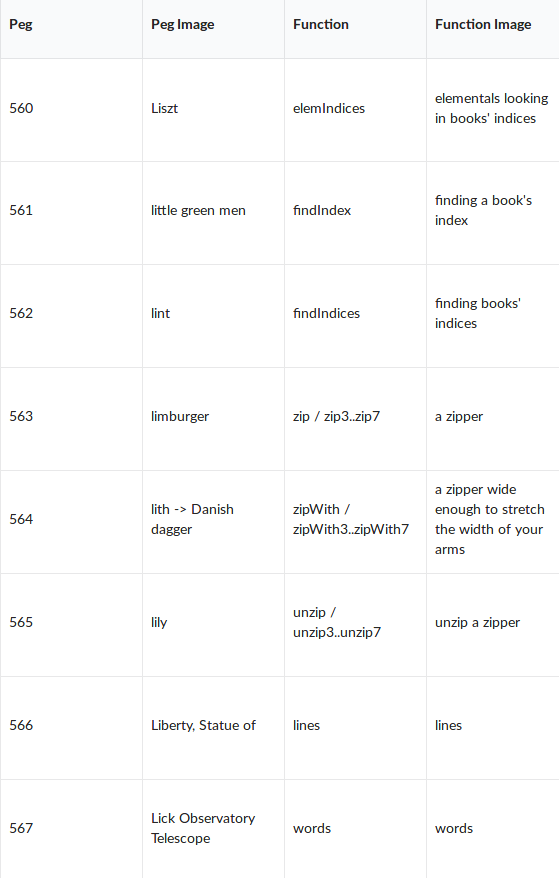
So for the number peg 567, the peg’s image is a large telescope. The programming function that I’ve stored there is called words. I link them together by imagining that the telescope is looking at words in the sky. I can remember the meaning of the function, because it’s self explanatory (it splits strings into a list of words).
I’m still working on it and will post an update soon, but here’s a sample in the meantime:
Using the peg system lacks in what you mention in your post: it needs a certain effort to memorize. Memory palaces that resemble real places are easy to use because they are easy to memorize and easy to navigate. In the end a memory palace is also a peg system, you attach an image to a location, the difference is that every location in a peg system has a physical place wheras the locations in a peg system have a logical or memorized place. To me the physical places of a memory palace are way less effortful to use.
Now, you mentioned grouping three cards. It is actually not used that much. I use 1-card images now and on average I am 5 seconds faster with that on one entire deck than when I use PAO. For memorizing multiple decks, I am using PAO due to the lower amount of repetition of images.
Work with existing places first, like your own home. Try to turn things into loci rather than the other way around, that way you can get a feel for it and it might help you get an easier time creating other palaces.
Nice system, I am pretty much following the same one for memorizing law articles, it works pretty good, the only thing that slows me is the comprehension of the articles, memory techniques work wonders but stil you need the understanding of what you are memorising so no other option but to chew them up hahah In my case I just have the first 1-100 images, the for the 101-199, 200-299,300-399… I use the same images but in a different place for each interval.
And now I am starting to use the loci system but the problem is that when I place some object in a room, for example some pair of glasses, it can happen that a friend who has those glasses pops up in that loci, so I don’t know if I should use that person as loci or to try and focus more to just have the object… but still not terrible if the guy that appears is Musashi, right? hahaha “from one thing, know ten thousand things” (Miyamoto Musashi) Could he be talking about memory palaces ahhaha
Thanks for the tips, I was just about to begin to use my house as a memory palace, before I was just takeing the subjets of law or psychology that I was studying and while reading placing the images I am making on some journay of some place making it up on the spot, so I never really had like a memory palace for a real place or imaginary with set number of concrete loci to use as references, I was just like making a film but a very poorly organized one, therfore the need to work on memory palaces and mind maps. So I´ll try this for the nex days and see how it goes!
Oh and reading what you said the I will work with one-card images as I just want to learn to memoryze one deck of cards at the moment, thanks for the replyes!