I have always been interested in learning Mental Calculation, but I think many beginners would agree with me when I say that I am unsure of where to look to learn techniques. There are a lot of books discussing different techniques such as Arthur Benjamin’s, the Trachtenberg System, and using an abacus. To aid with this problem and thus help spread the popularity of mental calculation, I wanted to ask seasoned mental calculators on the forum: What are the techniques you keep readily at hand to answer a question?
With your answers, we could compile a master list which would look like this
Multiplication:
Anchor Method
Trachtenberg System
etc.
Square Roots:
Duplex method
etc.
I think this would greatly help me and other beginners who would like to know what techniques are most helpful and what we should start learning if we’d like to excel at mental calculation.
Either would be fine, I wouldn’t expect much discrepancy (Is there a discrepancy?). I think general use may be better because those best for competition could be handpicked by the person reading the list.
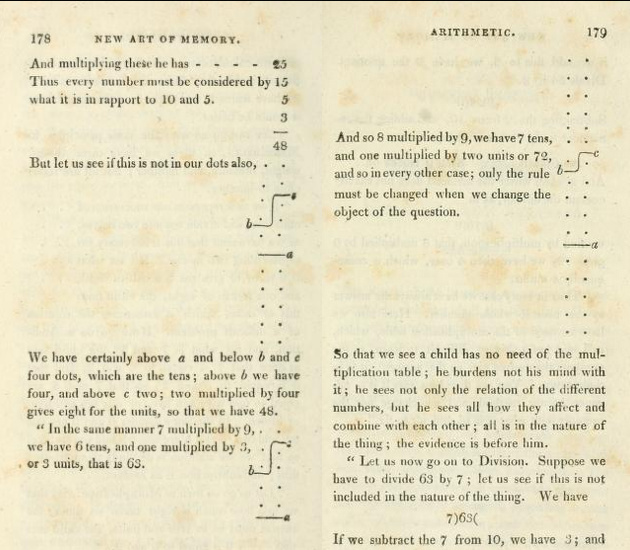
In the book The new art of memory, founded upon the principles taught by M. Gregor von Feinaigle: and applied to chronology, history, geography, languages, systematic tables, poetry, prose, and arithmetic there is a method to sum and multiply with points. I wasn’t looking for that it that moment, so didn’t pay much attention.
squares formula (a + b)^2 = (a + 2b) * a + b^2
72^2 = 74 * 70 + 2^2
squares end in 5
75^2 first two digits are 7*(7+1), last two digits are 25
squares near 50
52^2 first two digits are 25+2 last two digits are 2^2
squares near 500, 5000 etc. similar to the above
cubes formula (a + b)^3 =((a + 3b) * a + 3b^2) * a + b^3
42^3 = (46 * 40 + 3 * 2^2) * 40 + 2^3
Small Division
long division (method learned in schools)
vedic division
division by 7 (after reaching fractional part, we can use memorized expansion of a fraction)
divisor end in 5
5937 / 255 = 11874 / 510
factor divisor (It’s not necessarily faster, but it’s easier)
3040 / 72 = (3040 / 8) / 9
ever shorter divisor (round off the divisor in each step)
Big division
cross(Fourier) division
Calendar
add up codes for century, year, month an day (Probably the fastest method)
Doomsday method
Square roots
Newton’s method (It seems fast for low accuracy)
duplex method (The best for high accuracy)
Cube roots
Newton method with Chebyshew’s correction (Explained in “Dead Reckoning: Calculating Without Instruments”. Probably the fastest method but requires good memory.)
It is best if the second number is a multiple of 3.
Like 84 * 37 = 28 * 111 = 3108
Otherwise, this number can expressed as multiple of 3 plus minus 1.
Like 85 * 37 = (84 + 1) * 37 = 3108 + 37 = 3145
or 86 * 37 = (87 - 1) * 37 = 3219 - 37 = 3182
Alright then, I will use this only when other no. is multiple of 3.
Yeah, I know you are giving the example of 37 (note : except 86 isn’t a multiple of 3)
Sorry , for again asking (i am just clearing my doubts)
I think you will saying again this , it will only work when the other number is even no. ??
Half the other number and double the no. that has 5 in the last.
And then multiply.
I am currently doing this type of things like this -
28 × 45 (multiple of 5 = 9 × 5)