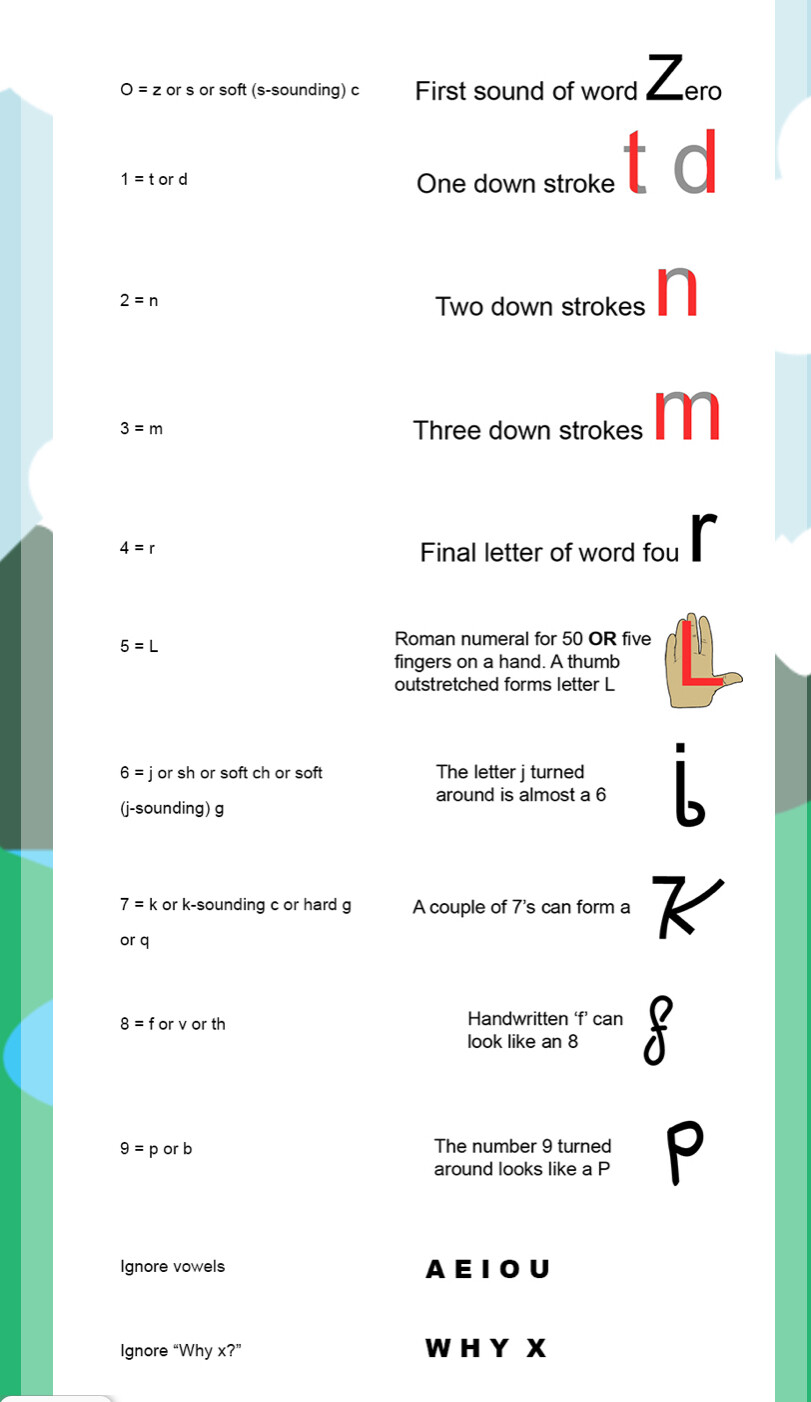
How does the number 6 map out to the consonants ch, sh, j, zh.
It doesn’t exactly explain in the ebook, the only thing i can think to correlate it to is when I was looking back at number shapes and visualizing how the ‘6’ can look like a cherry, and obvs cherry starts with “ch”.
Vowels and those specific consonants w,h,y, annd x are ignored as far as holding any number value like our defined consonants in the chart do but those are free to use to make words. Plug in vowels and those valueless consonants wherever needed to make words but only counting number values from the chart letters
So Housewife would be 08 since were ignoring vowels and consonants w,h,
houS(0) wiF(8)e
I try to avoid words with lots of extra leading stuff not holding value when possible so Safe is my goto 08 but for my PAO I do use Housewife
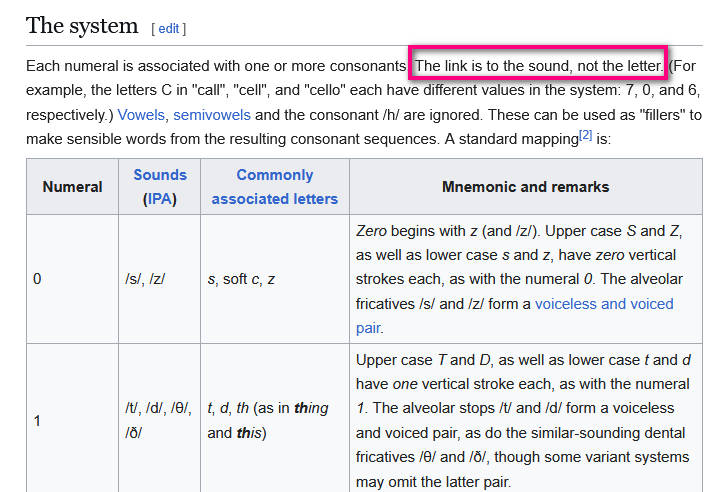
Guys, that “mapping out” to 1 down stroke, 2 down strokes, etc… is for day 1, when you don’t have the correspondence memorized, then it doesn’t matter (never did) Major system is about the sounds.
I guess the creator thought the correspondence given was the most convenient, but if you can find a more convenient association for the sounds, go ahead.
6 is the number with more letters assigned in the major system because it represents several related palato-alveolar and postalveolar sounds.
If you check the International Phonetic Alphabet (IPA), those ssounds are generally transcribed as tʃ, dʒ, ʒ, ʃ
The rule of thumb for the Major System is that the number 6 is assigned to “sh” and similar hissing sounds that involve placing the tongue slightly behind the tooth ridge.
Right but I didn’t know how much the questioner knew so thought I’d share the mnemonic to help learn the Major. And the reason for why each sound was paired to the corresponding number was the question there is a connection to the shape it doesn’t hurt to know when learning the why for each letter to number assignment. But yeah its second nature once you’ve been using it for a little.
well the thing is there’s not connection to the shapes, that’s something they look for… afterward, to help a little at the start of memorizing the correspondence, so it’s not completely by rote… if I had to teach the corresponde to someone I wouldn’t mention down strokes or anything.
—… but why 2 is n?
—because!
Lol well Thats like choosing rote to remember vs using a mnemonic that will help it get to natural memory quicker. Might as well use the tools when starting out to get it in instant recall quicker. If they forget when learning at least they will have a quick way to find the answer built into the question itself instead of just using a FlashCard that says 1=t/d 2=n
well t one down stroke, 2 down strokes, 3 down strokes it’s OK, then it gets in ridiculous territory, but to each their own. It shouldn’t take more than a couple of hours to have them down, quicker with the “down strokes” maybe but if one is getting confused looking for shapes, they have to be told what it is.
Why are both of them incompatible, it does seem more logical, since we learn to read with phonics? (Although apparently not in English?) See a letter and sound it out? Isn’t it more logical to get the same sound from “letters” similar to what we already know?
I did my own version of major precisely because the shapes didn’t seem logical to me (why isn’t 5=S?) and it seemed logical that they would correspond if the goal is to “read numbers”. So I chose equivalences that made sense to me - especially given my mother tongue (and the other languages I’m using).
Funnily enough I had no idea what major was based on, just didn’t like it and made my own… I guess at the time (a dozen years ago) I didn’t know this forum and had nobody to ask. Ah, well, doing my own thing has worked well anyway.
see? and in “mnemonics and remarks” you have the “down strokes” stuff which is not necessary for me since how hard can it be to associate 10 digits to sound.
But of course you can do whatever you want for yourself and say you use the major system, if you publish you’ll use another name or add a “modified” at least.
Using sounds a Russian, or a German or a Chinese can use “6” for
ш, щ, ч or sch, tsch, or sh, ch, zh, x, q, (in pinjin) respectively… without problem.
by the way a Chinese sentence translated to major system must look like
666 662 366 666, so I dont know what they do. jk.
I wasn’t doubting that you quoted the references right, and that it’s the “official” version, but… So what?
It still doesn’t feel logical (to me). Why random links to only sounds instead of sound AND letter shape if you can?
10 years ago I didn’t systematically look up things on the internet all the time, so after getting the gist of the idea, I just did what I could with it - and honestly it worked just as well.
In some aspects, it was better because I had the habit of trying things out quickly instead of losing time trying to find how to do it exactly “how it’s supposed to”. On the whole experimenting a lot served me well (and was fun too). I’d rather have a system that’s a good fit for me and I know why, than a system that I followed because the wiki said so.
Different methods work for different people so to each their own. I think if your able to learn it just by the sounds and don’t need to use the shape to remember, great! If you use the shape while learning just like Hari mentioned we learned to read our language by sounding out letters so it is a natural system. After a while those training wheels naturally fall off and we are instantly converting letters to numbers just as if we had never used the shape reference.
Theres also some truth to the left brain / right brain dominant people. Some are more visual and others are not. Often I’ve seen someone who is really good at math may struggle with creative writing so it’s good to know multiple approaches to learning the system.
People is having thing backwards here…
Apparently some believe wikipedia creates reality, and it maybe does temporarily at least in these days of fake news, etc.
And learn it by sounds? what..10 digits?
Major system is a tool, to convert sounds to “letters”… to convert those letters to images, then you memorize those images.
At this point OK, I concede… one must use the “down strokes” to shorten the memorization of the sounds to letters correspondence in about 50% (gaining a couple of hours)


 .
.