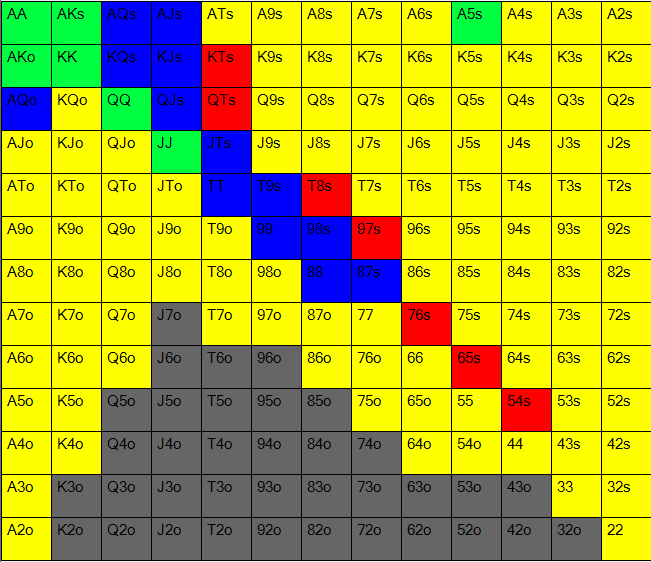
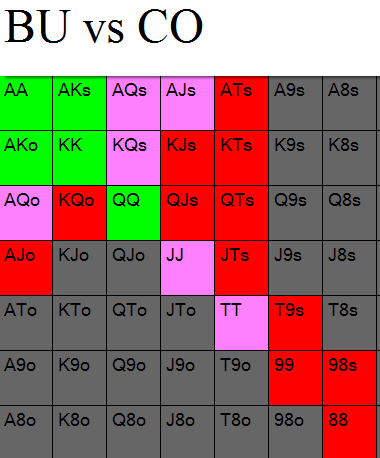
Some great ideas so far, so I’ll go ahead and toss my idea out there, too. So my understanding is that what you’re trying to achieve is what action to take given five pieces of information: your position, the position before you that raised, the value of the first card, the value of the second card, and whether the two cards are suited or not. All this is pre-flop action. Obviously you’ll have to have different, but hopefully less intensive memory-wise, decisions to make after the flop, turn, and river.
First, make sure you have a solid 00-99 system in place, and know it well. Then, number the positions on the table 0-9, with 0 being the SB, 1 being the BB, 2 being UTG, etc, and always letting the button be 9. So the identity of each of your cheat-sheet cards will be a two-digit number. For example, if the card deals with the Button vs. the Big Blind, your two-digit number will be 91. In my system, 91 is a bat (the mammal that flies). That’s the first part.
The second part will be identifying the two cards and whether they are suited or unsuited. You’ll need assignments for all 85 possible two card combinations (13*13/2, because the order of the cards does not matter, so 57 is the same as 75). You can re-use the 00-99 you already have, e.g. a 7 and a 2 would make 72, a 5 and an 8 would make 58. Let your A=1, and your 10=0, for these purposes. Then you’ll need to devise the additional assignments to the remaining combinations (those involving a face card, or one face card and one non-face card). Once you’ve done this, you’ll need a way to determine suited or unsuited. You can have your images be wearing beautiful clothes for suited and ragged, dirty clothes for unsuited. Or have them dressed in anything for suited, but naked for unsuited. You get the idea.
OK, there’s one piece of the puzzle left. That’s your action. You already have your colors assigned to items up above. This may be sufficient. Or you could make them be actions instead of items, like let Red=running, Yellow=vomiting, etc.
Here’s how it would work in practice. You’re sitting on the button, and the BB has raised, and everyone after the BB has folded, and now it’s your turn. Button=9 and BB=1, so the number is 91, which is a bat in my system. You peek at your cards, and you see a 75, unsuited. 75 is Cal Ripken (a famous American baseball player) in my system. Suppose your system tells you to fold in this situation, and folding is the color grey. You could let GREY=smoky for your image. Then you’d have a bat flying into naked Cal Ripken’s face (maybe imagine Cal trying to get the bat off his face), all the while he’s surrounded by grey clouds. So when you memorize this combo image, you’ll hopefully remember the bat=91, and Cal Ripken=75, naked=unsuited, and the smoke=Grey (=FOLD), and you’d know to FOLD in this situation.
All of your memorizing for the specific situation of Button vs. Big Blind will begin with the bat (91). I’m not saying any of this will be easy, especially sitting in a live poker game trying to remember this stuff. You’ll have to practice your assignments and know them at least as well as a memory athlete, but it is doable. If mental athletes can memorize over 2,700 images, you can do it, too. The good thing is you can take your time memorizing your images, since you’re not being timed for that. So you can take a few months to get really familiar with your system assignments, and then spend a few months memorizing the rest of this stuff.
Of course, you know that even this is a simplified system that doesn’t take into account the playing styles of the other players, or the pot odds, or several other factors. You’ll need to modify the basics to account for all this other stuff.