Learning Japanese Kanji Try #3

Hi all,

A bit of a background

I’ve been studying Japanese for about 10 years now. I can survive in a working environment that’s purely in Japanese, but it’s a struggle. Constant look ups, I learn the same words 20x times and I still can’t remember them, I can recognize probably 70% of all Kanji once it is in context through sheer amount of exposure that I had, but from memory I could maybe write 10-20%. I think the biggest hurdle stopping my progression is the fact that I can’t be considered literate in the language I spent thousands of hours studying. Which now that I put it into words, sounds absolutely ridiculous.

I have played around with memory techniques, had my PAO system and remembered maybe 400 digits of Pi and had them stored in memory palaces. So I have the basics, but I’m in no way a proficient user.

Previous Attempts

I tried fixing this issue by learning all the characters using the James Heisig’s Remembering the Kanji method. Which is basically the memory technique method that associates radicals to objects or characters and creates stories that help you remember meaning of the character you’re learning. I’ve gone through 2400 characters, changed many of the authors associations for my personalized ones and created my own stories. An example of how it works:

言 is Cicero
音 is Brook from One Piece
戈 is Urukhai

So a Kanji character for "discriminate" (識) is just an image of Cicero
stopping a bunch of Urukhai from attending Brook's concert.
The Urukhai feel clearly upset and discriminated against, 
but Cicero points to the sign that says "No Urukhai allowed".

Not all of my stories are this good and some radicals and characters will need to be reworked or changed completely, but I basically already have all of the radical associations plus stories for each of the 2400 characters.

All characters are basically a combination of 200 or so radicals (smaller characters)

First attempt

I tried using memory palaces and things would stick remarkably well, but the mental strain was high and the speed of progression was so slow I lost hope it would work. I would place characters in an order given in the book which meant characters not associated with each other would reside in the same palace.

Second attempt

I decided to make my own physical flashcards but couldn’t really get the review method down and switched to electronic flashcards with a built in SRS and the speed was fantastic. However, retention was poor and after a 3 week hiatus I had 2400 flashcards ready for review and when I try, I can recall maybe 2 out 10.

EDIT: to make a note here, the SRS recall system is the one recommended by the author of the book. The user is presented with the associated word and they have to recall the Kanji character. So in the above example, I would be shown the word “Discriminate” and would have to recall what Kanji was associated with it.

Now

I’ve tried twice and I failed and could really use some help. Please, could someone give me an advice on how I can finally make this work?

I have 50 memory palaces prepped and ready and a whole neighborhood around my house ready to be encoded.

Apologies for the long post and thank you in advance.
Use flashcards and stick to a manageable schedule. Commit to 100 days because it is difficult to learn much more than 15 new items per day, and while you’ll already know some, you’ll also want to force some time for review at the end. [Edit: try to learn 10–30 new words per day and more importantly keep on top of the backlog of reviews otherwise there’s no point.]

SRS is the GOAT for long-term associative memory.

Only for the few kanji that don’t stick (for whatever reason) use whatever mnemonic you want e.g. get Cicero and the Uruk-hai involved only as a last resort.

Good luck!

1 Like

Thanks for taking the time to read and reply, Daniel.

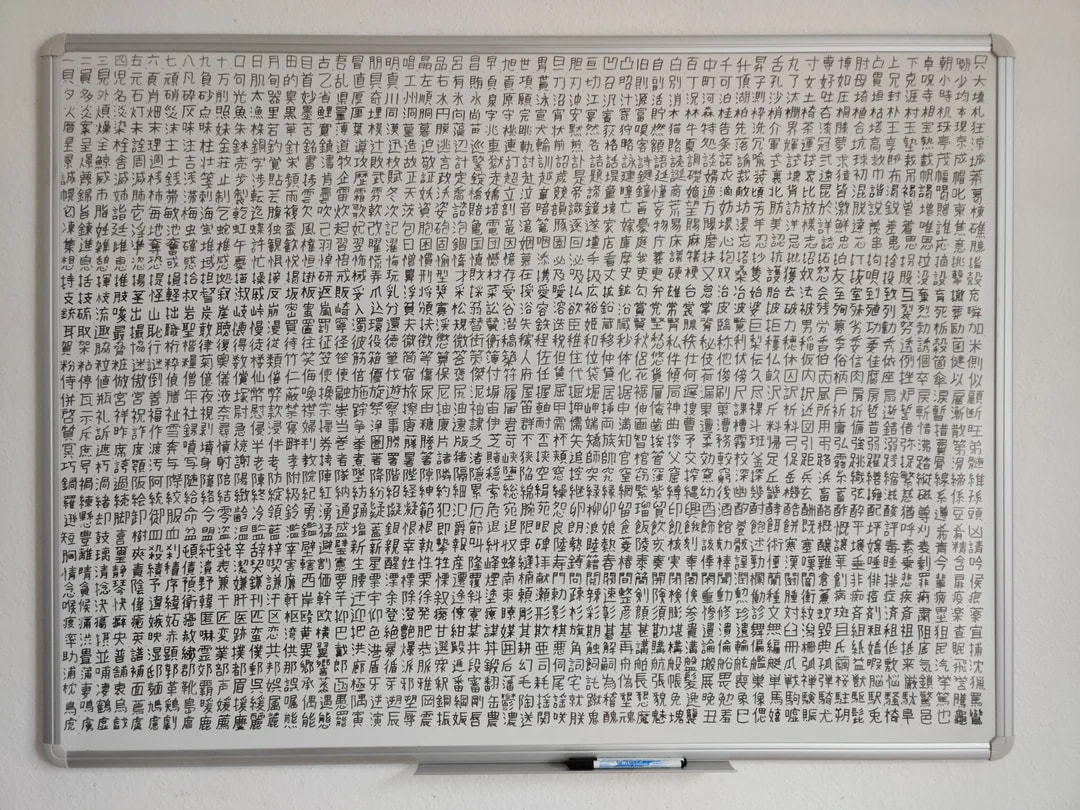
Just to double check that we are on the same page, I am attempting to learn an alphabet that will help me learn and write words that use this alphabet. Not actually learning any words yet. Though I probably already can speak about 5-8 thousand words. The below is a list of all the Joyo kanji which are considered basic letters people should know to be able to read and write words (picture from a reddit post)

Given this context, does your advice still stand?

Take the most 10 or 20 of the most complicated Kanji according your consideration, and apply this reviewing schedule and see if it works.
As it says, in any case you have to remember (play it in your head) at least once every 6 weeks (if you don’t use the info at all) or if you see use it constantly (at work or something) it’s not necessary, in this case they’re individual characters I guess you need to do that. So in 2 months time you’ll know if it works. :smiley:

1 Like

@vector Awesome, thank you very much!

From your message and the link being in a thread about the method of loci, I am assuming you’re suggesting the memory palace method.

Do you think the kanji characters should be grouped by radicals (my heros) or the order/grouping does not matter?

As in, if I have a palace full of Son Goku doing 20 different valiant/gore/lewd things, will the stories start to blend with each other or will that actually make it easier to remember them?

EDIT: I of course understand your testing approach of choosing the most difficult kanji first and seeing if they stick. I’m just thinking ahead with my questions here.

yes I guess it has to be some sort of memory palace to review them mentally, and making sure you didn’t skip any.
And the grouping in that case doesn’t matter, the locus will set them apart.
See if it works first, then go “for real”

I would (because I’m not memorizing kanji) do it like this:
memorize 5, review them (mentally, and write the kanji, check if everything is OK) until they’re memorize correctly, add another 5… then check if you have memorized correctly the 10 of them, then add 5 more and 5 more… when you have the 20 correctly memorized, then set a timer for 40 - 60 minutes, and review again (mentally, supposedly no need to write anymore you have them well memorized when you finished memorizing the 20) but check if you want one last time. When you’re done, the set timer for around 3 hours, review mentally, then after 6 hours… Then next morning, then before sleeping, next morning, before sleeping, next morning… 3 or 4 days. And… in 6 weeks. (if you thought about it in the middle is cheating :wink: )

1 Like

Thank you so much for the detailed instructions about how you would go about it. I will go ahead and start first thing tomorrow :slight_smile:

I think not thinking about it might become a challenge in and of itself lol.

Again, thanks a lot!

1 Like

Absolutely, yes.

Just make sure the flashcards match the character to the actual information you want to remember.

It is vastly more efficient than memory palaces, especially during recall when actually reading Japanese, and it’s what successful learners of Japanese language have been doing.

Search for sets of flashcards that other people have already created, as kanji memorization is a problem that has already been solved many times by other people.

If you are not convinced, you could start a SRS approach and a memory palace approach at the same time with the same amount of effort/time given to each (and for mostly separate sets of kanji) and following the best advice you can find for each aprpoach. Then after 1–2 weeks it should be clear what is effective for you, and proceed only with that for full efficiency.

[Disclaimer: I haven’t learned Kanji (or Chinese characters or similar) myself. But I understand algorithms and data structures, I use memory palaces, and I’ve learned foreign languages as an adult.]

1 Like

Thanks a lot, Daniel.

My reservation was related to your note on only creating stories for kanji for selected few difficult ones. I understand the power of SRS and it might be even better than I thought from what you’re telling me.

However, I’ve tried almost every non-mnemonic approach there is (including SRS) and I can recognize quite a lot of kanji within context. In my opinion, unless you spend years writing each kanji hundreds/thousands of times you will only ever be able to read the language.

This is of course anecdotal, but having lived in Japan for 10 years I have met maybe 10 foreign residents that when given pen and paper can write the language at or near native level. Or be able to tell you which kanji is used in what word without a screen in front of them.

I’m sorry, I don’t mean to be dismissive of your comment but it’s contrary to my experience.

I like your idea of trying SRS and method of loci at the same time. I’m going to give that a try while using the stories method for each one.

Thanks again for taking the time to help me.

I faced a similar challenge when trying to learn the most frequently occurring 2,000 Chinese characters, some 20 years ago. I started with Pauker, then Mnemosyne, then Anki. All of them were good, but I quickly discovered that adding more than about 8 characters per day would overload me with reviews, especially if I missed a few days.

After maybe 2 years I reached 1,200 cards, and realised even though my retention was high (around 85-90% most days), I couldn’t hold a useful conversation. At that point I got disillusioned and gave up.

Now I focus more on comprehensible input than cramming characters or vocab. But the method worked okay for that.

My advice would be to just tone down the number of new cards per day, and make it concrete: my cards tried to give an unambiguous clue on the front side (“dog (8 strokes, not x…)”) since recalling 獢 xiāo instead of 狗 gǒu and marking it as a failure would be a huge waste of time.

The thing is, do you need to be able to write them by hand? I can type in Japanese easily enough (since you only need to type phonetically and then select the right kanjis proposed to you) and honestly given how difficult the language is, and how much there is to learn, to write by hand isn’t really high on my list of priorities. I mean, except your name, address, etc. which you maybe need to fill out forms and such…

Even Japanese people themselves forget how to write a lot of kanjis with time (since writing is mostly done on computers and smartphones nowadays).

Not saying you shouldn’t write at all, since the kinesthetic part is also important for memorisation, but maybe cut yourself some slack… Being able to recognise kanjis and to write by typing words is already huge.

A few observations:

I too have been trying to learn Japanese, both oral and visual, off and on (mostly off) for about 30 years. I have made not use of memory techniques, per se, along the way. But over the years I’ve studied such techniques, though not applying them to my every-3 years assault on the Japanese language.

Regarding your “leakage,” I think the most important thing is daily call-and-response with flashcards is critical. The best times for memory operation is when you first get up in the morning, and the last thing before going to bed at night. If you devote only 10 minutes to that practice, and perhaps during the day I think you’ll have better results. But you have to keep the process in endless cycles of daily for 4-5 days, then review every 3 days, then a week, etc.

Regarding the group in palaces: What little work I’ve begun with this I find that verbs and nouns, should be stored separately. Additionally, I think they shouldn’t be grouped in random jumbles, but stashed in association(s) with others, whichever seem most handy for you. Perhaps visual, related to radicals, or by the type of story you have assigned. And there are other ways to group things that may be related to neither, like food, or body parts, or mechanical constructions (cog, wheel, lever, joint, etc.).

My personal opinion is that in review they shouldn’t be written out in many of the earlier reviews. I can review a “snapshot” of a complex kanji in my mind, but find I’m really only visualizing it’s gestalt, not it’s molecular structure. Writing them out, however sloppy, addressed that until it’s irrelevant.

Thank you for reminding me of the value of Heizing’s book, I have so many books on the topic of Japanese it’s hard to come to grips with which one is my best distraction du jour. Regarding grouping by association, the book “Kanji: Picto-O-Graphix” (1992, Stone Bridge) by Michael Rowley is a monumental and award-winning effort that might aid in your palace placement.

Upstream some have pointed out that even Japanese people lose track over time with Kanji learned in school. It’s because there are many words that rarely come up in convrersation or print, regardless of language. In English one says “quotidian” they say “daily.” Rarely is “lugubrious” used, perhaps “mournful,” instead. The lucky distinction kanji-readers have is that they still might be able to distill meaning by poring over the visual “hints.” We can do that too if we know old German, Latin, Greek, and French, though not visually!

Good luck! And please provide periodic updates. I’d love to hear how it goes.

— Gerry

@Ganxel

Thanks for sharing your experience and for the advice, I really like that clue idea.

@Hari-P
If a genie showed up right now and said I could recognize all kanjis, but would never be able to write anything by hand except maybe filling out forms at my ward office, then I would take that deal, yes.

I’m just afraid that the thing that is holding me back is my lack of command of kanji. That it’s the reason why I have to relearn the same word 20x times, because there is no anchor and it’s just free floating until an outside stimulus occurs and then it’s either there or has already floated away. I’m honestly not sure, I guess I’m just desperate for a new approach.

@GScottMoore
Thanks a lot for sharing your experience. It is quite uplifting to hear someone going through the same thing.

I appreciate your advice and will implement it in my study.

How about Nouns that can also be verbs? :slight_smile: (e.g.,選択)

I think I have one last sortie left in me, so I’m taking my time and looking for a new approach before I sally out again.

I just put an order for “Kanji: Picto-O-Graphix”, thanks a lot for the recommendation!

I’ll be sure to come back here and update on my progress. Thanks again!

Easy peasy my guy. Just get a Japanese girlfriend

Already done. We speak mainly in Japanese. Progress unsatisfactory.

1 Like

I spoke about skipping the writing, because the main problem for me was that there is so much to know for each kanji (not only that there are many of them).
For only one kanji you have:

  • the radicals
  • the place of the radicals in the kanjis (is it sun+moon or moon+sun?)
  • the on-yomi (sometimes several)
  • the kun-yomi (very often several possibilities… you learn them all but then you’re not even sure which one to use in each particular case, making it pretty useless!)
  • the meanings (often several too) or the words you can write with them
  • the stroke order if you write by hand (although it tends to to follow a certain logic)

The first time I tried to learn kanjis I failed because there was just too much information and my brain was overwhelmed.

The second time, I was a bit smarter and, instead of diving in, I took the time to think about what exactly was a problem for me and why it didn’t stick. One of the things that helped it be more successfull was to limit the information to learn (no writing by hand, no on/kun-yomi, etc.) Basically I created my own variation of the Heisig system. (My system for japanese kanji)

My recommendation would be to choose a method and try it out, but in SHORT cycles. Test it, see where the pain points still are, adapt. Then try and evaluate again, and adapt again. Yes, it’s a marathon and it IS hard work, but you shouldn’t feel like you’re running in circles.

1 Like

You may improve your method of memorizing by reading a book titled “PEAK” By Anders Erriksson.

1 Like

There’s already some fantastic comments here, I won’t detract from any. Ultimately what works for one may/may not work for someone else, there is a bit of self experimentation when it comes to learning in general, not just languages. One thing I have found very useful over the years, is to not translate. That is, when learning Japanese, I use an actual Japanese keyboard, (I’m purely electronic in this example), so when shown a kanji via anki, I type the answer in hiragana. There’s no English at all. I’m not typing “su”, just one character, す. And I found actually having to type every answer was the key for me. In reverse, I use an image, type the correct hiragana, and select the appropriate kanji. No English on any flash card.

The making of the flash cards is huge. Selecting the right image, which may only take less than a minute, deciding on why this kanji is important (how often is this going to be used, how important is it to have this as working knowledge, even if it doesn’t get used that often, do I struggle with it for some reason?), all goes into making the card, and that is often half the battle. While I’m not adverse to mnemonic stories, I personally have found that they can be a double edged sword. For me, if I’m going to use them, than the story has to be in Japanese. It has to have a Nippon flair about it, and there is to be no English. Usually I find that once I am thinking in Japanese, life gets a lot easier.

Even the little things, like typing strictly on a Japanese keyboard (as opposed to some software IME where you haven’t had to learn anything) can get you to start thinking on the right track. It might feel very slow, but if you can have your internal dialogue in Japanese, mentally force yourself, even if just for an hour at a time, you get to the point where it’s a dedicated part of your brain that is doing the work, and being trained, and it will feel a lot more natural.

Obviously I don’t know you, haven’t met you in person, but I’m just guessing that if after 10 years it’s still quite the struggle, there may be a lot of English upstairs doing all the heavy lifting. Could well be wrong though! :slight_smile:

Hopefully there is something useful in all that for you.

3 Likes

Thank you all for your recommendations. @Hari-P I ended up going with a similar approach to yours and built my own Heisig system.

@rts so I’m going to try and incorporate some of your advice as I build my vocab Anki decks for JLPT N1. Could you share a screenshot of a couple of your Anki cards so I could better understand your method?

Onto the update. It’s been 4 weeks since I started memorizing the Joyo Kanji and I’m doing my own version of the Heisig system.

I’m using the memory palace technique and I’m grouping the kanji per their radicals. So all kanji sharing the same radical will reside within the same memory palace.

This has some disadvantages, mainly that in Heisig’s book you would first learn 夂 then 口 then 足 then 路 then 雨 and then finally the main boss 露. But with my approach I kind of have to learn 5 kanjis to learn only 1 (in this extreme example). This of course will make it easier later when I start placing the 5 in their own memory palaces but the initial hurdle is increased.

The main advantage is that if I know that all characters sharing the rain radical (雨) reside in my local taco restaurant then my memorization is significantly simplified because I know Raiden (雨) will be in all my stories and I only have to memorize the bottom parts of kanjis like 雪雰電雷震 etc.

I had an unusually busy 4 weeks at work and I still managed to memorize 160 characters. I’m also getting faster with each iteration. There were quite a few trial and error moments and I’ve struggled with not square/rectangular shaped palaces as I would often skip over some loci. Whereas, if I have a rectangular shaped room I know there are 10 loci in there and I will know if I skipped something.

I’m getting better though and it’s really surprising how well it works. If I do proper reviews like @vector recommended then after 4 or 5 reviews the information is just there. At my disposal whenever I need to call upon it.

The biggest update is that it’s been a month and I haven’t lost motivation to study. I see progress with this new method and with that I have found hope that I will learn this ridiculous language. My feelings towards it have shifted from dread to fascination and that in itself is powerful.

Thanks again to all that have given their opinion and advice in this thread.

2 Likes