Hi Folks,
This is my first post so hello to you all.
My question is this - I need to learn English Grammar in DETAIL and was wondering what your thoughts were on the best way to go about this.
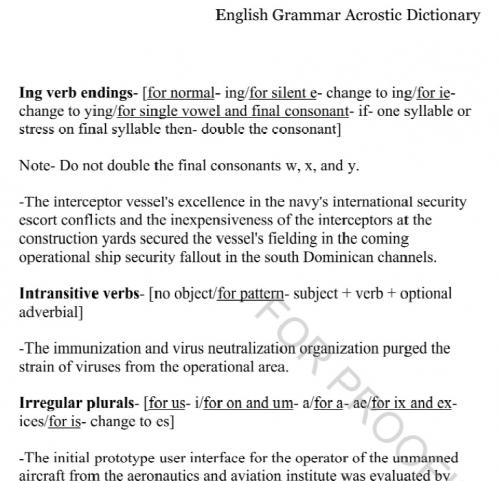
Should I try to assign an image to almost every word and try and run a sequence/ story with same. Or would it be wiser to use another system I have just come across namely, use the first letter from each word and learn it verbatim that way. There may be another way you can suggest.
Hi radi, I’m not sure you’re being very clear with what you’re trying to do here. English grammar is a biiiig thing (and an ambiguous term) with lots of different elements, and verbatim memorisation wouldn’t be particularly helpful. Grammar is really just a set of rules about how things should work; you should be memorising these rules as opposed to any text!
You’ll have to be a bit more specific.
There’s a lot of it which can just be done easily by rote, too. You don’t need an image to remember that a sentence shouldn’t end in a preposition; it’s quite easy to remember on its own.
Thank you very much for responding to my query. I apologise for providing insufficient detail which is one of the reasons why I need to be doing this ‘A’ Level.
I will try and keep it as brief as possible.
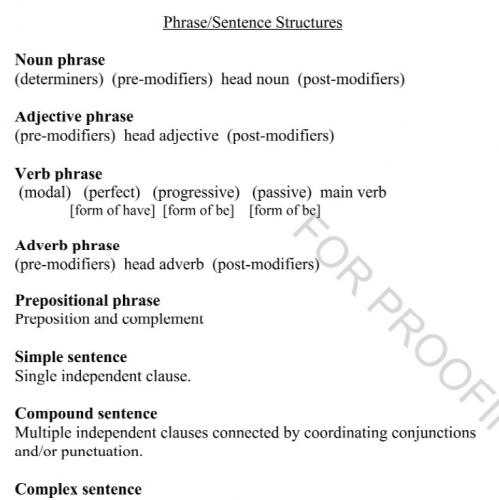
I think I am asking for a format similar to a ‘list’ which covers not only the actual rule but also the explanation, and an example which would make it easier for me to identify content in examination conditions which then requires interpretation. My concern is not only the volume of work but the fear of missing out the obvious. I will be able to ‘understand’ what the content is and not merely just recite the info learned.
I am at the wrong side of 40 and finding ‘rote’ learning incredibly difficult. At this juncture I feel I need to try other methods. I did want to do more memory training before entering this course but unfortunately it did not work out that way and now just starting to feel the pressure a tad.
Directive sentences for instance:
R - Requesting - ‘Open the door , please.’
A - Advising - ‘Go to bed’.
P - Pleading - ‘Do not do it’.
E - Expressing good wishes - ‘have a good one today’.
W - Warning - ‘Be careful of that whole in the floor’.
I - Inviting - ‘Come round to my house for supper’.
C - Commanding - ‘Stand over there’.
The verb is in its basic form , with no endings and usually no subject element
‘RAPEWIC’
Exceptions:
These allow a subject with a strong stress
You stay there! Everyone run!
Then there are the ones beginning with ‘let’ followed by a subject:
Let him run away.
Then the ones which begin with do/don’t:
Do put that in the box – Don’t cry.
The above is just part of this small section- there are other parts- Including Exclamations/statements/questions etc.
Figures of speech - similies- metonyms-- the list just seems to go on and yes, the verbs (auxiliary/finite/non finite/active/passive etc)
Thank you very much for responding to my query. I apologise for providing insufficient detail which is one of the reasons why I need to be doing this ‘A’ Level.[/QUOTE]
Oh, you’re doing an A Level are you? Is it the English Language one?
[QUOTE]
I will try and keep it as brief as possible.
I think I am asking for a format similar to a ‘list’ which covers not only the actual rule but also the explanation, and an example which would make it easier for me to identify content in examination conditions which then requires interpretation. My concern is not only the volume of work but the fear of missing out the obvious. I will be able to ‘understand’ what the content is and not merely just recite the info learned.[/QUOTE]
Fortunately, there’s not much to understand in English for a native speaker. We know all the basic rules of grammar that a foreign learner would be taught, and every other rule we don’t follow is a very nuanced one that is more or less “It’s this way just because it is.”
[QUOTE]
I am at the wrong side of 40 and finding ‘rote’ learning incredibly difficult. At this juncture I feel I need to try other methods. I did want to do more memory training before entering this course but unfortunately it did not work out that way and now just starting to feel the pressure a tad.[/QUOTE]
You should have come to us sooner! There’s no such thing as being too old to start training your memory, after all, Dominic O’Brien was in his late 30s when he began training his, and he went on to become 8 time world champion.
You’re certainly nowhere near the oldest person on this forum, either!
[QUOTE]
Directive sentences for instance:
R - Requesting - ‘Open the door , please.’
A - Advising - ‘Go to bed’.
P - Pleading - ‘Do not do it’.
E - Expressing good wishes - ‘have a good one today’.
W - Warning - ‘Be careful of that whole in the floor’.
I - Inviting - ‘Come round to my house for supper’.
C - Commanding - ‘Stand over there’.
The verb is in its basic form , with no endings and usually no subject element
‘RAPEWIC’
Exceptions:
These allow a subject with a strong stress
You stay there! Everyone run!
Then there are the ones beginning with ‘let’ followed by a subject:
Let him run away.
Then the ones which begin with do/don’t:
Do put that in the box – Don’t cry.[/QUOTE]
With directive sentences, I’m fairly certain that in most cases what type of directive is obvious to the person. As long as you remember that RAPEWIC acronym, you’ll be good.
Although, I would say that “Go to bed!” is an imperative (commanding), rather an an advising directive sentence.
If you’re having trouble remembering what the letters stand for, and their examples, this is the picture I’m getting in my head when I try to create one:
The acronym RAPEWIC is already in my head now, just from repetition, but if not, I’d go down the morbid route and imagine a rapist Wiccan. Rapewic.
Then for each individual letter: requesting, imagine someone looking at you, pointing at the door and making a motion of pulling the door towards them while they say; “open the door, please”.
Advising, have someone looking kind while pointing to bed; “you should go to bed”.
Pleading, someone with their hands together like they’re praying, but they’re on their knees begging you to not do something; “do not do it”.
Expressing good wishes, you shouldn’t need an example for this one, but imagine someone walking past you, smiling, and they tip their hat to you and say “have a nice day”.
Warning, imagine someone dresses in black and yellow and they’re warning you: “be careful of that hole in the floor”.
Inviting, imagine someone motioning you towards them with a dinner plate on their other hand; “come over to my house for supper”
Commanding, someone looking demanding, stamping their foot and saying “stand over there!”
What image you create really depends on what it is you’re trying to memorise. You might find one kind of thing is better for you to represent another. Although you’ll find auxiliary verbs really easy to identify, I like to remember that auxiliary means the same thing as “extra help”, so an auxiliary verb is a verb whose literal meaning doesn’t fit the sentence and is simply there to lend the reader help in understand the tense, i.e. I have done, have is the auxiliary verb. The actual verb is done, and have just informs the reader on the tense - the present perfect simple tense.
I’m a big believer that grammar is something that should be learned by rote (unless it’s particularly weird!), but when it comes to the nuances, like what radi wants to learn for the most part, I don’t think there’s anything wrong with using mnemonics a bit.
Thanks again for your comments and the examples you gave above. Regarding the examples above, I think what I have concluded is to try and alter the information given in text books to a level that I can not only understand but also enable me to make up images easier. The English language hopefully will allow me to go along this line initially.
In response to Hype’s comment, I am currently doing the English Language ‘B’ ‘A’ level and this is the first examinable course I have done in about 20 years, so finding it quite challenging!!
Because as part of the course you need to examine and compare a number of texts in a number of different areas with an obvious time limit, I believe I need an almost foolproof way of going about this and will continue along this vein to find a satisfactory answer for me, hence the mention of following some form of list.
I think a combination or learning ie image based and rote will be the way forward, however the rote learning I have been doing so far has just been passive reading and I feel that this has not achieved very much. I know this is one of the most inefficient ways, so my final question at this stage would be how do you both go about rote learning? Do you physically write out the information/passive read or a combination of both or some other method.
This will be why the rote learning isn’t working. Passive reading is by far the worst way to learn. When I’m working from a textbook, if I have the time what I’ll do is read a page over (or over the page if that’s where it takes me for the next logical stopping point), then go back and go through it again, picking out the key points and summarising them - physically writing them down. There has to be an active processing of the material to make it stick for you. Hence why simply reading, or watching a video, are the worst ways to learn as it’s very easy to slip into the passive mentality where you don’t process the information.
One thing I’ll do while reading up, but not wanting to summarise, is I’ll create an image of what’s going on. I don’t use any techniques to memorise this image, the creation of it is just strong enough to make me understand. For example, in free radical substitution reactions for alkanes, I create an animation in my head of what’s going on. We’ve got a discrete molecule like bromine in an alkane solution, we apply UV light to this solution and this causes the bromine molecules to undergo homolytic fission, creating two bromine radicals. Excess UV light helps to break the methyl bond in an alkane group, and the extremely electrophilic/nucleophilic nature of the radicals created causes various different reactions to be undergone by a combination of all possible pairings.
To you, if you’re a non-scientist, a lot of that will be gobbledygook. But to me, I understand it because each piece of jargon I have an attached meaning to, it represents a quality that I can attach/include in the image. I can see everything happening because I know what the words mean, and the fact that I can see what’s happening in my head and then EXPLAIN what’s happening is confirmation that I understand the information. It’s this kind of process that shows an active processing of information.
I am in the process of trying to summarise part of the course and will look again at your ‘words of wisdom’. I will persevere with building the ‘images’ but in addition make adjustments to the ‘rote’ learning which I am struggling with.
I will no doubt be back in touch and can only hope you pair are still replying to emails.
Hi
I 'm strongly agree with Radi, and interested in using mnemonics in teaching grammar. I’m searching for different mnemonic techniques to use in teaching grammar. So please I need your help.
dr heba