A correction, useful for this forum and topic: at 6 months Retossy finished Heisig I. He never started Heisig II because he preferred to continue learning kanji by reading native material.
3 Likes
I skimmed the above topics. And I come up with a tip for those who are learning chinese characters.
There is a article describing Chinese language very well. www.md.nkust.edu.tw/images/upload/files/class/20191217_1.pdf Unfortunately there is no translation copy. You might try to understand it by Google Translation.
Let me simply summarise the writer’s opinions
- Chinese characters can combine into many words and phrases. Though people don’t fully understand the words, they know the general idea.
- Chinese character is a complex conjugation, because of this Chinese sentence can be read faster than English and think idea in Chinese “might be” quicker than English.
- Chinese characters are bounded into a square, visually appealing and no reading direction problem. directional problem example, pop upsidedown is bob.
- ideas omitted…
I am not praising how good Chinese character is, the meaning of above contents, I wish you can discover more about Chinese characters, by raising your interest and learning styles of a language, you can prolong your learning journey and accomplish a higher level in Chinese language.
I am getting to background and observing you Future Stars.
Wish all learners success! 
3 Likes
Looks like in Chinese you have multiple readings too.
It’s a little video, can’t upload it, so a couple of screenshots.
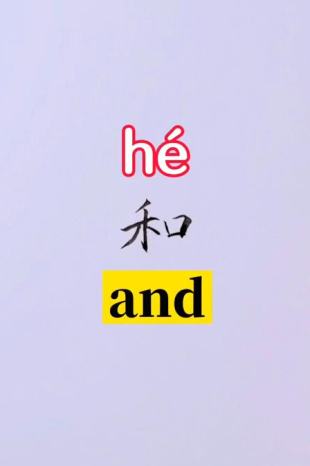
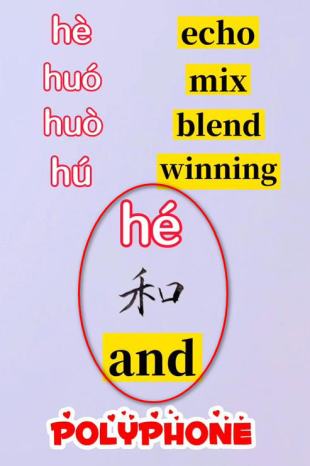
OK. back to the main topic.

1 Like
Of course you have polyphones in Chinese as well; they’re called duo yin zi but that’s not even close to how it works in Japanese. In Japanese, every single kanji has at least two readings. For Chinese, we’re talking about 10% or maybe a little more depending on the corpus you use.
To make this easier for English speakers… it’s like minute which you can use as either a noun (60 seconds) or an adjective (very small). Another example would be content meaning either contained inside (noun) or happy (adjective).
Now, I would have considered those to be exceptions, but if you think that Chinese has multiple readings too… as a rule rather than an exception; then I don’t even know what we’re talking about. You initially said…
…but now you’re telling me that’s not true for Chinese either, so what exactly is your point? I was saying that Japanese, as a rule, has at least two reading for every single kanji… but what is it that you are trying to tell me?
Well, I think this is part of the main topic… let’s look at a couple:
好
hao3 means good. It’s one of the first things that people learn because Hello is 你好 (literally “you good”). Alternatively, as hao4 it becomes a verb meaning “to like” and curious for example would be 好奇 using the 4th tone instead of the 3rd tone.
和
he2 (from your screenshot above) usually means and and is obviously also beginners vocabulary. As he4 is means to join s.b. in doing s.th. and as huo3 it’s to mix/blend s.th. with or into s.th.
行
xing2 can be ok or as 不行 not okay. Alternatively, it becomes hang2 when used as a measure word, so if you got a row of trees 一行树
Now, if you ask me good/like are not very different as a concept. Similarly, and/join/mix isn’t really that different a concept. Measure words are funny in English as well: flock of birds, school of fish, etc. All in all, I don’t really think that Chinese polyphones have anything in common with the different readings of the same character in Japanese.
Now, before you run out to google again to show me that different tones can change the meaning to a point that you can insult people or you find a little poem with all “shi” in different tones… let me just add my reply to that in advance… tone shifts are actually quite normal… let me continue from the above…
不行
bu4 by itself is the 4th tone and usually remains 4th unless it is followed by another 4th tone as in 不是 in which case it becomes bu2 instead. It could also be a neutral tone in the set phrase 对不起 (I am sorry).
@Liam, @Antelex feel free to add or correct any of the above and maybe the percentage of characters that you think it is that this happens.
@LynneKelly if I understand correctly, you’re in your thirds semester of Chinese now? Maybe you can tell us from a learners perspective if this is something that you run into all the time, have seen as an exception before, or didn’t even notice yet.
Anyways, I hope this is useful to somebody… I get the feeling that @vector was just going for his mic drop meme here because this supports the opposite of the point he was making initially in his comment at the beginning.
4 Likes
No, I just said “back to the main topic” and “talk amongst yourselves” since I wouldn’t be making another comment.
And I’m not even learning Chinese, I just wanted to know, if all Chinese variants use the same “writing” with different readings… since it’s not read phonetically, it’s possible.
But thank you, you just made me win a bet. it’s not much, you can get around 5 cokes (using it as a Big Mac index, since there are no Big Mac’s around here).
2 Likes
Sorry, I have lost track of the debate and don’t know what the ‘this’ is that I am running into, see as an exception or haven’t noticed. I am familiar with all the Chinese examples, know nothing of Japanese, although I hope to in the future. I am not sure what the actual issue is. I am really short of time at the moment, so can’t go back over the whole debate and try and work it out.
Sorry! I am no use at this point.
So, the answer of your question is “yes* or” no", depending on how you define the terms.
If it is about a bet, you both won.
Qué tengas un buen fin de semana.
2 Likes
Hi all,
Some great discussion in this thread above. I will continue a few remarks on my approach and resources I’ve used in case they are helpful to others.
My approach to learning Mandarin (Putonghua), is best described as “haphazard”. And I have become comfortable with this approach, because it meets my goals. And I think this is the most important point I could contribute: The reason you are learning Chinese (in any of its forms) should drive your engagement with the language and the approach used.
Learning Chinese to read Tang poetry is different from wanting to understand Chinese investment in AI and still different from only wanting to have a casual conversation and order a bowl of noodles.
I previously offered a few resource recommendations here.
Additionally, I’d recommend the You Can Learn Chinese podcast, from the team at Mandarin Companion. Perhaps start with episode 13 on Paul Nation’s “Four Strands” of language learning. The Mandarin Companion readers are good as well.
The Chinese Grammar Wiki is a terrific resource when needing plain language explanations of complicated grammar points.
The r/ChineseLanguage subreddit is often hit or miss, but has some excellent contributions such as this post detailing the author’s journey to HSK 5 in 15 months.
It’s easy for me to get over-engaged and lost in the technical minutiae of optimal methods to encode and decode semantic and phonetic character components. I now try to resist that approach and almost only engage in methods that I find engaging and/or fun. Often that means taking a long walk while listening/responding to Pimsleur recordings or listening to Chinese language podcasts (even if I only understand a small fraction of what is discussed).
Finally, I would recommend having several private tutoring sessions on iTalki or other platform. These can be surprisingly cost effective compared to formal group classes. Find a tutor who will help you engage with what you would like to learn.
Your results may vary!
Bjorn
4 Likes
You write beautifully! The courses I have done emphasise vocabulary and speaking but my fascination is with the characters. We are getting there, and I think both of those are valuable. But I think you are absolutely right and I should focus on what really intrigues me which is the script.
Thank you for all the resource tips. I can’t wait to get into them.
Lynne
1 Like
I have an Italki tutor. We don’t meet often. During our meetings we only practice pronunciation. I find it very effective.
1 Like
There are several basic structures for the composition of a Chinese character, such as up and down(吕), left and right(吅), semi-encircled(句) and fully encircled(回), and monogram structures(大).
Usually in a Chinese character, part of the character indicates the pronunciation and part the state(For example, “忍 [ren]Patience and endurance” , which consists of the pronunciation “刃[ren] Knife-edge” plus “心[xin] heart” for the position.). This is because a long time ago, in the wild, many people forgot how to write the complete character, so there were cases where only the half with the pronunciation was written instead of the whole character.
“和 he” is “禾 he” add “口 kou”
“如 ru” is composed of “汝 ru” and “口kou”, with “汝 ru” abbreviated to “女 nv”, but the pronunciation remains unchanged.
There are also Chinese characters that are composed of a radical with a meaning plus the main part; these are so often used that there is little chance of forgetting how to write them, and so there is no part of the compositional structure that indicates the pronunciation.
For example, “打 [da]fight” is made up of " 扌(手)[shou] hand " plus “丁[ding]person” .
3 Likes
I am finding learning the characters absolutely fascinating. It is dividing them up into the radicals and other components and making stories out of that combination which is such fun. Eventually, the whole character is familiar and the story is redundant.
When I started copying the characters without understanding the components, it was quite confusing and almost impossible to remember. Now that I recognise the components as you describe, it is so much easier to write the characters. I am only at the early stages of this journey, but loving it. What a fascinating language!
2 Likes
Almost all the monograms in Chinese characters are transformed from images (nouns), and there are 280 such characters in total. The appearance of the radicals can perhaps be seen as the verbalisation of nouns in English.
You can search for “独体字” to find some of the original and most core Chinese characters.
1 Like
There’s the logical way to approach learning to read Chinese: learn to speak it first, then learn it by writing…
then there’s the passion of the mnemonisist.
This thread is firing up my passion for it again where I live in China, and yet I’m more interested in the characters!
The characters have a phonetic component, so that it makes more sense to learn one of the dialects first. Very few people have learnt to read Chinese without speaking it. But it has been done, and what a great mnemonic project.
The last time I tried this, I went through Remembering the Hanzi and got 100 characters, but the way it works, I didn’t find anything usable from that stage in daily life.
So, I’m thinking about learning words from their components that I can actually use instead. For example, words from online shopping.
2 Likes
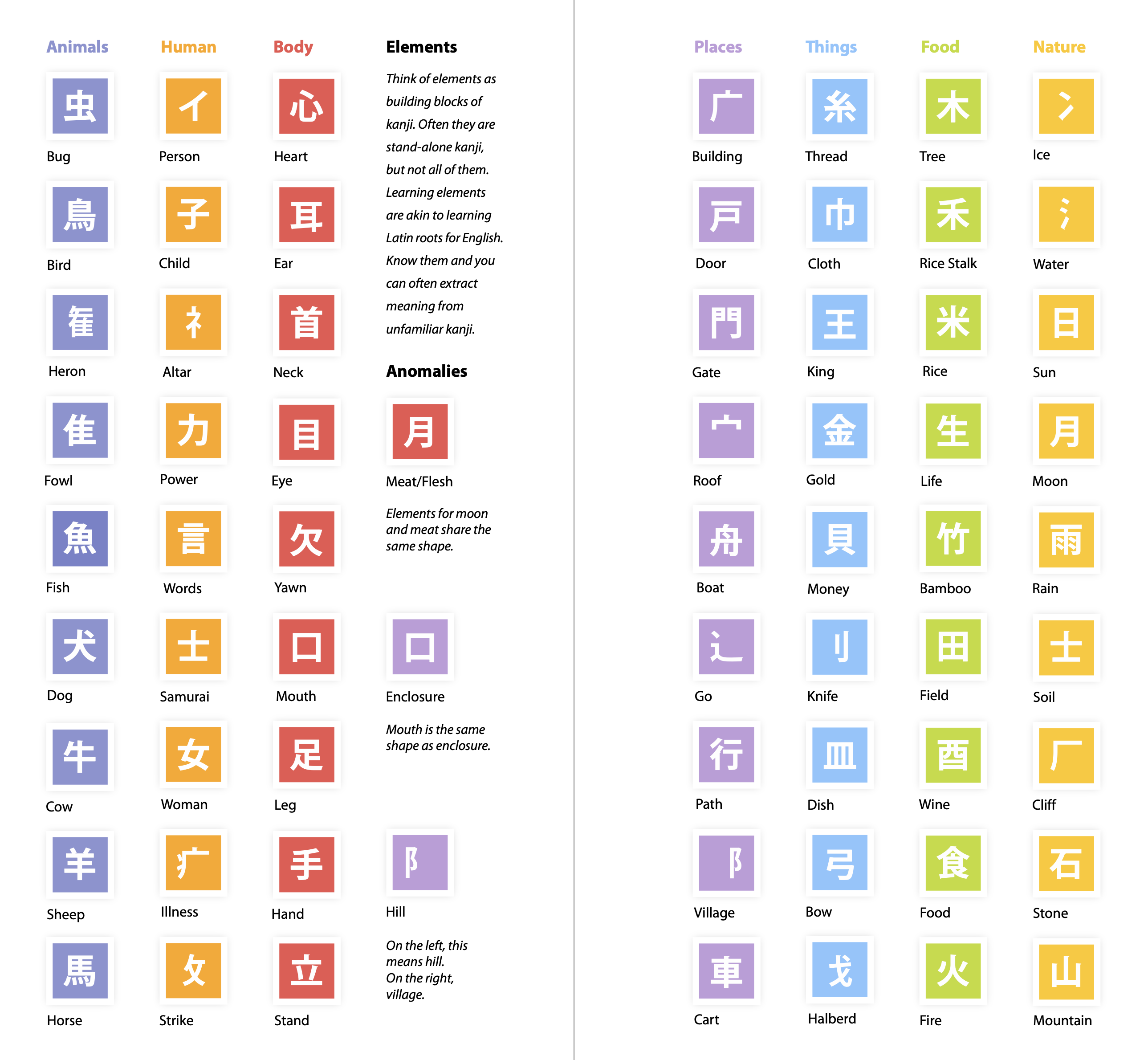
I made this shortened list of the most common radicals organized by concepts for Japanese kanji (which should work for non-simplified Chinese).
4 Likes
Intersting, thank you. I want to add in the Kanji characters and attempt Japanese too when I have Chinese more under control - a fair way to go yet! I am doing simplified, but I know all these radicals.
Now that I am further into learning Chinese, I am finding learning the characters is becoming easier as I know the components well now. I have a mnemonic image/story element for each of them, so I can form stories pretty quickly. Plus so much vocabulary comes from logical, or amusing, combinations of characters. The language, art and history just fascinate me more and more the more I learn.
4 Likes
Chinese is really considered one of the most difficult languages in the world, and honestly I have no idea how some people manage to learn Chinese in 3 months at the native speaker level when some indigenous people study it throughout their lives.
Hi Lynne,
I am also interested in using memory techniques to learn Chinese characters, but just beginning - I joined the forum to ask about it. I am most interested in finding ways to use the character itself as a hook for the pinyin and/or meaning. Do you think that your technique (which seems to be pinyin-first) still helps you to read all characters you have ever seen?
Please could you share which you think is the best introduction to radicals? I would like to learn a lot more about radicals, their meanings and origins, for all of them (especially the simplified ones). I hope it will allow me to remember more easily.
Also I would love to see your spreadsheet with the rest of your current mnemonics! Dragon shooting lightning is such a wonderful image.
Instead of building from small parts,
I think it’s better to start by learning words you can actually use immediately.
example:
- recognise the word for “carbon fibre” on Taobao.com
碳纤维
- be able to type the word, via a jyutping keyboard, teaching yourself the pronunciation in the process:
“taan1 si1 muk6”.
The REWARD is getting those juicy cheap deals.
However, being able to write the characters is also a way to remember them…
My technique is not Pinyin first. I try to do both pinyin and characters at the same time because I am linking the pinyin to the location which represents the radical of the first character in the word.
I am writing up the full system, but it will take me a while, as I have a book to finish first with very tight deadlines.
For the radicals, I use:
But I also put the very common ones, often on the left hand side in that table, at the start of the memory palace. So I have the two common versions of person (rén) and heart (xīn), for example, in separately. Each version has its own location. Also speech (yán) is up at number 162, when the Simplified version is really simple. I have it near the start of my palace. I adapted as I went. Just leave room and start and spread it out - you’ll soon learn what needs more space. It is why I only use one side of the road, then I can expand to the other. The mouth radical (kou - can’t find a way to do third tone) now takes up a lot of the space on the other side of the road to the house it is attached to!).
I use MDBG to check each word, because it gives the radical and breaks down the components - not always accurately though)
I use Chinese Dictionary: Practice Writing & Character Memorization by Inputting English, Pinyin, Or Chinese! if I need a cross check.
I was highly influenced by:
As for the spreadsheet, it isn’t finalised and I don’t want to put it out publicly yet. PM me and I’ll attach it.
Plus I use other stuff. It has all merged a bit now that I have been doing Chinese for a while. And I am adding in techniques because of my research on the genetic underpinning of memory systems, but that is the theme of the new book, and takes too much to explain!
I put a lot of work into the radicals at the start and it has paid off in spades.
Lynne