I’ve been listening to the audiobook of Moonwalking with Einstein recently and that’s re-scratched the itch to get back into memory techniques despite how busy things have been.
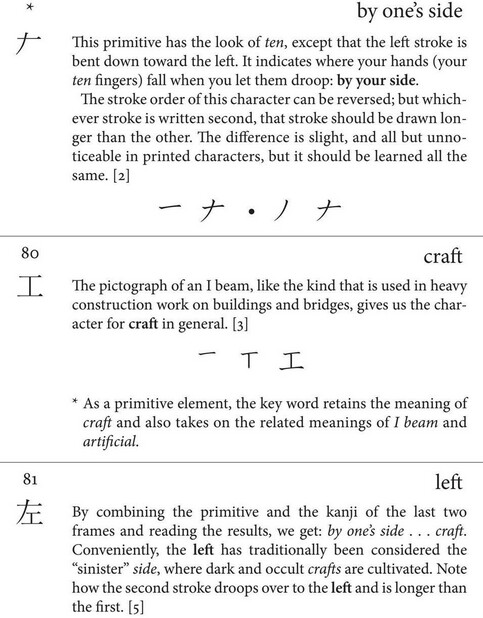
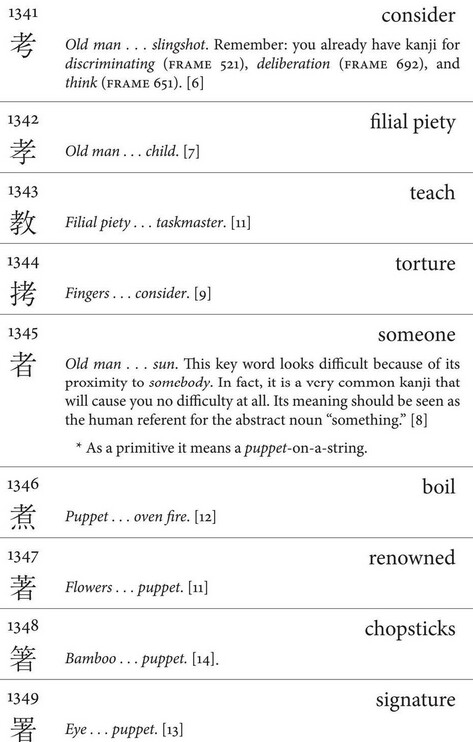
Remembering the Kanji (Volume 1) takes the most commonly used 2200 Japanese Kanji and gives them an English meaning/interpretation, building the link by utilising the kanji’s radicals and turning it into a mnemonic. I tried this a few years ago with a semi-contrived memory system, and while I did manage to get to 500+ kanji, the wheels started to come off a bit in the method.
Though RTK’s efficacy is disputed compared to other methods, I think the overall point of having any learning method which makes you stick to something far supersedes the overall efficiencies of individual methods. And as this is incredibly mnemonic-heavy, whilst also a great primer for me to be able to disseminate and memorise individual kanji('s provided meanings) when eventually learning vocabulary + reading(s) in the future, this feels far more interesting to me.
I’m not entirely sure how I can best approach this with memory techniques, however. I don’t really think a memory palace suits the task of memorising 2200 individual symbols? As much as I’d like to have them in a list format, considering many are lumped sequentially due to their similar characteristics, I’m not sure if that’d do so well.
But I’m going to give myself a bit of time to sit on it, think about what would be the best way to go through these, and then try and learn them all. In all honesty, while I don’t want to overwhelm myself, decent focus could probably get you through the book in very little time. I’m going to aim to finish it in 60-90 days maximum.
My opinion is to start as soon as possible, then adjust and improve. If you wait for it to be perfect, you’ll never start. Just start with what works, and if it starts to fail, find another way.
When I memorized words, I used substitute words, then the visual alphabet, then I expanded that alphabet, then I learned some of Bruno’s methods, then with Fludd, etc. In other words, there will always be different ways of doing things, but it all really depends on creativity. It all comes down to images and places.
I second the idea of just starting with it and adjust as you go.
I tried Heisig for a while and run into some problems, that’s why I modified his system a little bit. I described it in this thread, maybe some elements could be useful: My system for japanese kanji - Language Learning - Art of Memory Forum
edit(add): There is no need for a memory palace, IMO, the mnemonics are enough. But your mileage may vary, I’m interested to know how it goes for you!
I’ve been using Heisig’s books for learning simplified Chinese Hanzi for about 18 months. I only recently realized that using Heisig’s mnemonic stories/images was a terrible idea — If I could start over, I would have leaned much more, much earlier, on striking visual imagery than the dull stories that Heisig offers as examples. (This is blindingly obvious in retrospect, but I am a bit of a dum-dum). I wouldn’t mess with his system of naming the constituent radicals, etc.
For his book on Hanzi, he recommends working through the whole book before starting to actually learn Mandarin — that’s not necessary. I recommend using his Kanji book as a reference alongside your other Japanese materials, and using his system to learn the characters as you encounter them. You may sometimes have to go back and see how a compound radical was built up, but it’s worth it.