Preface: I’m only an amateur at mnemonics, and a beginner in Japanese study. This is less a concrete recommendation or idea, and more so a small observation/thought experiment!
Intro:
An alphabet peg list is a really cool tool to have in your arsenal, but there’s something that’s slightly bothered me about it (in the English alphabet, at least); 26 letters is so close to a solid round number. If it was one letter shorter, and you used several alphabet lists to memorise an order, it would work so nicely, in my head.
It probably isn’t that difficult to just exclude the letter X, and remember that Y & Z would be 24th and 25th in this altered alphabet list, but I think that’d lead me to tripping up over myself, or second-guessing for recall. So, I thought about what other languages could fit a peg list well, and my very shallow knowledge of Japanese made me curious.
Japan’s Alphabet (Kana) system (bold & italicised readings indicate exceptions to the formula):
| KANA | -a | -i | -u | -e | -o |
|---|---|---|---|---|---|
| No prefix | あ (a) | い (i) | う (u) | え (e) | お (o) |
| K | か (ka) | き (ki) | く (ku) | け (ke) | こ (ko) |
| S | さ (sa) | し (shi) | す (su) | せ (se) | そ (a) |
| T | た (ta) | ち (chi) | つ (tsu) | て (te) | と (to) |
| N | な (na) | に (ni) | ぬ (nu) | ね (ne) | の (no) |
| H | は (ha) | ひ (hi) | ふ (fu) | へ (he) | ほ (ho) |
| M | ま (ma) | み (mi) | む (mu) | め (me) | も (mo) |
| Y | や (ya) | - | ゆ (yu) | - | よ (yo) |
| R | ら (ra) | り (ri) | る (ru) | れ (re) | ろ (ro) |
| W | わ (wa) | - | - | - | を (wo) |
There’s a total of 45 characters in this table, and there’s a few things I really like about this:
1). Implicit order: Likewise to the memory palace tip - to base every fifth spot to a door or window - every sound (up to the Y row, at least) follows a straight forward 5-character-per-row structure. Thus, every spot that ends in 5 or 0 will be an -o kana character. This logic, but for different digit endings, also applies to the other sounds too, which could be really useful for easier recall of position!
2). Rendaku: This is a feature of Japanese, which changes the sound of a Japanese character by including a small symbol called dakuten (゛) to a character.
For example, か is pronounced ka, but が, the same character with the small symbol in the top right, changes the pronunciation to ga. In another instance, て would be pronounced te, whereas で would be pronounced de.
This can compound the total list of characters in a peg list nicely; on top of 5 characters that begin with K, you also could associate 5 additional characters that begin with G, which are just the K characters with the dakuten attached.
Rows K, S & T have 1 set of rendaku, and Row H has 2 sets; both dakuten & the unique handakuten (characters は、ば、ぱ are ha, ba & pa, respectively), which could add an additional 25 characters altogether.
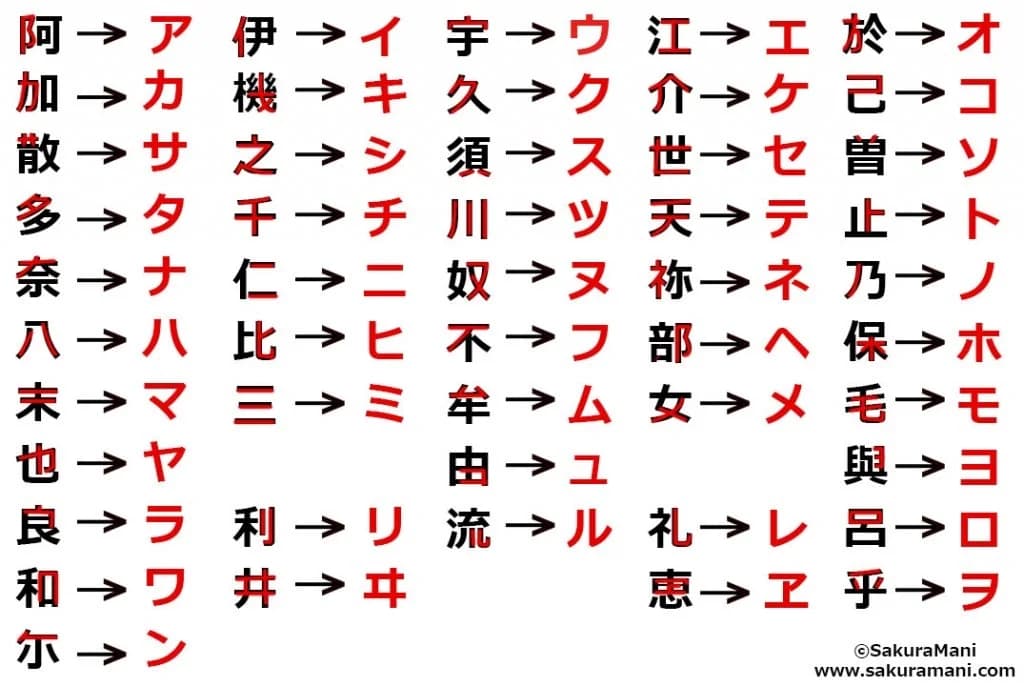
3). Hiragana & Katakana: I’m not doing Japanese orthography justice, but roughly speaking, hiragana is Japanese for native words, and Katakana is Japanese for foreign words they don’t have a word for in native Japanese.
Telephone in Japanese is denwa and is written in hiragana. Computer, on the other hand, is konpyūtā, and is both written in Katakana & sounds very similar to its English pronunciation.
I think having both an alphabet peg list of hiragana words, and a separate list for katakana, would compliment each other nicely, whilst also giving you double the list of words (as in, you go through a hiragana peg list, and then follow it on with a katakana peg list - similar to stacking multiple peg lists).
Problem & Solution:
The issue comes when you get the Y set of characters, it throws off the formula for the characters previous to it and can make it confusing from then on. However, considering this list and order isn’t burnt into my mind like the alphabet is, it makes it easier as a non-native speaker to adjust the alphabet to my own liking.
Taking out the Y and W rows would still leave 40 characters, as well as keep an incredibly rigid and reliable set structure; if I included the possible rakuten, that would bolster the numbers to 65 characters in a single alphabet peg list.
In practice:
I’ve been trying to put together a list, but work has taken priority. Still, I was able to get started on the initial 10:
A: ame (rain)
I: inu (dog)
U: ushi (cow)
E: enpitsu (pencil)
O: okane (money)
KA: kazan (volcano)
KI: ki (tree)
KU: kuruma (car)
KE: kekkon (wedding)
KO: koori (ice)
I think it would definitely help to have more vibrant and interesting words than some of what I’ve got, but it’s not been too difficult to retain the order, and I think if (BIG if) I’m able to stick to studying, I’d be able to not only put together a full peg list, but also take from more interesting resources than beginner Japanese vocabulary. such as from Japanese mythology.
Still, it’s been a fun small project to do on the side of learning! I’m curious how other languages can compare for a peg list, as well as how they interact with more systems, like the major system.