Is Aphantasia a Memory Disorder?

For people interested in aphantasia :

Congenital aphantasia is considered the inability to consciously generate visual imagery. Although there are early descriptions of this disorder going back to Aristotle, it was not formally described in the scientific literature until 2015. Aphantasia affects around 4 percent of the population, with those affected reporting either a greatly diminished or total inability to bring to mind mental images (while awake). Half of people with aphantasia report a diminished ability to imagine information from other senses as well. They cannot, for example, generate the sound of a song in their mind, or mentally conjure the smell of a rose. Because other sensory modalities are affected, some researchers argue that aphantasia might not be a visual imagery disorder at all. It might be a memory disorder.

4 Likes

Question, before reading the paper that you share. How is aphantasia evaluated quantitatively? Is there some clear boundary, where someone “has” aphantasia, or is it somewhat more of a continuum, and what are the criteria to decide that 4 percent mentioned? I guess that “those affected reporting either a greatly diminished or total inability to bring to mind mental images (while awake)” answers this. So, self reported. On the basis of what kind of interview tool? I guess I should look at the paper :slight_smile:

1 Like

I share your reservation regarding the 4% statement and the problem with self reporting . I have made similar comments in another aphantasia topic: New Neuroscience Article on Aphantasia.

1 Like

The main question of whether aphantasia is a memory problem or a visual problem suggests that both problems are mutially exclusive and in my opinion this is not demonstrated in the article. The question, dare I say, feels not much more then empty semantics. Defining something as a … problem also becomes very confusing when you don’t make it clear if you are referring to the cause or the effect of something.

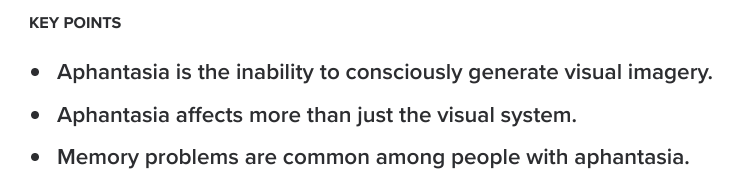
Key points analysis:

The meaning of the word aphantasia in the article is also confusing as it is used in multiple ways. In the first sentence in the below picture it is defined as nothing more then an inability. This definition says nothing of the underlying cause(s) of that inability. But in the 2nd sentence it is used as a name for the cause of this inability and other inabilities.

The last sentence is interesting as in the New Neuroscience Article on Aphantasia basically the opposite is claimed:

While aphantasics accurately perceive elements of reality and show no deficits in memory or language processing.

If 2 studies report fundamentally different conclusions regarding the same topic as appears to be the case above, it raises the question in my view how much trust one should give to any similar scientific study and whether there is a better way to do research on similar topics.

Some in my view more confusing parts of the article:

Half of people with aphantasia report a diminished ability to imagine information from other senses as well.

The more I look at this sentence, the more questions it raises. If only 4% of the population has aphantasia, it would be reasonable to assume that they have specifically asked people with this condition to take part in the investigation. This raises the question if the people they end up with are representative of the full spectrum of the alledged 4%. I would expect that the extreme cases would be over-represented as they are more likely to be aware of their condition. Based on a possible standard normal distribution of abilities, it is reasonable to assume that half the population has diminished abilities of any kind. The reported inabilities all seem quite vague in terms of severity.

And then it continues:

They cannot, for example, generate the sound of a song in their mind, or mentally conjure the smell of a rose.

Are they suggesting that half the people with aphantasia cannot do the above things at all or only some of them? I don’t understand what is actually being claimed here. And what about the people that do not report that they have aphantasia, how many of them report not being able to mentally conjure the smell of a rose?

My overall view of studies like this one is that the data that comes out of it is so vague and unreliable and the terminology is used in such a flexible way that I don’t see how this leads to any kind of foundation that would be helpfulll for further research.

I’m looking foreward to anyone with a different (or similar) view on the matter.

Can be diagnosed via MRI, and a simple eye dilation test. Take 1 person with it, 1 person without. Ask them to both imagine it’s dark, and also light. The persons eyes without it will dilate according to what they imagine, the person who had aphantasia will show little to no dilation at all.

I am curious as to why you think that this is indeed the case.

I can imagine that people with aphantasia will have a change in eye dilatation when they imagine it to be dark or light without actually seeing anything in their imagination that looks like that; it may be simply that the idea of brightness/darkness may trigger changes in eye dilatation.

In the article Windows to the Soul: Pupils Reveal ‘Aphantasia’ – The Absence of Visual Imagination - Neuroscience News your statement is contradicted when it says:

While the pupils of those with aphantasia showed no difference when imagining light versus dark objects, they did show a difference imagining one versus four objects, suggesting more mental effort, thereby negating an explanation of non-participation by aphantasic individuals.

So they only used eye dilatation as a way of measuring mental effort regarding imagening images. I would like to add that even this method is problemetic since the aphantasia persons in the study have self reported their condition. So we are possibly dealing with a condition that is partially a matter of believe of having low level of ability. If you are asked to do something that you believe is difficult for you, you may show more mental effort.

In a recent study, aphantasics reported more difficulties in recalling autobiographical memory, were less confident about their memories, and described less internal and emotional details than controls.

https://elifesciences.org/reviewed-preprints/94916v1

I’ve been challenging this “disorder” since the day it started acting like an egregore of times yore.

1 Like

I aim for a state of uninformed-ness on the subject as to avoid disagreeing with people.

Idiot privilege is a thing, and I’m not giving it up without a fight.

But that’s not why I’m commenting.

I’m commenting to commemorate today being the day I spent 15 minutes reading about the word egregore.

Most of that time looking between the pronunciation and the IPA.

Thank you, fine thread. Thank you.

Cheers and regards, :clinking_glasses:,
Beau

3 Likes