I want to learn the periodic table only visualizing things in my head.
All techniques are fair game (memory palace, PAO, story method, linking, etc.), but I am not allowed to take any notes (paper or screen).
Why am I doing this:
One of the reasons I use memory techniques is that I want to learn more things to be able to use them without always having to look at references (to be able to discuss with others, to be able to think and make links between different pieces of knowledge, etc.). Only what you memorized/internalized is truly yours!
But, since I (more or less) centralize everything in anki (easier to review all subjects in one place), I sometimes still feel very much bound to a screen and wanted a project to detach me from that a bit.
I want to train myself to use memory techniques in different ways, to be able to use them more spontaneously, to get rid of the feeling “oh this is so interesting, I should take a note to learn it later, otherwise I’ll forget.”
Also spontaneously, because I tend to be a perfectionist and spend too much time preparing / planning before actually starting to learn (and then my plans needs to be adapted anyways, because reality is different from what I expected). So I figured no notes = no complicated plans, quicker start.
Learning the periodic table should give me a “skeleton” of knowledge to which I will be able to attach things later, if I choose to continue to learn more about chemistry.
Honestly I don’t care about the periodic table all that much (even though it’s interesting), but it’s a very well organized body of knowledge, so I figured it would makes it easier to try it out, because all the work of structuring the information has already been done for me. (The periodic table is practically a memory palace already).
I’ve decided to learn the atomic number, name and letter(s) of element, one basic characteristic of each element and if it’s gaz/liquid/solid.
Since it feels more logical to learn together the elements that share characteristics, I’m not learning them following the numbers, but learning elements in groups (using the colors provided by the version of the periodic table I’m using): gaz nobles, halogènes, métalloïdes, métaux pauvres, etc.
Gaz = on clouds /in the sky, Liquids = in the sea, Solids = on land.
Atomic number = person from my PAO.
Then I choose one object representing the element (what comes first to mind: fluor = toothpaste, helium = party balloon, etc.) which I’m using to test Mattias Ribbing’s “trick” (keep the object in mind while reading about the subject, makes your brain associate what you read with the object allowing you to remember the informations later).
I’m reading up a bit on the characteristics of the group and choosing a location to place it (not a real place just “an island”, “a mountain”, “a swamp”, etc.). The idea is to associate the characteristics of each group with the location (f. e. noble gases = colorless, odorless, tasteless, nonflammable) and then to put the elements inside it so that I know in which group they are. It’s like imagining a (not very detailed) map of an imaginary country superposed on the periodic table.
Review happens in the shower, while walking, while folding laundry, etc.
After a week:
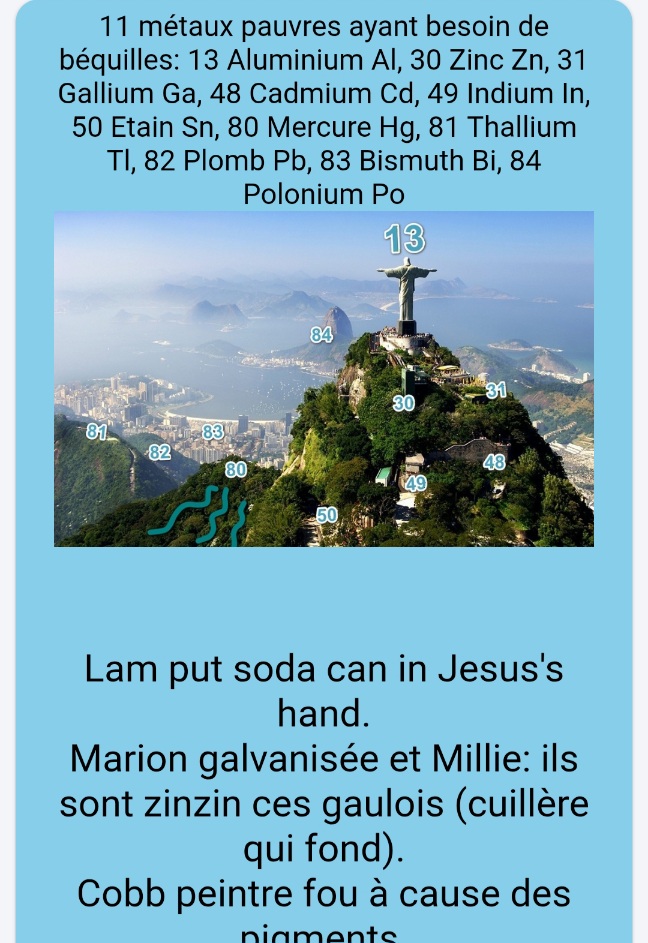
I’ve learnt about 50 elements (although the last group I’ve learnt “les métaux pauvres qui vivent dans la favela à flanc de montagne” doesn’t feel very secure yet).
That I’m not allowed to take notes really helps keeping me focused on what I’ve meant to memorize. I’m much less prone to go down a rabbit hole by reading tons of new interesting informations, since I can’t note anything down. I really need to fix the basics in my head before reading more, because I feel the limits of my working memory quite keenly. Need to build the skeleton, before adding muscles.
Having things in my head only and not being able/tempted to check reference notes (wasting time organizing notes) is a very freeing feeling. I love it.
I’m not sure it’s the most efficient way to learn (time-wise), but it’s really fun.
I don’t feel like I have really tested the “visualise the object while you read” theory, because mostly I’m reading about the elements I don’t really know so that I can choose an object characterising them (but the info already sticks to the person a bit already). So I guess I’ll need to try it out more later. But I want to finish “building my skeleton” (learning until element 95 at least) before doing that.
Yeah one of the goals is to try out several memory techniques so everything is worth a try. I use stories often, but very rarely acrostics.
I also really like the idea of cross memorisation: learning by different groupings (families, columns, groups…) and by different methods… same info different angles so to speak.
On my second attempt it took me a day to learn all 118 (I was familiar with the PT from before).
For me it is important to easily tell the element from atomic number or the other way around, so I chose a peg system. That was a mistake. First, my peg system was not very well developed which was a bit of a problem. However, even with a good peg system I still think that the memory palace would be way superior, as my second attempt, this time using the memory palace technique showed. I knew almost all of the element after the first go.
The failure with a peg system also made me to reject your approach - going by groups of elements, because I assume it would have the same issue.
How I did this: first I prepared the MP with 118 places. I used a route where I go for a walk almost daily. Then I placed the elements on the route. To visualize the particular element I just used whatever association came to mind first, some are the same as yours: toothpaste for fluorine, ballon for helium, etc. E. g. for calcium I used a picture of the huge dentures in the middle of the intersection, as I associate calcium with teeth. For lawrencium I imagine a campel in the parking spot, because of the Lawrence of Arabia :). Others are by the sound of the name or a chemical symbol or whatever. I did not sweat on this part, as long as it is something that helps me remember.
So I have all the elements in the order, but how about remembering the atomic numbers, which I mentioned, are very important for me? I went the usually recommended route - I’ve marked every 5th and 10th places with some specific marker. For me it is a gold star every 5th location and a blue diamond for the every 10th. I chose those, because those just were the symbols I used to mark these locations on my initial list
I intend to add more information about the elements later. As for state - liquid, solid or gas, it is quite easy, as only two elements are liquid at the room temperature, then there are a handfull of gases and the rest are solids.
The one aspect I am not sure yet is how to best deal with groups (noble gases, alkaline, alkaline earth, halogens). I am considering two options - have separate small memory palaces or add some additional features to already existing images. For lanthanides and actinides my system works very well, as those are sequential and you just need to “mark” the start and the end of the series.
Yeah it’s always the question, what do you already know well, that you can attach the new information to easily.
I feel like the atomic numbers are the easiest part, because I spend a good part of last year building a PAO system, so the people (which I use for the atomic numbers) are at the forefront of my mind right now. Putting a group of them in a locus of a memory palace makes sense (telling myself a story why they are a family).
But if I had done this just one year ago, it probably would have been better for me to proceed differently.
Others are by the sound of the name or a chemical symbol or whatever. I did not sweat on this part, as long as it is something that helps me remember.
Yes… That’s the point I always struggle with. I tend to take too much time to think out the perfect mnemonic although I know very well that the first thing that comes to mind is usually the stickiest.
That’s why the “no notes” rule is great for me right now (it stops me from doing endless research, because everything is interesting). It just forces me to go with what I have, which is amply sufficient. In fact I’m thinking about ways to implement it more in other projects.
Also for the reviews, since everything is in my head, and the only reference the printed table I stuck on my fridge, I’m forced to actually try to remember the things and not giving up too quicky and not just flipping a flashcard to see the answer.
And if I don’t remember, I skip it and usually it comes back to memory a while later, it’s like the brain continues looking even if I’m doing something else. It’s quite interesting.
That’s an interesting question (that I asked myself too, because I considered learning the elements sequentially at first like you).
I thought adding a marker would be confusing (the simpler the image for each element the better), so in a way I went the “a memory palace for each family” route. Because I thought a memory journey where the sequence is by number is sort of redundant… Number sequence is already pretty well encoded in everybody’s mind, so no need for a location sequence doing the same. (But that doesn’t mean it isn’t a valid approach, I have other memory palaces with this kind of double encoding… I just wanted to try something different).
Another solution would be simply linking them with a story. For example, for the halogens, Fluor is up on his cloud (it’s a gas), squeezes the toothpaste tube and paste splatters on chlorine which is on a cloud (gas) just under it. Chlorine is startled and lets chlorine pool dispenser fall on the sea underneath, on Bromine who was swimming in the sea (its a liquid), etc.
Interesting, thought about doing it myself, but not nearly as advanced as you
Does the typical structure/ diagram of the table serve as a decent memory palace? I try to find recognisable symbols in the ‘mosaic-like’ layout. Even tried coming up with a cartoon character to represent decimal points in the atomic weights (not sure if it worth the hassle though)
Yeah I do find the structure and colours of the memory table pretty memorable in itself. I guess it depends on how strict your definition of a memory palace is, but for me it’s a type of memory palace.
When I review/recite the elements I see the table in my mind.
I know the blue column on the far right are the noble gases, then the yellow column on their left the halogens, the metalloids in the version I use are olive green forming a W between two dots, etc.
In fact, once I’m finished learning them all, it would be a good test to just rewrite the table from memory. Given how things are logically arranged it feels very doable.
Because I have so many ideas of things to learn and so little time, I have been thinking about how continuing reviewing the elements without actually spending time on it (reviewing it other ways than the “classical” ways, including it in other projects).
For now, I’m doing two things:
Counting with the elements while doing push-ups (instead of 1, 2, 3… I’m saying hydrogen, helium, lithium…)
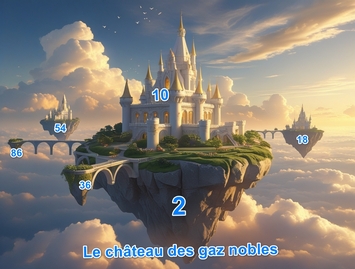
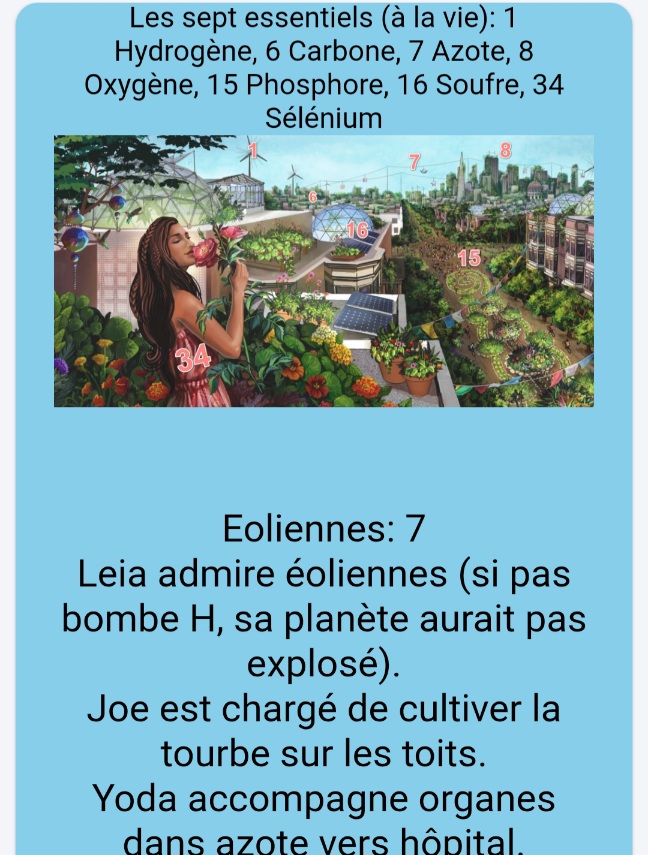
Since I did plan to tinker with AI image generation anyway, I did some exercises by generating loci for the families of elements and portraits of elements
I’m not sure I’m progressing fast in chemistry, but I’m having fun, which is the most important I guess
Small update about the periodic table.
Thanks to @Xadawn who asked about images for memory palaces a while back, I got interested about images as memory palace again and experimented more with it.
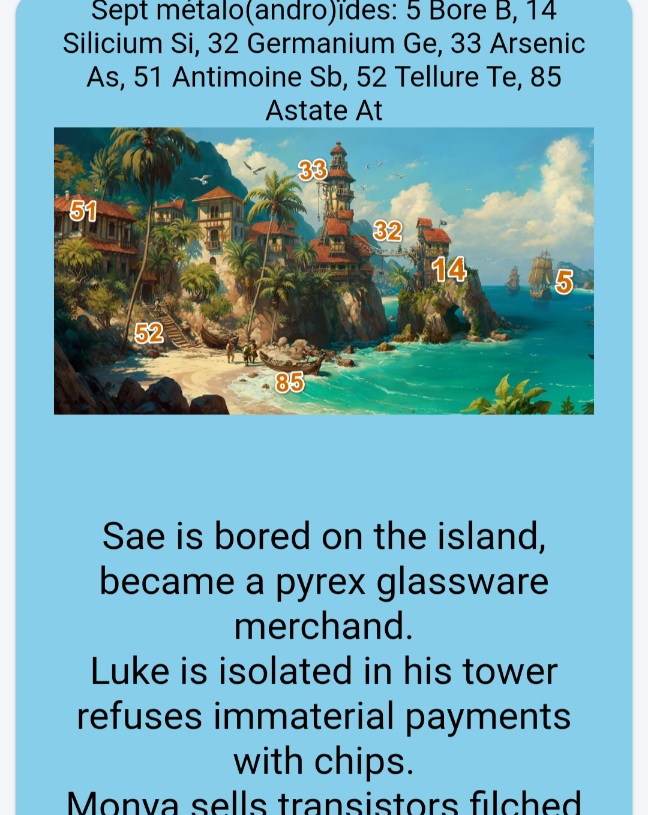
I’m using now one vignette (image) for each “family”.
I use the people from my PAO for the atomic number and their “backstory” for the element and one basic property/usage. I add a detail for the abbreviation if it’s special (like Sn for tin or Hg for mercury).
What I really like is that I can review in different ways:
recite the elements going by atomic numbers 1, 2, 3, etc.
Or review by family: who lives in the cottage in the marshes? 3, 11, 19, 37, 55, 87. Who lives on metalloids island? Etc.
Or ask about an element: what about tin? Sara (50) is holding a tin can with a snail in it (Sn) and she’s living in the favellas of Rio so she’s one of the “poor metal”. – Plus each place has characteristics giving me some properties and usage of the family of elements who live there.
I’m not quite finished because I haven’t made an image for the last family of elements yet (104-118 the non actinide synthetic), they just seem kinda… boring, so I somehow never come around to it (basically elements who don’t seem to have special properties, all very radioactive and desintegrating fast)… If anybody can tell me why they’re interesting I’ll be glad to hear about it
Have you checked this app yet? This is one of my favorite apps I have ever used when it comes to the periodic table. It’s practically gold for those who are really interested in the periodic table.
propertiesproperties
I learned many things from this app, such as atomic number, atomic mass, discovery year, discoverer, valency, and more.
It used to be a pro app, but now they have made it free. That’s awesome.
If anybody can tell me why they’re interesting I’ll be glad to hear about it
I don’t think it’s about being interesting?
104: Rather Ford-ium (Ford is a car)
105: Dumb nymph
106: Sea boring gum
107: Bog rum
108: Hussy sum
109: Maid near rum
110: Darn stadium
110: Rant genome
112: Cop emission
113: Nihon is the Japanese for Japan
114: Flea rave (maybe add ‘yum’ if you need)
115: Moscow (yum)
116: Liver more yum(my)
117: Tennis inn
118: Oh gun lesson
More of a tangent, even reading all you wrote I still don’t fully grasp your motivation behind this approach. Using that link I provided I think it’d make a lot of sense to use a memory palace to just learn this peg-list of 118 items. Then have another memory palace to memorize specific information about the ranges of numbers. For example ranges 21-30, 39-48, 72-80, 104-108 all contain transition metals. It’s one image for transition metals and 4 pairs of images for each range. Just thoughts.
Sure I could have done a peg list and/or a classic sequential memory palace, (I’ve done enough of them to know it would work), but there wasn’t really much interest in that, since I don’t actually NEED to know the chemical elements.
It was never about acquiring the knowledge, but experimenting with new things in a low stakes situation. To try out other ways of doing things.
The periodic table is only a pretext, it could have been anything else. (Although it being an already curated body of knowledge is a huge advantage).
At the very beginning, it was about learning something without writing anything down.
Worked quite well, but then I struggled to remember to review at the right time to not forget things again (part of the problem is that I forgot to review because I don’t actually have a reason to care about the periodic table except for the challenge it represented).
In the second part, I wanted to experiment with several things. Firstly with images:
What makes an image a good memory palace? How many loci are manageable/comfortable on one image? Do I need a “path” in the image or can I use a grid, a geometric shape? What kind of images are best? Photographs, paintings, rough sketches, schematics? What about modernism, surrealism or abstract art? Lots of details or simple? Which kind of composition? Does it work better if I find the image pretty?
once I’m able to define what is a “good” image for me, how do I find more of them? Would it be better to draw them myself to tailor the image with the information? Or is a certain degree of incongruity better? Or maybe I can generate them with AI? Are the images I can generate with AI as satisfying? Does the time invested in using AI worth it compared to simply using images I find on the net?
when I reach a certain number of images, will I need a sort of index to “keep track”?
Second part of the experiment was about encoding several sets of information and compressing it in one image in different ways. Adding components by extending PAO and/or using parallel memory palaces is effective but feels tedious to me (and cognitively demanding because it’s not compression anymore, just keeping adding data on top of an anchor making the images feel cluttered). Effective but not pleasant. That’s why I tried a system where the loci are not only hooks to trigger recall but are themselves encoding information.
Was it the best way to go about it? Part of it is very subjective (memory palaces being pretty may not result in truly significant efficiency gains but it sure makes reviewing more enjoyable for example). And with the perspective of life long learning where I don’t need to respect certain deadlines, pleasantness is more important to me than effectiveness.
Well I find interesting to know about the elements I’m going to encounter again to understand the world around me. To understand the chemicals in the products, cosmetics or food I use. Or in the human body. To understand which one are important for energy transition and why. Or which ones have geopolitical implications. But these super rare expensive radioactive ones? I suppose they may be mentioned if I read about experimental nuclear medicine or something but there is very little chance of that. That’s what I meant by not interesting. I’ll probably learn them for the sake of completeness, but they feel… useless.
 every 5th location and a blue diamond
  for the every 10th. I chose those, because those just were the symbols I used to mark these locations on my initial list