Has anyone here had success improving your visualization skills by practicing art? The art could be drawing, painting, sculpture, digital illustration, etc.
Or are there any other visualization exercises that people have found helpful?
The biggest link I’m aware of between art, and learning to visualize better is actually observation.
Drawing things has you studying them more closely, so the details are intentionally learned for later recall, instead of falling into the vast ocean of things that you recognize.
(Many) artists will practice observation on it’s own, and it’s as simple as it sounds. Make a conscious effort to take in the details of something, treat them as important.
Here’s a simple exercise: Think of a pen you own. Imagine as many details about it as you can, really explore it in your mind. Then take the actual pen and spend a full minute observing it. Change it’s angles, note any little scratches, ridges, seams, the weight, etc. Afterwards set the pen aside and imagine it again, pulling out as many of those details as you can.
If creating art improves visualization, I bet it’s tied to some of the strategies or skills much more strongly than the act of creation. You will find many people say they can draw or paint from reference, but not from imagination. Those who can, typically study and practice perspective, construction, and drawing the same things from different angles. The actual creation process for most people I’ve seen is iterative, working out the idea on paper until it more or less fits what you wanted.
It helps me sometimes to draw or model in some way a mnemonic. Giving concrete shape to the imaginary. Quite regularly I can remember the model I made to cue the mnemonic or sometimes the model is strong enough in my mind to take the place of the original mnemonic.
I particularly like drawing out memory palaces on graph paper. Especially if the memory palace is too fuzzy for my liking.
Taking the Riven Phoenix courses with all its formulas was great for me in many ways. Learning them also provided memory exercise that lends itself to thinking of space and figures in space in new ways.
Going to see art often/looking at art in books/cinema is a win too because the more references you have, the more readily you can assign mnemonics sans invention. One painting I think of a lot for its mini-Memory Palace with a prism possibilities (and sphere implied by the hidden sun) is Raft of the Medusa:
One thing I’ve been doing lately came up in my research: color breathing (as such). It doesn’t have mnemonic outcomes as such, but creates interesting effects during and seemingly after meditation. There are variations of linking color to breathing patterns in many traditions, including colored shapes and the like. Christopher Wallis has a lot of stuff on this.
John Michael Greer (one of Bruno’s translators) has the Sacred Geometry Oracle which I have some stuff coming out around soon. Although I’m agnostic about shapes having any particular meaning, thinking about the proposed meanings as part of the discursive meditation instructions he provides with the cards and the guide is great visual-visualization and conceptual-visualiziation practice. Some of the exercises has proximity aspects to them as well.
I could go on and on… there’s so much wonderful stuff out there when it comes to this topic!
The Benton visual retention test is one that tests peoples retention of simple drawings. You should check it out on Google. The Benton visual retention test is on Wikipedia.
Absolutely.
For me, a step of each memory palace I make is that I make a simple drawing to represent each loci / mnemonic.
This step helps me remember each mnemonic.
It makes for a better, more accurate image than I could possibly get from a web search, and reduces it to the essential elements.
I can make a simple drawing faster than than I can get anything close on the web.
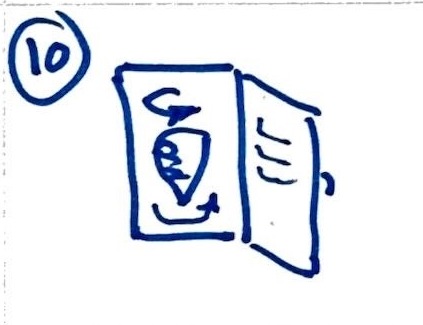
Here is an example— the German word for “Locker” which is “Spind.”
So, my drawing is a locker with a top that “spinned” in it.
Good luck finding that image on Google.
And then I paste this into my Memory Palace key drawing.
My (visual) imagination is fairly good, but has many limits and flaws. When I was trying my hand at art, it didn’t really help any.
My imagination has a lot of limits that are clearly linked to focus, working memory, and short term memory. I can visualize an apple with very strong detail, however those details will shift over time, and not every one can be “seen” at once. The apple might also do things on it’s own, rather then be a perfectly still model. It may transform into something else entirely. Sometimes it’s necessary to stop “looking” at the image for a couple seconds in order to once again visualize an apple.
I can’t even trace the mental apple, trying to hold the image and work on paper at the same time causes the image to break. Then there is the idea that we draw in symbols because we “don’t know what something looks like”, and while there is truth in that, it’s insultingly far from reality.
Got a lot more thoughts on the subject, but for now I’ll just say the links between language, cognition, and memory can, and should be studied through learning to produce art. I have a pet theory that seeing or not seeing mental imagery is just a neat side effect of what happens in our heads. If there is an advantage, perhaps it’s acting as built in bio-feedback.