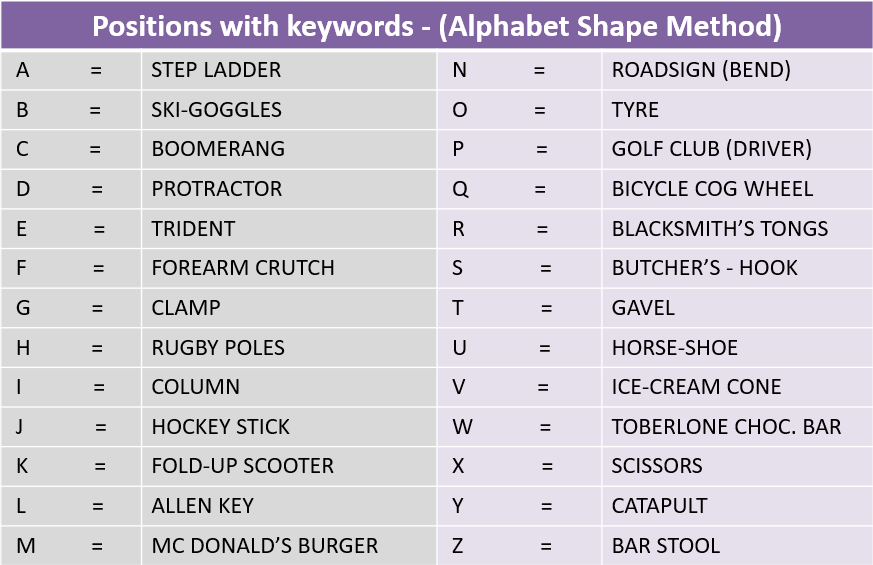
As I have received no answers to this question, I’ll treat it as a rhetorical one. Obviously, there is no correct one way to answer how one may go about the task. That said however, I would consider that in this particular example there would be a method that surpasses all others as a preferred way?
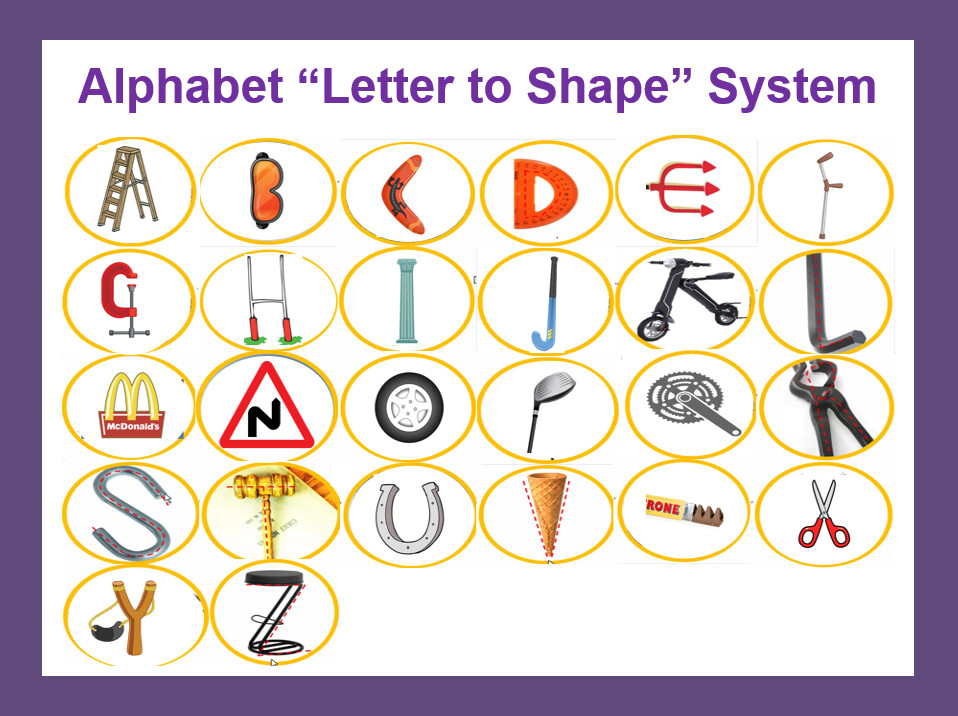
One way of doing it, but still not the simplest. The words in the list that total 26 in number are in fact more easily converted to the shape of the corresponding letter’s assigned in the alphabet, where 1 = A, 2 = B, 3 = C, 4 = D etc. The following images display this. It is effectively “a bestiary of letters to shapes” for each of the sequential letters of the alphabet. The original list was thus not as arbitrary as it may first appeared to have been:
Same, two objects per loci more likely though, seeing how some “words” are more than a word.
Objectively speaking, there is no “simplest” way. If this is your preference and what you consider simplest, good for you. I always use the approach that @TheHumanTim mentioned to memorize words in competitions, so only because on one list that happens to be 26 letters to match the alphabet is not going to change my standard (and to me “simplest”) approach.
Of course not “one-size fits all”. I would hasten to mention that such a contrived pre-conceived list of objects that correspond to their alphabetic counterparts would in all likelihood never be given in a competitive environment. It would appear again that “memory palaces” trumps all else, which I can well understand. If nothing else, I have provided a ready-made bestiary of 26 peg words that translate directly to the letters of the alphabet that one could use as a quick go to “loci” in and of itself?
…so, just saying… it’s neither here nor there. The question of simplest or best is very subjective.
Well, the same applies here… only for people who have them. Others might not have the need for it and stick with peg lists and maybe they only have a single digit number system on top of that. It all depends on the audience.
I suppose, as long as you have memorized which number = which letter. It seems a bit convoluted. The letter to shape system makes sense how you’ve described it. But I feel you’d be better off figuring out shaper images for the numbers themselves rather than going through the double conversion of number to corresponding letter of the alphabet to image. Unless I’m missing the point of the exercise?
Maybe you missed it, but the words are the images. The same could have happened by using major system and 01, 02, etc. being “stew”, “snow”, etc. and then you have images of exactly YOUR major system in the list of words.
So really, unless you learned his exact list of letter-word pairs, it wouldn’t help you in the slightest… I actually only realized after replying, because I thought it was a peg system; not the images (i.e., words) matching his system.
This is very true. It requires measurable metrics to have any sort of comparables. I generally think people mean efficient when they say this. Effectiveness comes through practice. The efficiency metrics I use when doing analysis are the number of conversions required and the number of associations made. In compairing the basic two systems of the story and pegs, the story wins out.
Having a ready to go to list of 100 pegs for double-digit numbers (shaper-system) is a very useful thing in and of itself too, more especially for people who prefer using peg words to a system of ‘loci’ for recall. Interestingly, I have never heard the doyen of ‘memory techniques’ (Harry Lorayne) mention the loci system in any of his authored and co-authored books, so I’m wondering whether he found pegs as opposed to loci to be the more ‘efficient’ method? Of course, this is only speculation on my part, I am quite sure with the vast amount of knowledge that Harry Lorayne had on the topic of memory that he was all too familiar with the concept of ‘journey method’/ (loci system) or Roman Room, whatever one wants to call it? but it still remains a mystery to me, why Lorayne never alluded to it in any of his books? I think perhaps the greater value of the alphabetic visual shaper peg words I’ve alluded to in the list, is that they do provide an easy (note not necessarily ‘easiest’ way), to peg the actual letters of the alphabet to their corresponding alphabet positions. I remember many years ago being subjected to a battery of ‘testing’ for university entrance purposes, where the test contained questions relating to what letters would be next in a sequence of coded letters given and a knowledge of say T was in the 20th position of the alphabet etc. proved very useful in answering such questions. I think these types of selection criteria techniques are similar to what are commonly known as SAT tests in some parts of the world? Obviously, there were far more questions than the transcription of ‘letters to numbers’ type of questions I have alluded to and there was also a limited amount of time given in answering the questions, adding a great deal of pressure to the exercise, but I digress.
By ‘pegging’ the bestiary shaper peg words to their corresponding numbers in the Major System (eg. A = 01 = SuiT to a LADDER) for each of the 26 letters, you would immediately know for instance that ‘T’ is in the 20th position of the alphabet through paired- association. You could of for instance have made a link between (T = Gavel) to (#20 = NoSe). An image of a judge pulling a Gavel out of his NoSe would work well! Of course after a while the actual linking or association would fall away and automatically you would know that T = 20th position in the alphabet without too much difficulty. Using a different method, I think of the “T20 cricket competition” and that solves that particular problem for me. I already know the positions of A-J = positions #1 - #10 and that X, Y and Z hold positions X = 24, Y = 25 and Z= 26. So all in all that’s 14 letters out of 26 letters without any legwork at all. Again, it all comes back to what it is you are setting out to achieve. If one is going to be subjected to similar type university selection testing as I was, knowing your A - Z by numbered positioning would have definitely proved useful.
I find ‘paired-association’ rather than story more efficient but I suppose it really all comes back to is it important that one needs to know the actual position of an item on a list. Say you are given a list of 100 items and are needing to know immediately what item is in position #78. Linking each of the items on the list to a pre-determined peg word system of 100 Major Pegs would get you straight to the answer. By using the story method you wouldn’t immediately know what is in position #78 without rolling out your story. The disadvantage of ‘chaining’ or ‘story-method’ is quite literally they are only as strong as their weakest links
Simplest way for me (if you look at the ‘images’ I put up for each number 1 = A = Step ladder, 2 = B = Ski-googles, 3 = C = Boomerang is to identify the shapes correspond to the positions of A, B, C etc. in the alphabet and you’re home and dry. I can’t see the necessity of needing to link the images in any way to one another. One look at the “Alphabet Shape” images should engrain them onto your memory, so if someone says what is letter O, you would immdeiately be able to answer a “Tyre” (same shape as the letter ‘O’). Please recognize that the images presented in the original question posed were carefully selected by me to match their corresponding images. @bjoern.gumboldt gets it when he mentioned I could of set up the list of images presented using keywords that I could have previously learnt from a Major System encoding: 01 STew; 02 SNow etc. I was merely having a bit of fun to see whether anyone immediately saw a pattern that existed or whether ‘blind-spots’ existed in seeing the pattern.
But full credit to those who would link each of the 26 images in a storyline of some sort as their preferred method. Again as already stated by @TheHumanTim and @bjoern.gumboldt , one could use a memory palace putting two objects at each loci. The premise here is that one has a predetermined memory palace to do so, which I suppose most ‘memory hobbyists’ would have?
@fred2, having random access is a nice feature that pegs give you but as far as efficiency goes, the story wins. I often reinforce my stories with numerical pegs to allow for numerical random access. But even the story does not need that for random access unless numbers are the focus.
After rewriting the New Testament into mnemonic stories for my book, I’ve found that it’s easy to jump in the middle of any story using any cue of the story and move forward or backwards like a peg list. Matthew has over 120 cues and even without the reinforcing pegs, I can find my place much like remembering a scene in the middle of a movie and navigate from there.
Here’s why. Using a peg list first requires a set of pegs.
a conversion from the number of the peg to an image (either one or two steps)
an association of a peg to the next peg by rule
Then you have the targets to fix to their pegs, aka the cues :
the conversion from the target to an image (either none or one)
the association of the peg image to the target image
The story is much simpler, and therefore more efficient in using less brain power, in that you have the conversions for each image (if needed) and one association to the next image.
Doug, I see where you are coming from with this but I think its important to remember to commence with the new testament is a story divided into ‘sub-plots’ by the various books contained in the new testament. I can appreciate that for biblical studies the ‘story-method’ works well, because after all, the gospel is a story, thus the story method is ‘fit-for-purpose’ for biblical studies. But moving away from scripture studies, towards a more unstorylike (yes, the word doesn’t exist) scenario, say the memorizing of the order of a stacked deck (aka Tamariz Stack), the paired-association method is going to take you to the finish-line in this application because there is no logical plot to the order of the cards (as there is in the scriptures for biblical studies) to a story-line. So again, we are back to ‘fit-for-purpose’ paradigm. The stage magician, needs to know exactly what card is in the 48th position in the pre-arranged Tamariz stack and needs to know the card that precedes it (in position #47), as well as the card that follows it, (in position #49). The card in the 47th position of the Tamariz stack (happens to be a 7 of Clubs) and the card in the 49th position (happens to be 10 of Diamonds), one of the cards precedes the Queen of Spades, and the other card follows the Queen of Spades. The Queen of Spades residing in position #48). In short, unlike scriptures, there is no logic to the order of the Tamariz stack, thus the ‘story-method’ doesn’t quiet make the cut in the Tamariz stack example and the ‘paired-association’ method will out-trump the story method in this example. I think, if we can agree to disagree and find ‘common-ground’ in the final analysis, it has to come back to what is it that you are setting out to achieve in the first place and is there a logical flow in the information provided. Obviously, there is a logical flow in the example of scripture studies? But, that being said, there is no logical flow to the Tamariz stacked deck of cards. To remember a stacked deck the ‘paired-association’ method would (in my opinion) be superior to the ‘story-method’?
@fred2, you seem to think I use the story from 4 books of the New Testament for my mnemonic stories for all 27 books. I don’t. Superior is a subjective word and I prefer using metrics when doing comparisons.
Doug, I am at a loss to what you are saying? If you are not using the story method (as I first thought you were) to remember the scriptures from the New Testament, what method are you using? I would welcome any examples you could provide. Forgive my ignorance, I clearly understand too that ‘superior’ is a subjective word. Every word in the English language is laden with some form of emotive and evocative loaded meaning. I have clearly misinterpreted how you go about remembering and recalling scriptures. Perhaps religion is too an evocative and emotive subject to discuss using mnemonics? I am interested though, how you have handled the recitation or recall of the New Testament though, as it would have a general wider application to ‘anything written’ that one wants to commit to memory, I’m assuming? But perhaps, we should steer clear of religion and you can generalize your favoured method to something far less emotive and evocative in furnishing an example? Sorry I was not meaning to offend you, nor your beliefs in any way?
@fred2, no offense taken, just short on time on the response. I’ll wait and write more the next time around.
The stories I built for the NT are first based on the cues of book title, then order number with pegs, then chapter number, and then chapter subheadings. Nothing religious there since they all are original stories following the cues that I start with. They all combine to make a giant story of about 740 images but to be fair, they could be seen as 27 separate locations/loci with stories. I attach verse stories on top of all that if I want. The whole design chapter is available for free in the Amazon preview if you want more detail.
The story method is very generic and can be applied to any set of images. I tried to stay within the context of the main cue of the book title when adding relevant images to the story but it made the story generation much more difficult. John starts out in a beach bookstore with hippies and a yoga class. Acts is in a collapsing Jewish synagogue with a wiener roast. The Corinthians made me think of banks.
And is may be difficult to eliminate competing meanings but metrics is a skill that seeks to create a single meaning for being able to quantify business performance. It’s something that I found one of the most challenging things to teach. But I will stand by my opinion that mnemonics can be assessed through the proper metrics.
I know I came late to the party but weighing in on the 26 items, the shape system is the most efficient of a conversion for the alphabet pegs. If you needed the number order of the letter in the alphabet you would add more complexity with another conversion and association.
A story might progress from you playing a game outside in the snow which requires you to stand on a step ladder but a skier wearing goggles plows in to your ladder knocking you off. You were supposed to catch a boomerang on the ladder but now it just hits you in the head leaving a large dent. The doctor assessing your injuries on your head draws circles around the dent with a protractor etc.