Hello guys. I am currently studying for a very important exam for me. Some genetic abbreviations need to be memorized. These abbreviations use a special spelling method. t stands for translocation. The numbers that follow indicate the chromosome. I am sharing an example as a photo. For example, how would you memorize this table?
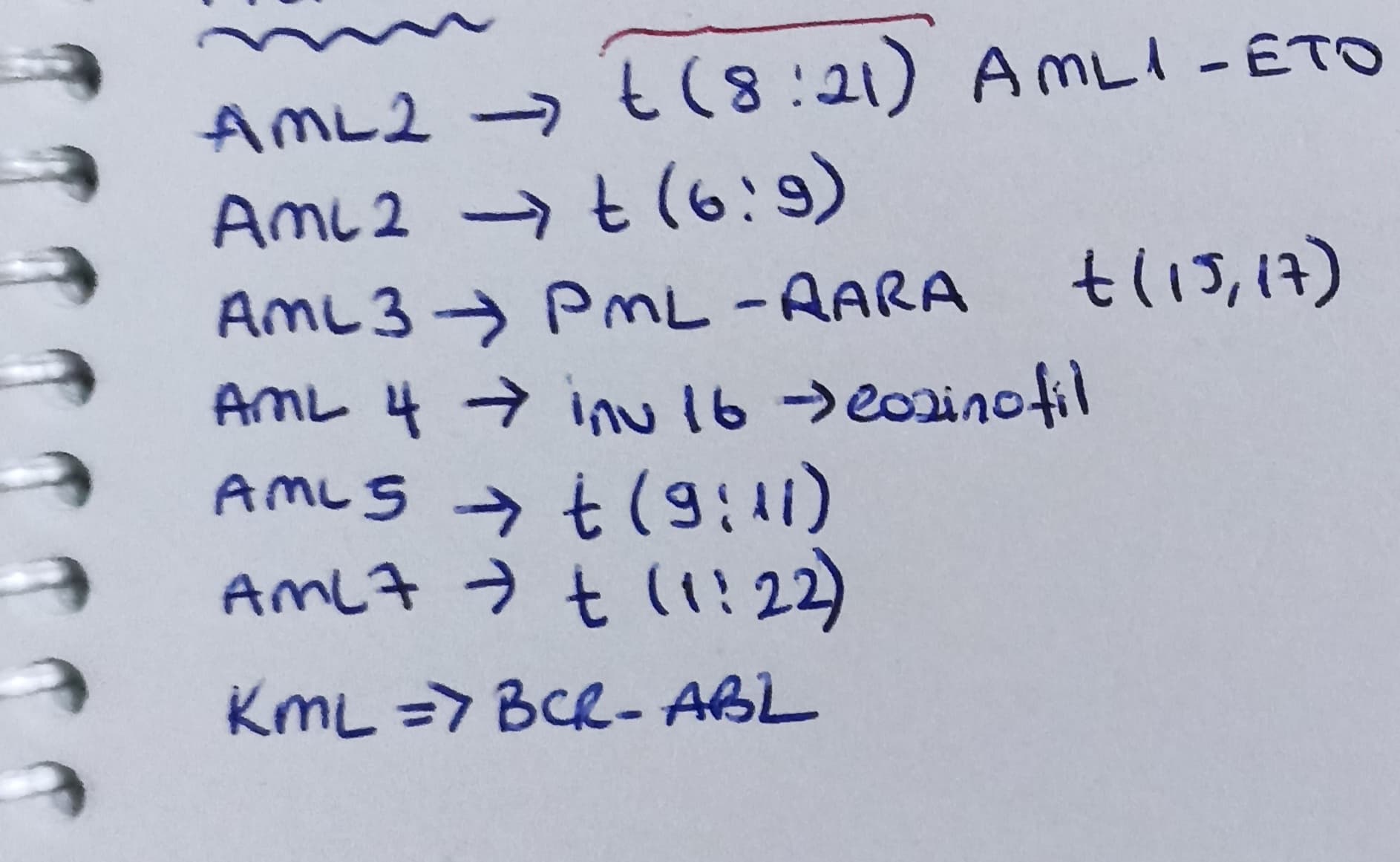
@tynax, the simple answer in my opinion could be that you should develop a vocabulary based on word substitution. AML = a mole, KML (CML for English I think) = camel, PML = pommel horse, etc. Numbers should be converted to images. The arrow could be seen as an arrow and the t could be Mr. T. Put everything into an image with associations having plenty of action and you’re done.
But I don’t think this is the best answer. Systems developed with limited data don’t scale well. A better system would be created with an understanding from an overview of the complete set of genetic abbreviations that you want to recall.
Maybe AML should be apples travelling in the bloodstream, CML should be cherries floating along the arteries, and so on. My preference would be to start with a terrain/palace representing leukemia and find areas/loci that can store information about each type beginning with a subject that can act on items. You can find real places to pin your images to but I prefer to imagine them to design a better system.
In something I have done, you would start with a general background of leukemia represented by an apple orchard with the ground covered with rotting and mishapen apples. The trees are bones that grow these abnormal apples. Now you populate the terrain with objects that when explored have the data you need.
AML2 is a mole eating apples on a table with honey (2 in the Major system). Maybe he’s having a cup of tea with a huge pea (6, 9) steeping in it. The teapot is a weave of knots (8, 21). His dining partner pouring the tea is another mole wearing a formal tie (1 in Major system).

That ETO is mysterious to me and other than a protein family I don’t understand it so I’ll go with an image of E. T. sitting with the mole in formalwear that is like a ghost (a chimeric gene product). Maybe you can add an extra action or elaboration imagined from the relationship between the mole and E. T.
AML3 is our mole shooting apples off the trees with ammo (3 in the Major system). KML is a camel stopping to drink gallons of apple juice at the trough outside the apple press.
I think it’s very important that you have a master plan to start with so you can build with some meaningful images as you learn. Too many odd images doing weird things without a hierarchy will make you have to review too much. As it is, moles eating sweetened apples and having tea is strange enough!
Good luck on your exams!
3 Likes
You are amazing! Such a great and detailed answer. While the other parts are neat, the inclusion of numerical data confused me. I tried using the major system but needed an example.
1 Like
I agree with Doug using substitute words (and I love the idea of a mole).
We do quite a bit of work with medical students and adopt this philosophy for non-tangible letters and formulae. It’s good to create a system that will work for all situations - so for example if the numbers referring to chromosomes always appear in brackets then create an image for this that will decode to prompt you of the brackets.
We use rhyming letters getters rather than the major system but the idea is the same to change numbers into letters and then images, (we often use the number shape idea for lone numbers too). And good old acrostic mnemonics still have their place for certain things.
So I’d suggest finding a substitute word for AML (a mole is an excellent idea)
Maybe a shotgun to represent the → symbol
Turn the numbers into letters in your preferred way
Maybe use number shapes on one side of the formula (a mole holding a duck - AML2)
and numbers within brackets are imagined within a Chrome Box
and consider acrostic mnemonics for letter groups (ETO - Eagle Tries Oatmeal)
Hope that helps in some way.
2 Likes
That is a useful tip. The part that challenged me the most was the parentheses. this solution looks pretty clever. Thank you very much for your detailed answer.
No worries - hope it helps. All ideas are obviously very subject to your imagination. For the parentheses, on 2nd thoughts I’d probably personally choose a Perspex frozen box (like a cryo chamber - because it’s a great multi-use image (that can have other things within it) and my personal imagination would link Cryo with Chromo)
1 Like
Categorizing is a good solution, I don’t know how I didn’t think of it. This was not only for this example, but it was an information that increased my mastery of memory techniques. Thank you.
1 Like