On a few occasions I have muddled the order of my loci. For all new memory palaces I’ve got a simple system that stops this happening.
When I’m mapping my loci in a room
I start by the door and choose each of the loci in a clockwise direction.
When I have objects close to one another I start with the closest, lowest and work up and back towards the wall. E.g. A desk with a chair, a lamp, and a picture above it would go:
Chair > Desk > Lamp > Picture.
and go all around the room until I get back to the door.
Simple as that. It seems to be natural to me. Do you do something similar?
I’ve found I stick to clockwise paths around rooms, and on each wall or section go left to right, top to bottom.
Some things are close to walls, and I treat them as part of the set for that wall.
I’ve not come across a wall complex enough to have three levels deep (top, middle, bottom), or a wall/section more than left, centre, right, but I think any section I can divide into more than that, I would probably make it two smaller sections.
So I guess I don’t treat things as close/far, but as higher or lower from my perspective facing them as a group.
In theory, if I started doing that, it’d make a cuboid of places. I think I’d start from top-left-far, go across and down that ‘slice’ before moving closer. Interesting to think about
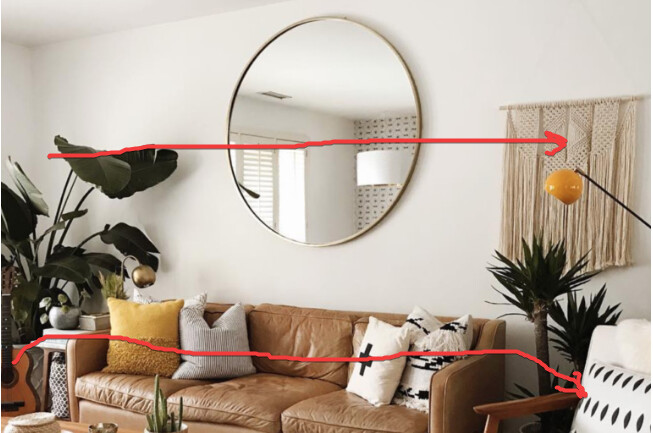
So Ian, given this example you’d do something like this?
Plant, mirror, tassel thing, lamp
Guitar, side table, sofa (or even each cushion), Yukka, Seat with spotted cushion.
I would split the sofa to left and right seat cushions, partly because the mirror is a dominant feature on the wall in the centre. I vaguely “see” where I am on the wall when I traverse through, so the mirror is a bit like when you read a page of text with a picture in the middle - you know exactly where the picture/mirror is even while looking elsewhere around it.
A gap in the middle of the sofa is good in case what I’m doing with the big mirror drops, drips, droops, or dangles! The big mirror suggests bigger interactions with it, and the space beneath helps prevent unintended combinations and makes it easier to “see” the wall. If the mirror was smaller, that sofa could do three spots if I needed them, but I think I’d still prefer not to use the centre, as it’s distinguished to me by its lack of distinguishing features. Still, with two places on the sofa, that’s ten spots on one wall, which is a good even number!
When I’ve done that (it’s been a while, thinking about it), I always put the 9 on the floor and the 10 on the ceiling (the opposite of that diagram). No idea why, but it felt better to me that way. Always important to go with what fits your way of thinking.
I pondered rotating those numbers one step anticlockwise, so the corners would be 2,4,6,8 and 1 would be at the ‘door,’ because they felt more navigable to my early mnemonics-learning brain, but if 2,4,6,8 around the walls makes more sense to you, do that.
That’s how it is in the original version. I modified it to move 9 to the top because I try to go top-to-bottom and left-to-right inside the locations (from the Ben System).
I thought that it might be faster to keep everything in the same direction instead of switching directions when moving between locations and inside of locations. I don’t think it really matters, but that was the original reason.
I try to think of every space as a soft-edged rectangle. E.g., if I’m making a space out of a single wall, I’ll just treat that wall as one side of my imagined, soft-edged rectangle space. This is great for creating pseudo-rooms within a real physical room.
I perceive a perimeter and interior to the space
I start in the bottom-left, SW corner of the room
I traverse:
perimeter → interior
clockwise (More relevant for the perimeter. The interior is usually just a column of stuff)
top → bottom (Within a ~3ft-wide vertical slice of space. See below for more details)
landscape → left → right (E.g., if I have a couch and two end pillows on that couch as objects in my space, I would traverse as couch → left pillow → right pillow. That’s because the couch covers the full landscape of the vertical slice of my space.)
I practice traversing by imagining I have a ~3ft-wide squeegy. I then squeegy the space along my traversal route. It ends up being a very predictable, natural movement.
So in a simple room with 10 items placed as they are in Vaughn’s room, I would follow the same path he does except I would go top → bottom (9 → 10) at the very end.