Im new to creating palaces. Im quite good at creating the “pictures” for the things I want to remember, but I haven’t really figured out how to “visualize**”** the palace alone. How in-depth does it need to be, if I should want to visualize a big room in my school for example; do I need to place the different tables at their respective places and does the distance between the table tennis tables need to be “accurate”. How do I make this easier, and how do I go about visualizing?
It doesn’t need to be accurate or to reflect reality as long as you’re consistent in what you “visualise”.
I put visualise between “” because it doesn’t need to be visual… With my oldest memory palaces I just know where I am and what’s in there… I could tell you all about it, but I don’t really see much images anymore.
In fact, when I go back to a place I’m using as a memory palace I often notice that my brain remembers it differently, in a way the place was “rewritten” to better suit my needs.
I guess it all depends what your brain prefers. You’ll have to try things out and see.
If you have trouble starting, go somewhere with things you want to memorise and put them there while actually walking “on site”. It’s much easier than having to imagine everything.
And also you will notice many more details (“hooks”) giving you more stations in the space. I know I’m much more observant when I walking somewhere with the perspective of making a memory palace out of it.
Hi Swedenium,
You don’t visualize the Palace by itself.
The “palace” is normally supposed to be an actual structure not imaginary.
You can imagine one however.
The “palace” is created room by room, by going clockwise or counterclockwise around a room per topic and placing things to be remembered on a piece of furniture or a wall of the room.
Remember each room should be assigned one topic OR topics that blend into one another, IMHO.
Hope that helps,
Stefos
So if im in my room, and only place 3 items (on my desk, bed and door); Do I not need to “see” all my different posters, the mess of clothes on the floor, the carpet or the bookshelf?
Hi,
No, just the things you’ve placed on eachitem in that room.
You review by walking around the in order of placement ypu want to remember.
Stefos
Memory Palace (by Magno)
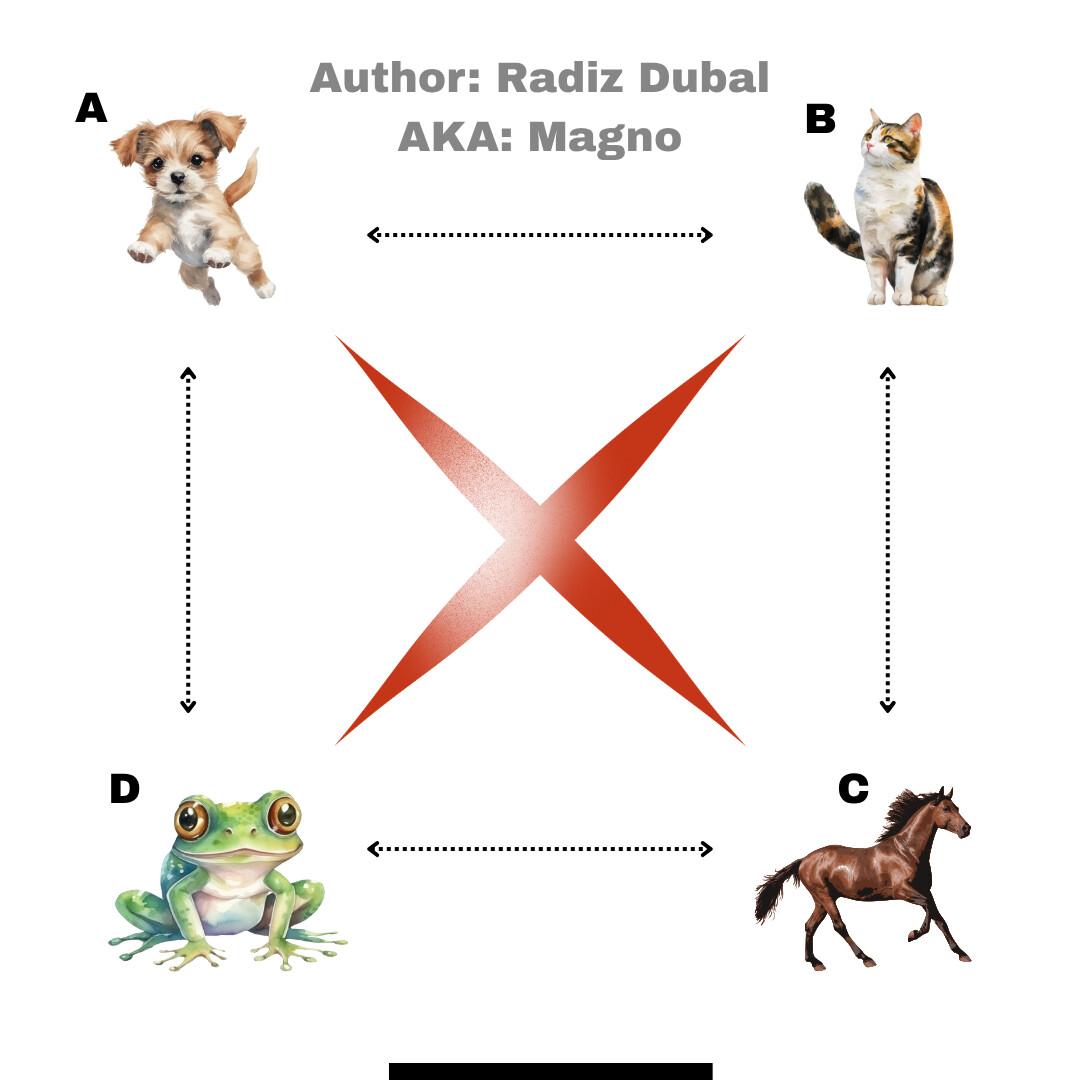
Explanation:
Places are divided as follows: from general to specific, that is, from your father’s house to a room in that house, where that room has a series of specific objects in a certain sequence and/or order.
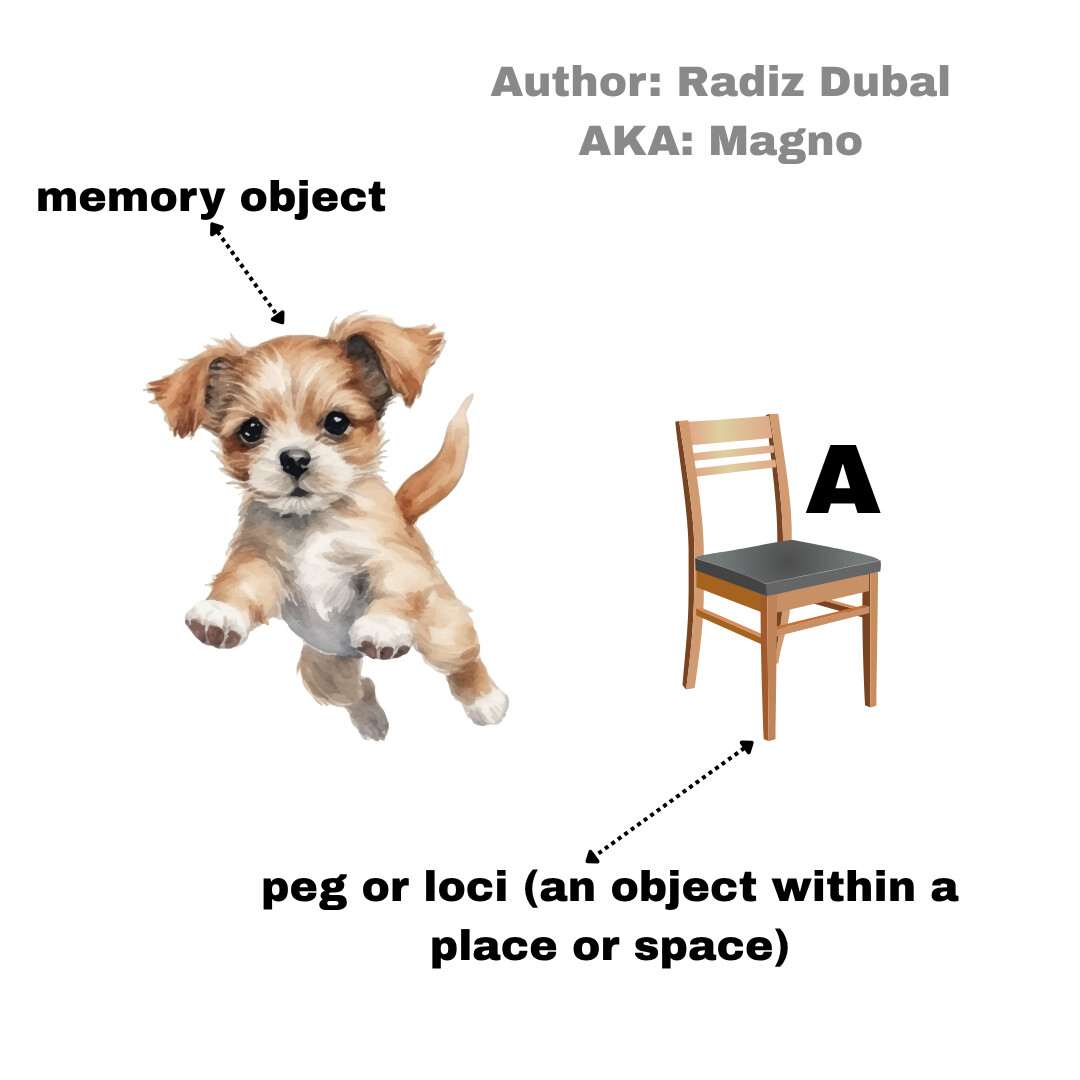
So you order the spaces (the spaces can be square rooms, but it can also be the garden, etc.; they are not general; they are more specific, but they still need to be divided) in numerical or alphabetical order.
Then you will order the objects within each space. Some people have established numbers, such as 10 objects or pegs per location, such as a chair, window, nail, etc.
I usually create 33 focal points or pegs per space, as I name each room using Bruno’s method, but you don’t have to do it that way. So, in one room you can have 5 objects, and in another, 10 or 20.
The path or observation should also be established, so it can be zigzag, clockwise, etc. Use what makes sense for you. Also, choose how you will observe your mental images, for example, in a column or staircase, i.e., from top to bottom or vice versa, from left to right, etc., however you feel comfortable.
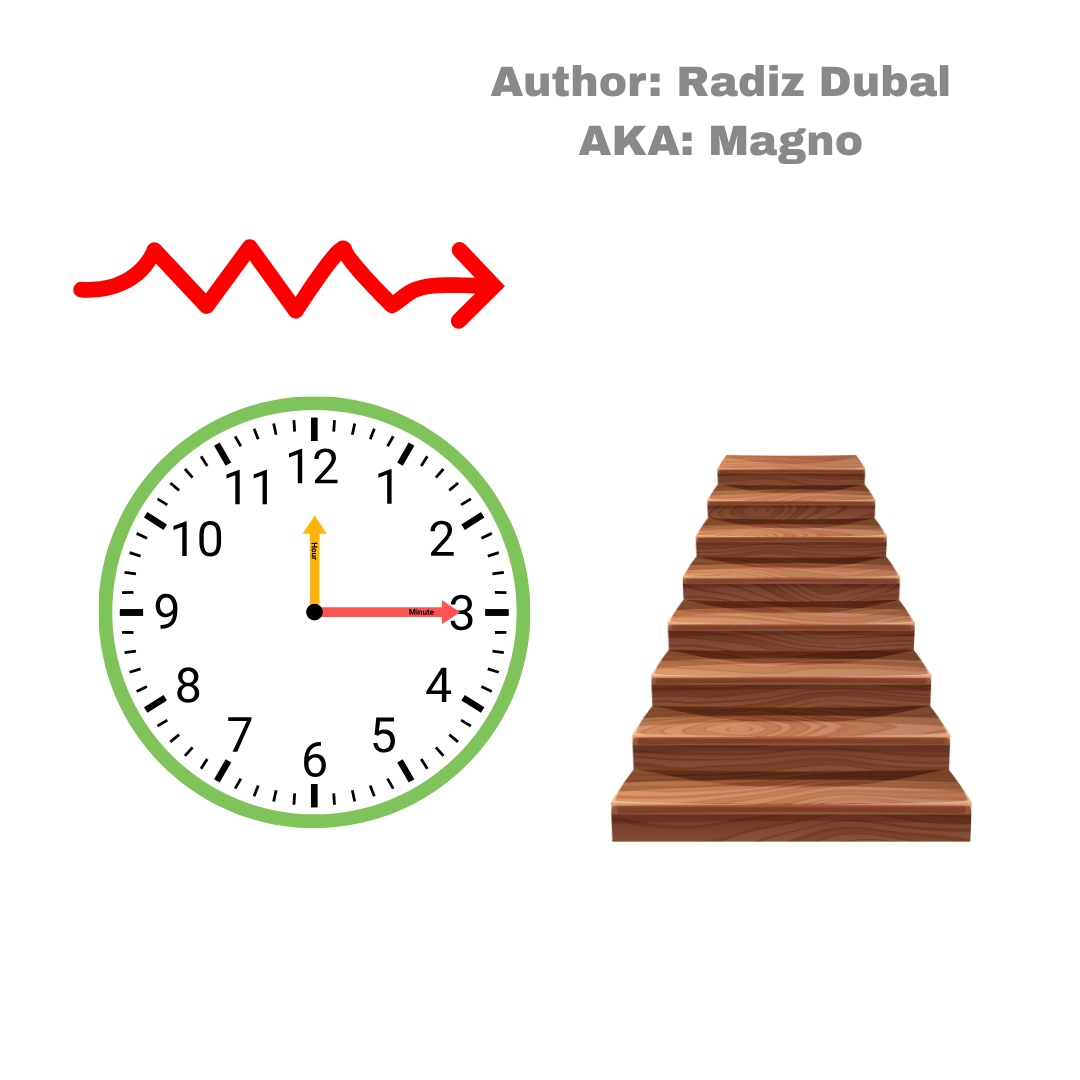
Once you have a certain order, as described above, you should review the anchor points within the spaces until you are clear of confusion. The focal points should not be too sharp, since images in the mind are shadows of reality. Therefore, if you see a cup in your mind, it will not look like a photograph, even if it appears to be one.
Other points that might interest you:
All my palaces have names that I give them, all in alphabetical order and some numerical, but I create them in a way that is beautiful to me. I have palaces like the brothel with women I find beautiful and others not so much (depending on taste and gender; this palace is highly functional, as I use the Ravenna method), the Olympian gods, Plato’s cave, Noah’s ark, Circe (she is the daughter of the god Helios, a witch who can reveal the true nature of gods and humans by transforming them into beasts), etc., each with 33 rooms or more, and each room with objects up to the number 33. I can combine these palaces with the tour. Each one has stories that evoke certain emotions in me, which is why I use these palaces to memorize things quickly, as they have a certain emotional force.
If you want to do this, but not make it as complicated as I did, you can use characters you like, like Dragon Ball, i.e., a Dragon Ball on an ordinary chair in your house, or the chair with a bear’s head, or a diamond chair, or the chair that smells like honey, etc. Use all your senses to make your anchor points emotional and not trivial.
Well, I also have points that are trivial. For other types of trivial information, such as playing cards, I’m not interested in them in the long run. So I simply create trivial palaces, but they are differentiated from each other, and with practice, i.e., reviewing the points makes them quick to use, and mental images make them less trivial in practice.
1 Like
Hi Sweden,
Old school memory books had the letter M in the middle of the room diagram.
M meant “manus” meaning hand which has 5 fingers.
They used the Loci to place items in each corner and in the center of the room only.
Experiment & see what works best for you 
Stefos
Tbh I don’t really visualize it at all.
Like, one of my locations is the bed in my room. When I place an image there and review it I don’t see the bed with the image in my mind, I just kinda know that the image I created is in my bed.
Like, I think about my bed and that’s enough.
3 Likes
I have seen your one post in which you mentioned you also use tour video for memory palace in tour videos how do you achieve this
This is simple: take a work you like, like movies, TV series, literary books, etc., and place images of them in the space.
You can use a list of characters from anything—anime, adult films (choose the opposite sex or whatever appeals to you most; these images are emotionally strong), etc.—and place them throughout the space. It could be a place that represents the letter A. I’d place all the characters that begin with that name. It could be in the center or at each point. For example, the Greek god Apollo would represent a palace, which would represent the letter A. The name of the palace would be the Camp of Apollo, and all the objects associated with Apollo would give me the letter A. In other words, place objects from these characters in each center.
This is really fun. You can take characters from comics, anime, whatever you prefer, exaggerate the character with stupid or unpleasant actions, and have your palace arranged alphabetically. This is called a small universe, since there are many places. You can also connect one place to another by having the characters travel from one place to another very distant place, but they connect because that character represents another place.
Noun places also work well for naming places, like airport, for example. It starts with A and can extract objects associated with an airport, such as airplane, airplane ladder, airplane pilot, etc. You can vary the same object in different places, for example, one plane lands there, another crashes due to an explosion, thieves emerge from another with bags of money. You can combine it with the larger system, etc.
I also have palaces AA, AB, AC, AD, etc. You can build them as needed; there’s no need to build them all at once… for example, if I want to memorize a dictionary, I look for envelopes with those letters, for example:
List of movie actors, taken from IMBD:
AA: Amy Adams
AB: Adam Brody
AC: Aimee Carrero
…AZ: Ayelet Zurer
For thematic palaces, like math, for example, which is divided into Arithmetic, Algebra, Geometry, and Trigonometry, etc., I would create interconnected palaces, and the characters associated with the theme. Each palace can connect to another because I have characters who can travel to another place, as if it were a PAO system, but more advanced, like the statues Giordano Bruno creates, to reflect on and learn complex topics.
And a long etcetera, you can do it however you want. This is the good thing. Do what I need. You can do it as a hobby, but I prefer to do it as soon as I need it. For large projects, it can also be done for quick recall, as this adds layers of emotion to the locations. As you can see, you can add objects at each point that will serve as anchors for information.
I take a character, for example, Amy Adams, and place all the information I need around her. But if I need a palace for arithmetic, I’ll look at her with a calculator. If it’s algebra, I’ll observe her riding a zebra (you can make the image more emotional by making the zebra breathe fire or be able to fly, etc.). I place it in the center. Then I place the index of the general topic around that room. With that index, I travel to other places to more specific topics.
All of these images are saved in Obsidian if the topic requires contextual text, but I can also perfectly use Excel to organize them. As I said before, I use what I need, and if I need to do something else, I do it.
First, be patient. A job done is better than something unfinished. So, I create something. If I need to change something, I change it, but I don’t undo previous work. This is why patience is required. Memory systems help me organize the knowledge I acquire and be able to review it at any time and connect that information to other information in a simple way.
2 Likes
Many people do not mention the simple truth that it might take a little bit of practice to actually visualize the palace(your home in a way you use it to remember items). I am telling you this because you might be a little hard on yourself when you fail INITIALLY.
There are many tips to choose workable memory palace. Ad Herennium suggest clear background(loci), not too bright nor too dark with enough light, preferably on deserted places. The forum will provide you with another 100 tips.
The idea that creating “pictures” will make you better at the technique also does not hold true. The main principle is “You are trying to make learning EASY on yourself and more effective”. You might remember you listening to others using memory techniques because it made their learning EASIER.
The principle even holds true for the technique itself. You want to make the technique more palatable to you. What I recommend: Take a walking tour video of any kind then stop at a shot you feel you can make Loci out of it. Now imagine putting some things in it. Nothing fancy just some animals or objects in it. After a while go to the shot and see if you remember object in it.
WHY I AM RECOMMENDING THIS: you are essentially externalizing cognitive load. The traditional way of memory palace is more demanding. It expects you to neatly pin out and Imagine the locations also keeping track of no of loci. Your video will do that for you. The traditional way recommends you to be able to make some visual representation of material you are reading. The readily visual representation that you have is of these real world objects.
I had same initial pitfall like you have now. I wanted these simple answers to my problem. I found no help then. I had to learn it the hard way but the upside to it is that I became better at diagnosing the problems.
3 Likes
Yes, thank you. I will try do to as you’ve said