How do you memorize information split into multiple branches?

Hi, I’d like to know how experienced memorization enthusiasts memorize information in their memory palaces that is split into multiple branches?

I’m am specifically asking because I need advice for memorizing chess openings.
There are multiple systems where you can memorize one move in chess using one image in your memory palace, so 2 persons or objects interacting could represent the move of your opponent + your own move.

The tricky part for me is how to place the images in my memory palace in case where the next image depends on the move of my opponent. Multiple possible moves of our opponent means we need multiple images for our own next move.
That means that the information we want to memorize could be presented as a tree with many branches.

Any examples would be helpful, I just gave an example using chess moves, thanks.

You might want to try the ‘Picture Notation’ for chess openings. See under this link: Picture Notation: A Mnemonic System for Chess - #17 by JohnDen

2 Likes

I use big memory palaces so that I can do exactly that - just not for chess. I set up a palace walking from home. Each house is one location - creating the foundation. I can then use any house for multiple paths using the facade, driveway, windows, roof, garden …

I also use only one side of the road. If something requires more definitive separate pathways, I mentally cross the road and incorporate a house opposite.

For example, I am using my largest palace for Chinese vocabulary and characters. The basis is the 214 radicals - used to organise superficially like our alphabet. For the most common radical I have needed so far (kou - mouth) I have my first words in the house in the original palace and have now incorporated two houses across the road. A single house can include huge amounts of information because the facade of each can be a memory palace by itself.

I would imagine each house as a different chess opening, adding more houses as you add more openings. I don’t always walk from the start of the palace. It loops around home, so I can short cut to any location.

Hope that makes sense.

Lynne

3 Likes

Hi Lynne,

I’m curious about your method for learning Chinese vocabulary. I’m working on this myself as well, and have tried a few different systems. The one that has worked best for me, so far, is based on “Mandarin Blueprint”’s method: splitting the pronunciation of each Hanzi into an initial, final and tone: person for an initial, place for the final, sub-location for the tone (kitchen, living room, etc) — and then integrating the radicals into the action of the mental picture.

Does your system of organizing by radical also have a way of integrating the pronunciation? And, do you organize the Hanzi by the radical that is uppermost, or leftmost in the Hanzi?

Rob

(This is not to endorse mandarin blueprint’s products at all)

https://www.mandarinblueprint.com/blog/chinese-mnemonics/

Hi Rob,

I hope the links and characters come through correctly.

My system is similar to Mandarin Blueprint, and we were both influenced by Alex Mullen’s method. I tried that, but found the location for the final and sub-location for the tone too difficult.

I also worked on a system which could be used by everyone because I have a teaching background. I also have aphantasia, so without imagery, people are far too alike. I can get much more differentiation from animals.

This is all documented on my website in a free booklet:

I use an animal for the initial, phonetic-clue action for the final and direction of the action for the tone. I use that as a story starter for the Chinese character. So a PA system.

I have the radical from the location and use a story method for the other components. I have created objects for the components which are not radicals.

Words are stored at the radical for the first character in the word. I couldn’t see how to do words on Mandarin Companion. Using so many locations/sub-locations for a single word would be impossible for me.

So my method uses a single image/story for any word of 1, 2, 3, 4 … characters - pronunciation and all components of the character(s).

To ensure consistency within a class (I don’t teach Chinese - it’s a hypothetical class!) I organise my characters by the official radical as given at MDBG:

So ‘potato’ would be stored at 土 and apple ( píngguǒ 苹 果) at 艸艹.

(Word dictionary - apple - MDBG Chinese Dictionary)

For apple, I have a panther pouncing upwards (2nd tone) while doing rings around a goatherd who is drunk on the ground (3rd tone)

-uo is from liquor - the only English word I could find with -uo pronounced correctly for the final. So the action is being drunk.

This story is all stored at the 艹 location, starting on a flat bit (I know the component ping as level and as the phonetic) with a field and tree for the guǒ - all requiring only one location ( 艹 ).

Does that make any sense? It is explained fully in the booklet.

I just couldn’t get the multiple-location imagery to work for the Mandarin Blueprint method, but that could simply be my aphantasia limiting me. Plus I couldn’t see how they do words of more than one character.

Love to hear more of what you use or answer any further questions. Or suggestions on improving my system!

Lynne

1 Like

For such a fundamental and simply expressed problem – “what is the best way to memorise branching data?” – there is remarkably little research on this. It would be fun if memory competitions asked competitors to memorise a flowchart, then we’d probably get some interesting innovations.

I think the main approaches are:

  1. Map the data to a matching branching structure, such as a branching memory palace through a town or campus. This is my approach for chess openings. Arguably it’s a more natural way to think about physical space than a linear memory palace, because the way I navigate through a space is more like a network of nodes than a single snaking path. You could also map to other things that have the right branching structure like a family tree (forum user Zweb chess’s approach). Lynne’s approach above seems to be a version of this too, using houses on the street as branches.

  2. Use a computer science method to convert the tree to a linear structure, then memorise the linear data in a conventional linear memory palace. I couldn’t find a satisfactory way to do this for unbalanced trees like a chess opening.

  3. Other: Joe Reddington has a method for binary trees in his Advanced Memory Palaces book, to do with film characters IIRC, where each node gives you a piece of information that leads you to the next one.

2 Likes

Today I was wondering how 2D platformer games would work as memory palaces. I was playing a lot of them when I was a kid and have grown some affinity to them. Interestingly a lot of platformer games are build in a branching fashion. Most of the times you go left to right with possibilities to go up or down as well.

Probably you could lay out a fictional platformer and branch it as you add information to it.

How does it sound?

@FrankMind
Thanks for the recommendation, I actually base my mnemonic system for chess on “Image notation” by JohnDen.

@LynneKelly
Thynks for answering Lynne, I recently started reading Memory Craft btw :slightly_smiling_face:
I like the idea of using a street as the main branch and each house as a separate branch. Do you think it would work if I incorporate rooms from video games and TV shows as separate memory palaces for each house (I would imagine that’s what the inside of the house looks like) and use the street only to help keep the correct order of the rooms?

1 Like

Thanks @JohnDen . It looks like approach no. 1 requires a memory palace that already has a tree-like shape so there’s a limited number of places (or family trees) that I can use.

Approach number 3 seems interesting, and I read the chapter about it on your page but I still don’t see a practical way to use it for chess.

I assume it would work very well. I have aphantasia so no ability to visualise, so this wouldn’t work for me at all. But from what I understand of normal visualisation, your idea could work really well - and you’d be able to control the space to make the branches match exactly what you need.

Good luck with it!

Lynne

1 Like

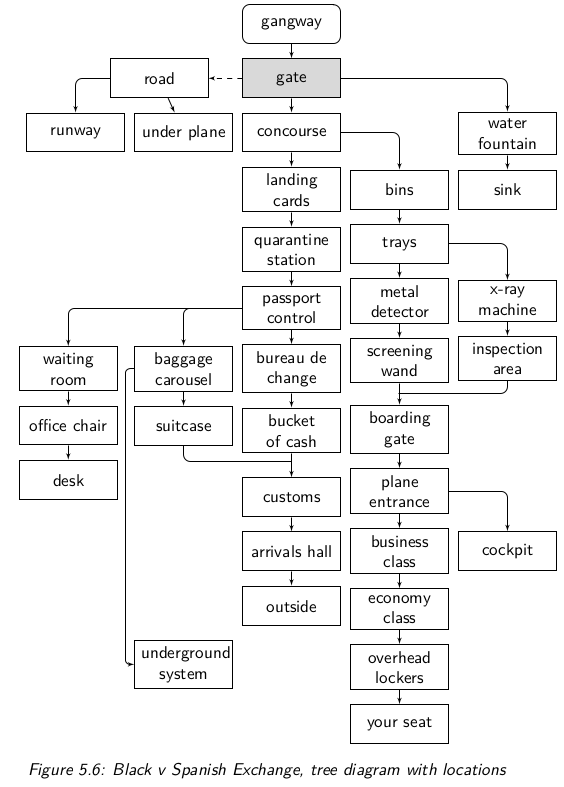
You should be able to turn any sufficiently complex setting into a branching memory palace. You need to imagine paths through the space (and it helps to make up reasons why you would follow those paths).

For example, an airport is a location-rich setting that does not naturally look like a branching tree. But it is possible to turn it into a branching memory palace:

Designing the branching memory palace is admittedly the hardest part of making a memory palace for chess, so I am always interested to hear tips on how to do it better.

1 Like

I second this. It really helps to give your brain a reason - it can be a whimsical, absurd reasoning, but it needs something more than just random.

1 Like

The problem with realizing chess branches with physical branches in a realistic place is that the game branches so quickly:

After 10 half moves there are a 69,352,859,712,417 possible board positions!

That’s a hard number to map to a real place in a way that you can palace.

Now for studying opening book you don’t need ALL branches, but the fact remains that chess has a high number of branches from each position - even if you “trim the branches”.

This isn’t really an issue. Those 69.352.859.712.417 possible positions include mostly blunders that aren’t worth remembering.

Even in the most theoretical lines you’d likely need to memorize at most 40 moves. And even that is an exaggeration because I can say with 100% certainty that no one in this forum will ever get to play 40 straight moves of theory in a chess game (we don’t even see that in the games of top 10 players), and even if by some miracle they did it wouldn’t do them any good, because at that point you are playing book moves that not even the top GM’s fully understand, so there’d be no point, the advantage you’d gain would mean absolutely nothing to you even if you had hours to ponder on your first non book move.

It’s far more realistic that someone would need to memorize around 8-10 moves of their chosen openings. If it is a highly theoretical one then give it some 20 moves when taking into consideration the different lines. But even then, most of that memorization will never be useful because most games will deviate far sooner.

For anyone who isn’t really a professional chess player knowing like 8 moves of theory + understanding the general plans will be more than enough. People really overestimate the value of knowing book moves, even if you played perfect theory most of the time you’d get like a +/-0.4 advantage, which is an amount of advantage that amateurs squander every other move (and for amateur I mean non chess masters, and even chess masters lose that kind of advantage very regularly).

2 Likes

Creating trees is not difficult at all; you just need to create sets of mnemonic images, for example, a father, mother, son, daughter, father’s profession, mother’s profession, friends, etc.

List the characters and their characteristics, ordered by numbers, such as 1. hair, 2. forehead, 3. eyebrows, 4. eyes, etc.

Find an image of an apple and divide it into sections.

A place like a Roman hall with objects around it and at its center.

All of that gives you trees, connecting one branch to another through the chain, which creates trees in forests. A forest is formed by several trees of associated information… You can also form an order with the alphabet and create images from there: A, B, C, etc., Aa, Ab, etc. Then A → Ab → Ac, or it could be A1, A2, etc. Use visualizable linguistic systems to form images with these letters and then associate information with them: for Ab = Adam Brody, for B = Broly (Dragon Ball), etc. Use the chain, the places, and you can form trees and forests.

If you need Aba, Abe, etc., you can add objects that begin with those letters or actions to the five vowels. If you use numbers, you must have lists with numbers. There are several methods; you just need to know how to combine systems and use your creativity. I’m currently creating a book for these types of methods, in numbered order.

The methods can be combined, so you can create chains in trees, trees in forests, and travelers through places.

Hi Hedgehog,

I would divide the board into the X and Y axises and then link each move to the prior one.

A memory palace is not a good tool for Chess, I believe, because it’s very dynamic and not static information.

If you’d like to try, try memorizing particular moves using a computer chess software program first. Move slowly at memorizing.

Stefos

1 Like