I posted before on my plan to memorize Academy Award winners. I’d like to memorize the important 4 category winners for each year. My plan is to have each loci in my memory palace be one year. Then I can have 4 items at each location. Or maybe person-action, or something like that. Not sure yet.
But I started thinking about something. I could make my 4 images for each year and remember the group at each loci. Or I could start with one category, say, Best Picture. Come up with one image for each year and put them in my memory palace. Then once I’ve gotten them fixed, I could go back and add one image to each place for Best Director. After that’s set in my mind, go back and add Best Actor, the Best Actress.
Would that be more efficient? So far in my memory palaces (I’m still relatively new), I tend to only change them if I think of a better image for some reason. But, for example, I have one for the Kings and Queens of England. I used my Dominic system to give each one an action so I would know when they attained the throne. I memorized that one a couple of months ago. But if I wanted to add something like their spouses, I think I could easily do that.
One of the benefits of memory palace over something like a mnemonic or a song is that it can be adjusted, right? I was reading @LynneKelly 's book where she said that she had memorized some history timelines. And she commented that if she found some new dates she wanted to remember, she just inserted them in. So I’m thinking that might work.
Do you think it’s better to try to create my memory palace using as much information as I currently want to remember, or to take it in steps?
I constantly add to locations building up an ever more complex image at the single loci. But I do this at real physical locations. Recent (ongoing) research is identifying the use of physical locations over imagined ones as enabling much more complexity.
Indigenous cultures do this all the time, with higher and higher levels of initiation, they learn more information about each site.
If you are at a physical location, you can always find a new detail that matches what you want to add - using vivid imagination, of course! One of the locations in Chinese vocab/characters palace now has about 50 words in it and will have a lot more. Some are now so familiar that I don’t need the palace to remember them.
In all my permanent palaces (except for Pi), I add new information to whatever location is the appropriate one. Once the palace is in place, I am not sure there is a limit to how much related stuff you can shove in there.
In my main palace I have five different sets of data, and I wouldn’t go higher than that. However, of those data sets, only one (Countries) is likely to get more stuff added.
When I decided to do Chinese, I established a new palace just for the language and set the 214 locations (for the character radicals) out over 5 km! Each house is only one radical, but that goes me so much detail in each location to add stacks of words and characters and it is working so well. I never thought that I could tackle Chinese, and I couldn’t be doing it without the palace. And I get exercise visiting it to add new data.
@LynneKelly, thanks so much for responding. I really liked your book.
My Academy Award memory palace is a real place, but it’s not one I go to with any regularity. It’s the local cineplex. I think I’ll try this anyway, though. My images overall are a little tricky because there are names like Leo McCarey and Paul Muni that I don’t know. So I need a combination image for them.
So I’ll start with just the Best Picture award. But leave plenty of space around each spot for future expansion.
Puns are really useful. When it is a name I can’t get a link for, I say it over and over with different emphasis and eventually I always find a pun. I hope that helps.
To better respect the subject of my question I preferred to ask you in this topic, even though it was prompted by your comments about stacking on Un-Stupiding Myself - a Memory Training Journal
Obviously I took the time to look for how much you had explained about your way of stacking, but at least I did not find these details about which I ask you:
I DID find that in your locations for Chinese radicals you go adding information/words using new DETAILS/ASPECTS of the location. That is, I understand that you don’t make a story or a chain (by linking the new info to existing info). But if this is correct, how do you maintain the order of those new physical characteristics/sublocations (inside that location) to be able to go through them when you want to recover something? Do you determine them BEFORE occupying them with new info? Or do you choose them as you need them, BUT with some geographic/spatial logic (for example, in a house first the front, then in the front from left to right until filling it, then the roof of the house, etc)?
Because if you don’t have an order you may not be able to go through them to review/rehearse them and/or you may inadvertently skip/forget them over time.
When you started experimenting with this in the 5 stacking levels in your main palace (I think it’s your house + your garden) did you also choose new features/details in/at each location for each level (each set of info)? Or did you chain/make a story with the 4 new elements to the first one?
If you used sublocations/new details, did you care to keep some logical order to better access those 5 sublocations/details? Or not because they were very few (compared to some of the Chinese locations)?
Hi mad10000
I don’t have any order in the words associated with the locations for the Chinese vocabulary. I don’t use specific places as you suggest - door, roof, front … That is what you do if you are imagining somewhere. I almost always go to the location when I want to encode new words. Some of the locations I know well enough to add things anyway, or the word is easy to attach, but with anything difficult, it works much better to go there. That way, I link to something which jumps out at me. That is why I am so keen on encouraging people to use large memory palaces and actually visit them.
Yesterday, I used the letterbox at one location because it resembled the Chinese character. I had never noticed that letterbox before, but it leaped out at me the moment I got there. The word was ‘seize’ and the ‘beast’ I use for the pinyin is a neanderthal, so my friendly neanderthal is now seizing a letter at that location. He will keep seizing it until I know the word and character well and don’t need to decode. I have a list of all the words at that location and can revise if I want, but I don’t tend to do that because revision is happening with using the language. Hence some words get forgotten, but they’ll come back when I need them. Or I will have to encode again, but that will be much quicker.
I am just letting things happen as part of my research exploring how best I can use all the methods.
Again, I encoded physically at the location and chose whatever feature worked. Sometimes they linked to something in one of the other data sets, mostly they don’t. There is no order in the way items in different sets fit at the location. That wouldn’t work because each location is so different physically - the desk in my office, a tree in the garden …
If you use real locations and physically visit them, it all works so much more easily. That is something that is coming out of the work I am doing with a multi-university research team looking at comparing Indigenous methods, like Australian Aboriginal songlines, with memory palaces.
Very interesting, because experimentation, practice and facts (what actually works, what doesn’t) is more important than what should work and what shouldn’t, according to traditionally accepted theories / recommendations.
I forgot that you (me too) have the list of what you encode / store at every place, to eventually be able to revise it if the language practice is not enough to keep an image fresh (until it’s not necessary, of course).
Otherwise you should systematically check each location by assigning a logical order to each sublocation beforehand when storing a new word, instead of choosing that sublocation spontaneously.
Good! It will certainly be a valuable read. Thanks!
Hi Lynne, good morning! I’m just curious in your memory walk, how do you record what you encode on a certain place? Do you bring a notebook or use your smartphone? Do you stop by a house while encoding and recording the data or do you record it later when you get to the office or home? I’m curious because my daughter will have a PE subject in college called walking for fitness and she’s in a big university with a big campus with lots of trees and buildings. I’m going to teach her how to use the memory journey method to further enhance her rote memorization skills.
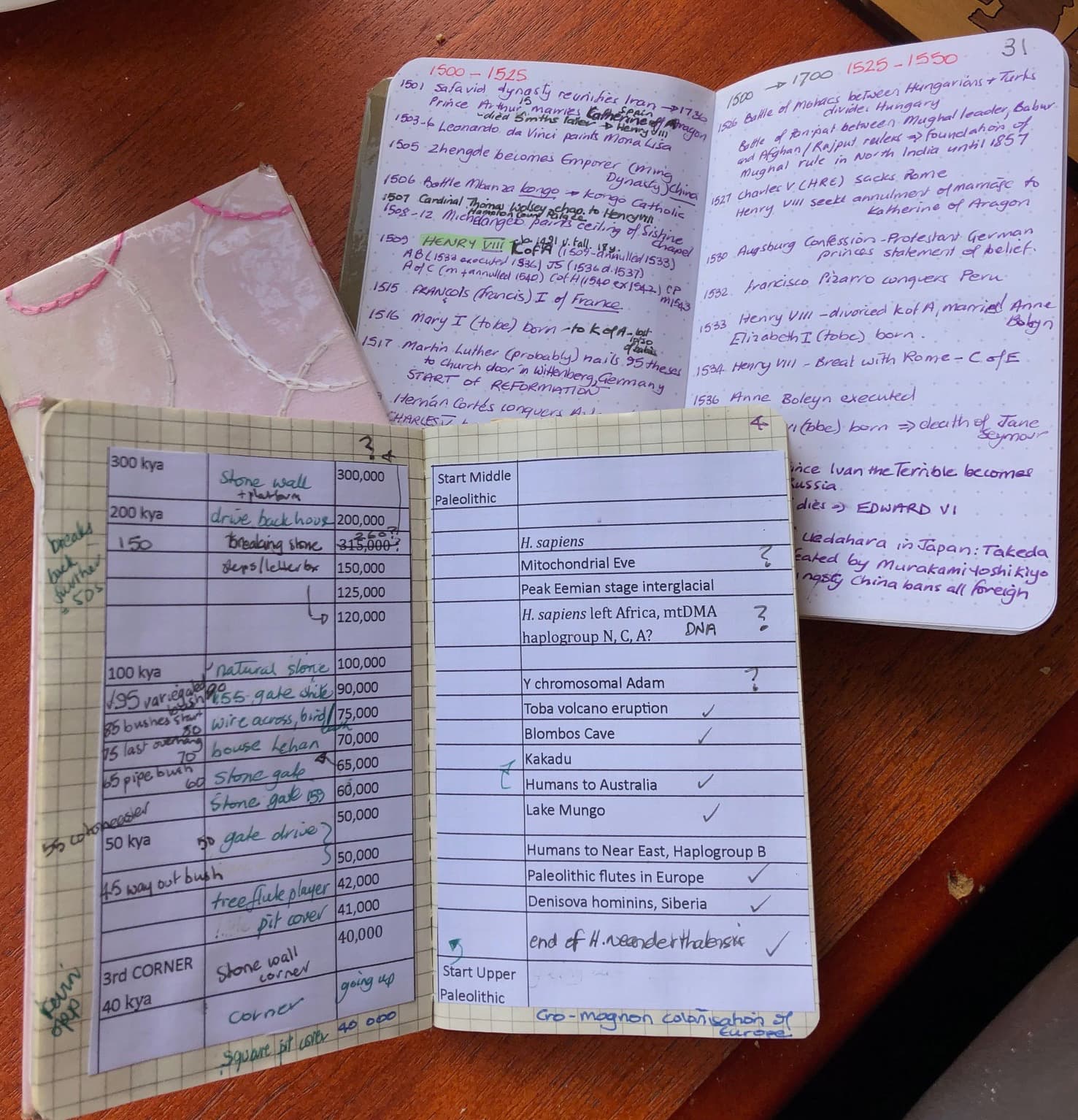
This is going to be a very personal choice. I don’t like using the phone. I have no aversion to technology. I just love handwriting. I adore little notebooks. I have lots of them for every topic and take one of them with me. I also have handwritten cards, my own Spaced Repetition System. I find by handwriting, I have to slow down and think about each item. I like to use particular colours and ways of presenting the information so it links to the palace. Photo is of a couple of my little books.
Sometimes I stop at the house to encode. Sometimes I stop to review. It all depends on how quickly things are happening in my brain, and what I feel like. I am not strict about rules. Whatever works on the day suits me!
I don’t engage with every location, only those on the schedule for the day. So most of the walk is at a brisk pace. I aim for a minimum of 50 minutes on my watch recording exercise, which doesn’t kick in unless I am moving at a reasonable pace.
Love this idea. I am over 70 now and ‘walking for fitness’ must be an everyday event. But fitness isn’t just physical. Lose your mental fitness and it won’t matter how well your body is functioning! So my daily walk is both physical and mental fitness. And because I tend to talk to people on the way, it is also social fitness. So ‘walking for fitness’ is a great theme!
I always encode on the walk. I rarely do any at home immediately, although review is sometimes at home. But I don’t do that when I get back from the walk. I have to get on with work then.
I find walking just for fitness a bit dull. But walking memory palaces means it is never dull. I wouldn’t like to do physical fitness without mental fitness in the mix. I’d get bored. When I do exercise stuff at home, I am always memorising as well.