Ya I am too learning Mantras of 700 shlokas of Bhagwad geeta , I am on 45 shlokha now, have started 15 days back
3 Likes
Once I was at a park with my friends and he got lost but luckily I made a memory palace of the way I walk to his house so I walk him to his house and showed him how to remember direction in the fog and to use a memory palace and now he is starting to train his memory too 
13 Likes
I have a memory palace that I use whenever I’m feeling down or depressed. Each locii in it corresponds to each one of my favorite jokes, funny memes, proud and happy moments. Going through the entire memory palace gives me some kind of positivity for the rest of that day.
32 Likes
I use adventure movies because they keep changing location throughout the movie. The locations are memorable because you remember the actors’ interactions there.
I have used movies like Lord of the rings, Jumanji 2017, Aquaman, etc .
I enjoy this a lot especially for movies that elicited fun emotions in me. Whenever I recall the stored items from the movie journey, those emotions come with the recall.
10 Likes
haha ,that’s brilliant
Wow that’s awesome. Can you tell me more about it?
even I use pubg maps
Ok, I’m sorry, but this so friggin’ cool. You’ve got me giggling and smiling like a fan boy over here.
That’s so dope.
That is just too wholesome, and such a good idea.
Real Application of Memory Palaces (Interpreting a Foreign Language)
Yesterday, I visited the Botanical Gardens in Oaxaca (Mexico) and joined the Spanish language tour because the English-language one was full. Fortunately, I speak Spanish to a good level.
Many other tourists joined the Spanish tour, but did not speak (enough) Spanish to understand what the guide was telling us. So many of them asked me to translate what the guide was saying.
However, the guide would just stand in each location of the tour and talk for up to 5 minutes about various plants and archaelogical features. It turned out the difficult part of my translating was remembering the different things that the guide had said.
I realized that this was a perfect opportunity to use memory palaces for a real-life reason. I would open a clean memory palace, and place something to remind me of each topic she spoke about. For example, someone bathing in red water, to represent that the red bark of the tree was used in this way for medicinal purposes.
7 Likes
I don’t know if I have mentioned this here before, sorry if I repeat the same idea.
Sometimes I prepare a class while commuting, or walking in the street or riding a bicycle. Often it is more inspiring than to work sitting in a desk in front of a screen (it seems also that the blood circulates better to the brain.)
Instead of taking notes, I organize the ideas in my mind and put them in a memory palace (I am already familiar with the content of what I am teaching.)
In that way, when I arrive to the class I can easily deliver the content.
3 Likes
Reposting here because thread is bigger. Well I learned the memory palace technique from Anthony Metivier with his ted talk because he claimed it help reduce the internal narrative. (Also just signed up for his masterclass). Basically if you flip through Gary Webers Book: Evolving Beyond Thought, you will find some information about the Self Referential Internal Narrative. I felt I needed the clarity and was also looking for ways to be more studious and the memory palace fit just that need.
So by going A-Z listing my palaces and going through my life places I found a great spot that I loved when growing up that was at my grandparents farm. I ended up turning that memory palace into a meditation palace. I encoded some imagery and characters in there with a ring that I mentally meditate inside of. In this ring I give myself permission to allow all thoughts to wander and run free but I sit there and try to become a passive bystander. I used an elephant and a rider at first to help remind myself that the conscious brain (rider) is much smaller than big sub-conscious brain. So I kept practicing and meditating on the imagery and my chatty thoughts and it has helped my mental tremendously. Practice slowly breathing and quelling these spontaneous thoughts inside this ring.
Really has been a pleasure to keep expanding the imagery on really important personal reminders. Like I know there is a lot of advice about meditations and quotes yada yada but having a concrete location of a happy place is just different than other techniques. Like I understand what a happy place is now. I didn’t really use one before for some reason but the more time I spend there the better it gets.
For example, I have struggled with quitting pornography and i’m still not all the way there BUT I have a really good journey there that highlights my feelings towards why I should quit. Its a bridge out onto the pond on the farm. When I have failed, I see myself failing off the bridge into the murky water like Frodo looking into the swamp. I see myself swimming with all the other images of things I wouldn’t want my friends and family seeing me swim with. Because when I think about it, if I was social enough with my space and problems, no way would I want to do that nasty stuff around the people I love. So I use that little bit of pressure help guide the process. Not perfect but a very a concrete journey and reminder. I allow myself to get back up onto the path and keep trying.
2 Likes
USE OF MEMORY TECHNIQUES IN MY REAL LIFE
They have been extremely useful to me since I was very young.
I have to thank the ancient Greeks, Dr. Anthonny Metivier, Dr. Fiona Macpherson, Ron White, Emowe and Dr. Gustavo Perez for the memory techniques and strategies that I practice.
My memory is not very good and that is why I resorted to the memory techniques that I invented when I was very young and at the age of 13, when I learned about Dr. Bruno Furst’s course, I used it with the pegboard technique to do my first career as a Civil Engineer.
When I was a university professor at the age of 24 in 1975, I was able to remember the name of my 30 students from each of my 3 semester courses. I used association with known names, repetition of the name, caricature of the face.
I worked as an engineer until I was 55: teacher, researcher and advisor to builders. Other uses in Construction Codes and construction and testing procedures. I used the peg technique with numbers and words associated with a topic. I used the peg technique with numbers and words associated with a topic.
I am not crazy about memory techniques. I am very curious and I want to do other careers. I say this because of how different the technical, social, emotional and spiritual health topics are.
At 28, I began my Physics degree at the University of Antioquia, close to the National University, where I worked for 31 years, while continuing to study. Recording mathematical formulas is very challenging. It also requires being very creative and observant. I could reproduce the formulas based on the associated variables. It is a particular talent of mine.
At 29, I obtained my Master’s degree in Administration and Finance. This degree requires a lot of reading and the focus is not so much technical mathematics but rather social, so the demands are very different. The focus is on how to help people with products and services and there is a lot to remember, imagine, manage and execute. The association of a topic with an image is very challenging, since there are abstract topics, such as accounting. Others are less demanding, such as administration, which is more associated with people.
At 46, I promoted postgraduate studies in Civil Engineering and I myself was a student of the Specialization in Structures. I was co-director of a research group in Structural Stability supporting the PhD and Master’s projects of more than 30 engineers. It requires knowing or learning, speaking and writing in English, drawing, using mathematics and reading all the world’s information on each topic.
Language learning is very interesting, because writing, meaning and pronunciation can be associated with the techniques of the memory palace.
At 52, I co-founded an NGO, El Teléfono de la Esperanza, to assist people with emotional life crises in the city of Medellín. The approach is primarily psychological, but with support from all kinds of professionals and all kinds of problems. You have to relate to everything that a human being needs to heal mentally using all professions and trades.
Emotional crises have an extraordinary component, which is suffering. I use several techniques: the suffering itself, the particular person, age, sex, temperament and voice, writing a summary of the case, the association with the DSM-5 code, the expert who will attend the case and the date and time of the appointment.
At 54, I took four courses on memory maintenance, which gave me a second boost for the years after retirement.
The best way to remember a course is to teach it and I set out to do just that, repeating the course several times and offering it to others.
At 56, I began my experience as a producer of a radio program on a Catholic station, as a bible scholar. I supported a project to bring more than 45,000 people to the local soccer stadium for religious events, with great success. The station’s rating in 2007 was 110,000 families.
The Bible studies have been easy to remember, as producing a live radio program is a very joyful and lively experience. In addition, preparing the material and repeating it is a key to remembering it for life.
At 61 years old, I started my first blog and experiences as a writer and podcast and video programs for the Telephone of Hope. Social networks for her.
At 64 years old, I finished my psychology degree, being the best student in my class. The thesis was the maintenance of the memory of the elderly. Today I practice this profession a lot, since I retired as an engineer in 2007.
Through psychology I learned the entire scientific side of neuroscience and the techniques to maintain it, recover from a stroke and how to research these topics for study, work and daily life with the famous memory lapses.
Being 69 years old in 2020, I became certified as an Executive Coach to practice it in the digital world. At 72 years old, I became certified with Grow Marketer, to sell digital products and services.
Repetition and repetition in this race is necessary to learn and it is memorized like someone learning to ride a bicycle.
For my hobbies, tennis, swimming, hiking, psychology, healthy lifestyle, scientific herbalism, brain health, memory improvement, language learning, healthy living as an older adult, nutrition and physical exercise, swimming, pilates, I use memory techniques a lot and especially for my Memory Course, Courses and workshops for Personal Development for students from 35 to 55 and from 55 to +90 at a face-to-face and digital level. It is necessary to know and remember many people with their names, phone number, life stories, their needs and goals, but above all to remember how to put into practice what you have learned and retained from what you read, hear, see that many people teach you.
Currently, I am enrolled in a Marketing, Advertising and Sales school, to support people in their personal development. There are more than 100 courses, the same ones that young people take in large companies.
My poor memory would not have served to achieve my purpose and goals, which for me extend in their interest until the end of life. I hope to live as healthy as I am now, to become successful as an entrepreneur and freelancer.
11 Likes
Monkey Mind - I learn something new from you every day.
The image (if visible) is part of a larger rendering I made for memorizing a drink recipe for work - it (the unruly monkeys rendering) is in a container object (canoe) with the value of 1/2 oz (15ml) where the wrestling monkeys represent both Simple Syrup and Orgeat (they’re having a wrestling “orgy”).
Synchronicity.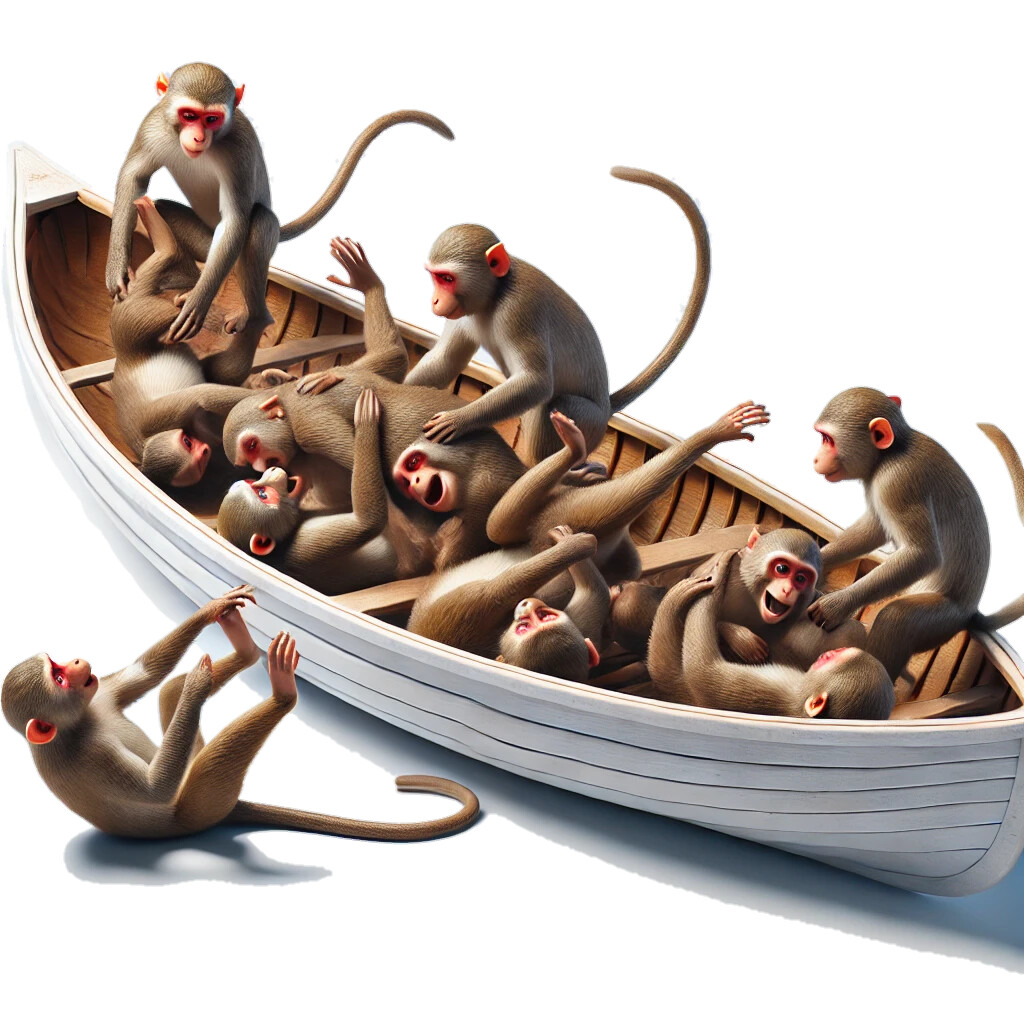

¡Qué bueno!
I’m just using it to rehearse my drivers licence examn, and I stress REHEARSED,
I find it it difficult to hold on to the knowlege long-term if I don’t.
Recall still requires repetition to obtain routine, but, I practice every day and it’s paying off.
My steps: phase1. index
what i need to know: a rule, then, decide: is it an abstract or a figurative fact?
Then phase 2. ‘translate’ from abstract to figurative, starting out with a rebus, then singling out a single image in order to be able to fix the recall on one image.
then phase 3. placing it/ making a cartoon in my mind of it at that location.
Then I rehearse every day.
I find it hard to learn this technique just by going on some random image in my mind.
I’m not a memory master, I’m okey with that, I’m just happy that this seems to be working!
Abstract facts don’t learn themselves.
Especially the ‘from rebus to single image’ step took a while to master.
Extensive rhiming/ alliteration practices were usefull, using a horizontal and a vertical alphabeth to come up with figurative words both living’ and dead’ (animals and professions as living’ and objects as dead’.
You guys probably had a way easier time than me.
Let me know how you’ve fared from beginner to seasoned study guide?
1 Like
In university I had two summer courses that I had to take but didn`t really care about because they were unrelated to my degree or my interests. Rather than studying I would spend about a half hour before the exam memorizing what I needed to and then go in and take it. I passed both classes with 90%+ and after that semester I was like wait…why didn’t I use those techniques for classes that were actually important??? Sigh.
2 Likes
Hi. How you use it as mantra?
Pick a mantra, in this case, one that speaks to the reduction of monkey mind.
Memorize it then recite.
The exact amount of recitation to address monkey mind is unknown and other practices may be required, such as attending to physical fitness, sleep, etc.
2 Likes