Thank you very much for this long form mantra meditation elaboration!
4 Likes
@EnderRyder, but of course.
Do you think you’ll give it a try?
I’m curious if the content actually matters. I might split-test with something like Ursonata, though as much as I love it, without some kind of semantic content, I’m not sure it would create a remotely similar effect.
But reciting it at the speed Christian Bök does it would almost certainly generate something like “runner’s high.” 
3 Likes
All the time.
I teach improvised theatre, and do presentations about improv and creativity for companies around North America. I use memory systems to remember all the participants names without having to play a bunch of name-games or wear name tags, I memorize hour long, or longer, presentations so I don’t have to look at notes. I make sure to remember details of students and clients lives (names of spouses/children, occupations, etc…). And sometimes I memorize a shopping list, but usually I just use my phone since my wife and I are adding to it randomly throughout the week and you never know what’s on it until you get to the store.
But yes. I use memory palaces and visualization to remember things all the time. I can’t believe I went through so much of my life not knowing how to do it, or understanding the importance of just knowing things without having to look it up.
18 Likes
After reading all the responses with suggestions of using a memory palace for mindfulness meditation, I tried this and it worked really well—thanks for the suggestions!
Most groups I speak to average between 30-50 people. I can’t wait for the world to open up again because I look forward to more practice with all kinds of groups of different sizes.
That’s a great size for doing that particular demonstration  I’ve been doing a bunch of workshops online recently, but I also can’t wait to get back to offline workshops as you can’t beat the dynamic of having everyone on the room together!
I teach improvised theatre, and do presentations about improv and creativity for companies around North America. I use memory systems to remember all the participants names without having to play a bunch of name-games or wear name tags
I guess this would be super useful for teachers at the beginning of every year when they have dozens of new students to remember while trying to appear authoritative 
I also use mp to keep a grocery list in my head throughout the week so that I don’t have to write down a list. It works great.
Nice—very practical!
5 Likes
I’ve been using the method of loci for about 1month now and I’m completely hooked!
Currently studying horticulture and I’ve managed to remember 43 British native trees, both the Latin name and common names (so about 86 pieces of information) in about an hour. Can do it forwards, backwards, in bloody any order!
Attempting to remember literally everything I find interesting. As for the amusing situation…I soon ran out of ‘real life’ loci so instead I’m using Call of Duty maps! I actually find their much better locis because each map is unique and different.
I like to read books but more often than not I forget most of what I read. Using this method helps solve that
Thank god the internet lol
8 Likes
That’s interesting. Which Call of Duty are you using? Do you remember the layout just from playing the game or is there a way to walk through the maps without the game action?
4 Likes
Yeh I create a private match and slowly walk through the maps as many times needed so that the layout sticks in
I’m using COD Black ops 1
6 Likes
Hi Elitely, I would really like to understand how you use mnemonics for chart patterns and the movement of a stock that you entered and exited. Would you please share a few examples. Thanks
6 Likes
I regularly use mnemonics in my daily life. I always recall telephone numbers from memory. At university I remember my notes almost word for word. I regularly memorize sports statistics. Therefore, I can write predictions for fights from my “mental library”. I also use my skills for card counting.
11 Likes
I used/use following mnemonic techniques for memorizing the stock/chart movements.
- Memory Palace. I put the stock chart in a locus/loci
- Each important event/move of the stock is ‘converted to a concrete object/image’. For example,if the stock ‘pullbacks’,I convert the idea of pullback into a concrete image of ‘pulley’.
- I create story with the story/link technique using the converted images to create a ‘story’.
- I review the ‘loci’ and story time to time…
Below is a profitable trade that I took back in September this year. I created ‘mnemonics’ for all important moves of this stock including my own reactions to the market.
If you see the chart,you would see “Arrows”. Each arrow points to an important event of the stock move.
------------------------------**----------------------------------
Below are the main moves(entry,exit and hold) of mine in this trade! I have created the mnemonics for this stock trades of last one month. This way,I will be able to recall the history from memory:
Bought due to bottom and volume spike (Butt+■■■■■■)
Didn’t add in small pullback,after fall of bonus (bone)
Added heavily at the top and regretted (adidas+top)
Sold with 8% profit (08)
Pinbar in index (Pin)
Pullback over (pully)
Bought again (Rod)
EPS on October (Octopus)
Added more (addidus)
Exited,again with 7% profit, at the top due to ‘intution’ (07)
The stock fell (rail)
Perfect Exit (perfume)
------------------------------**------------------------------------
Now,what I do is to put each ‘image’ from above list in Arrows of the chart below. For example,in the ‘Pinbar’ of the chart below,I imaging a “Pin”.
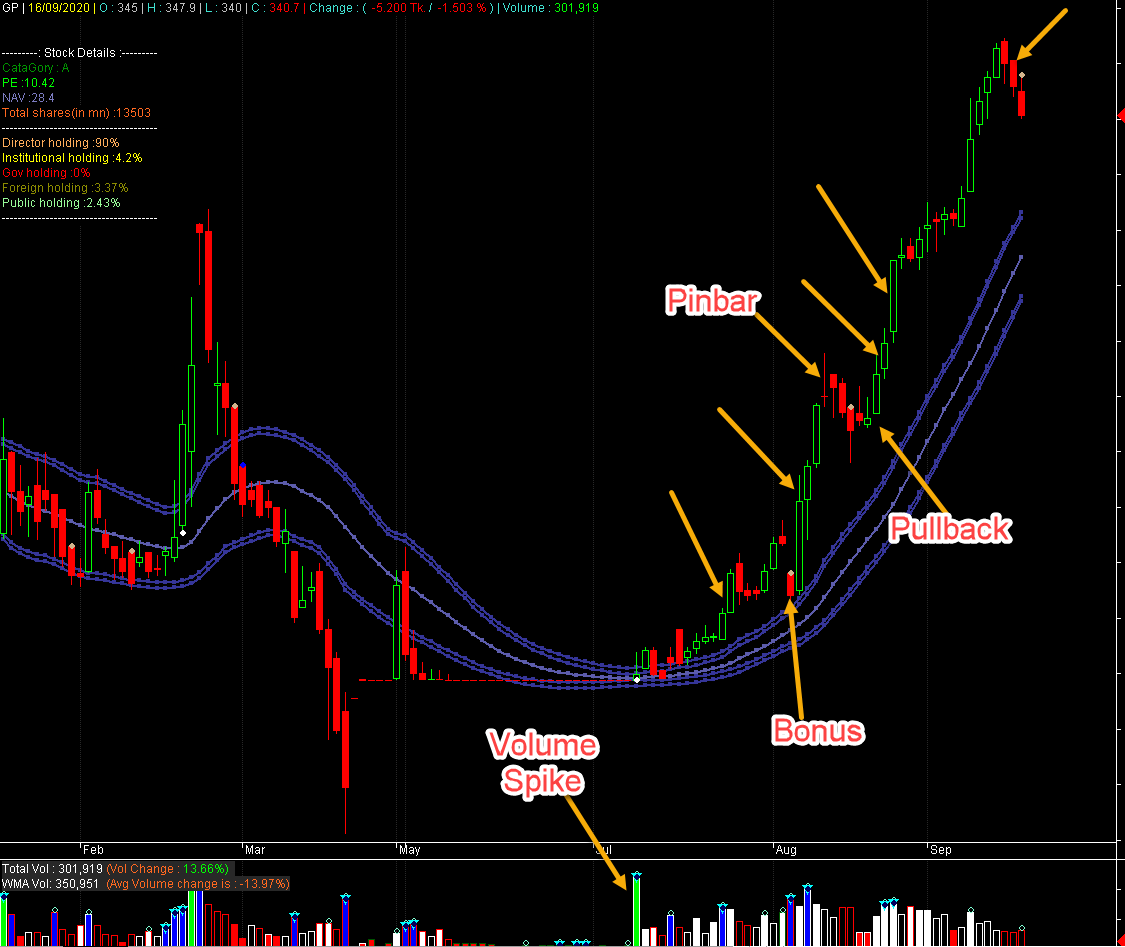
I also create a ‘story’ with the mnemonic images from the list above and I imagine the story happening one the chart. For example,from the image above,we can create a story with “■■■■■■+Bone+Pin+Pulley”! If we create a story in this way while imagining the story happening on the chart,it becomes very easy to remember the movement of the stock/and the chart! Cool…You can then visualize the chart in your mind’s eye and also recall the history of the stock moves,and what you did,how you reacted in the trade…
If you can recall the story,you can easily visualize the chart in your mind’s eye…
And this way,I can easily memorize the ‘events and the stock move’ easily. Too easily.
It is so easy to then recall the stock moves and what I did with the stock-my faults,my strength,my weakness!!
I think,it is better to use Memory Palace to store the stock movement instead of journal. It is because,you can always recall instantly what you did at the certain move of a stock,without referring to your stock journal…
I also used ‘mnemonic’ techniques to memorize all the patterns that I use in stock trading. And also,the psychological biases…
Pretty cool and ‘strong’…!!!
Here is the link to my ‘journal’ on this stock trade>>>> https://www.notion.so/elitely/GP-cddacb2fb3814c628a7c48136f28ffb4
Here is a link of my blog in which I have shown how I used mnemonics to memorize some stock patterns/rules>>> Mnemonics and stock trading: patterns and rules – mrtq13
15 Likes
I´m a magician, but stage performance is too obvious or secret for this topic and I´m not even working as a magician right now.
I´m also an actor, and having trained in mnemonics is very useful for me there, to learn the scripts very fast and concentrate in the things that matter. But I don´t use any specific artificial technique mechanically describable to remember the script. I don´t have enought experience to have an expert memory in the subject either. It´s just like… I study it, I visualice the objectives of the character, the situation, why he says what he says in relation to where he is and what the other character said, the possible tones, whatever else is actually about theater and serves to memorize, and repeat, many times very fast, vocalizing or at least moving my mouth in silence, or something like that, sometimes with a trick here and there like a string if I recognize I need it on the fly. And it works. And I get rid of the paper the same day I get it if I can, or at least before any serious practice so that I can look at my partners and think about more important stuff for acting than just saying the script correctly. I know that´s not so hard to do this by any means, but I wouldn´t be able to do it if it wasn´t for my practice in memorizing trivial stuff like words and numbers as fast as I could and learning from that about the importance of linking or visualizing or… whatever one learns from that that then is extrapolated to the whole memory like holistic fshhh.
Also, some people who know I have a mental calendar ask me instead of checking their dam calendars! it´s nice.
11 Likes

One time I forgot my wallet and I used my memorized credit card to pay for something, which I have memorized with mnemonics.
Plus I find it “real world useful” to memorize information of things I’m learning.
8 Likes
I recently used the 33 candlestick patterns on Steve Nison’s book to a palace of 33 loci’s. The charts are easy to see for a novice like me.
Would like to look into your method when back testing.
5 Likes
I use it to memorise new places names when I visit new cities. It helps a lot.
5 Likes
Instead of memorizing classical “candlestick” chart patterns, I prefer to just understand why the ‘candles’ really form during trading hours or end of the day! That way,I don’t need to memorize the classical patterns!
Also,I like to analyse the candlesticks in the context of overall movement of the stock…
8 Likes
agree with you there.
When I started, not so long ago, I was thinking of memorizing all candlestick charts thinking that it will give me all of what is required.
The more I read, figured out that it is not the case, but to find a trading system that suits your personality and back testing as much as I can.
Then I can memorise the outcome of the trades, why I enter/exit a certain trade and the lessons learned.
6 Likes
Sanskrit is indeed the most logical language I have ever had the pleasure of learning.
There are plenty of forms of word roots (I think that would be the most appropriate English translation) for subjects and objects to be memorized. These word root modifications are present in 3x8 tables - each of the three columns for singular, two and more than two subjects/ objects respectively; the first seven rows based on the whether the action is being done by, to, through, for, from, related to, into/onto the subject(s)/object(s) respectively, and the eighth row for when the subject(s)/object(s) is (are) being addressed to. (Some of those prepositions and modals might seem redundant, but the difference is hard to convey in English.) This word root pattern table to be followed is based on the gender of the subject (three of them - masculine, feminine and asexual/ non-living) and further on what sound the word root ends in.
There are 3x8 tables for pronouns too.
Similary, each verb has 3x3 tables - each column based on the number of subjects performing it, and each row based on whether the subject is in the first, second or third person. Each verb has 3 tables each based on the tense, 1 for when the verb is being used in the context of something that should be done or ought to be done, and I think another table whose purpose I shamefully admit I remember not.
However, once someone has successfully memorised all (or atleast a significant proportion) of the above, Sanskrit is an extremely no-bull$hit, no-frills language. There are no exceptions whatsoever to the above rules, unlike English which is full of conventions and it-is-what-it-is’s. Even the Devanagari script is incredibly easy to pronounce and speak once you get the letters right - for example, to say the word “pen” in English, you say “pen” while it is written pee-ee-en. In Sanskrit, the word for pen कलम् (kalam) is pronounced exactly as each letter is written: क (ka), ल (la), म् (m, just the beginning of the m sound as in Mars or moo).
So yes, a significant part of learning Sanskrit is indeed based on memorisation. I have not read much Sanskrit since middle school and intend to brush up my skills and start reading wonderful, powerful ancient, texts in all their untranslated glory and wisdom once I find the time for this endeavor.
For people who have developed efficient memory techniques such as the ones present on this extraordinary forum, I can say without hesitation that Sanskrit would prove to be a lovely minor challenge, the least frustrating and the most rewarding language to learn, especially if you are interested in the wisdom of the ancient Indian texts.
7 Likes
I’m a customs broker, recently I started giving each client a temporary room where I would store any relevant information about that transaction.
For example:
Container number
documentation reference number
Taxes to be paid
if I encounter a new tariff code (9503.00.90 - toys) I would also create images for them as I’m working.
4 Likes
pen कलम् (kalam)
*writing reed कलम (kalama)
म् (m, just the beginning of the m sound as in Mars or moo).
*म (ma)
2 Likes