Greek mythology – How I am organizing the info

Hello.

I have lurked and asked in here, so I thought I could, at last, contribute with something – namely my way of learning Greek mythology.

For some time, I have been trying to figure out a neat way to learn the family tree (the most important parts, at least) of Greek mythology + the chief characteristics of each member. There are so many cross-connections and different types thereof in the tree, so it seems to be a problem of a topological nature.

To start, I used my home to categorize the Gods and mortals in the categories Sky Gods, Titans, Olympian Gods, Deified Mortals, Underworld Gods, Primordial Gods, Sea Gods and Daemonses. I thought this would be useful information to know what sort of God we’re talking about.

Example. For entrance to room #1 (Sky Gods), a cloud is on the door. On the door to room #2 Titans there a picture of the Titanic. In this way, I know which category the Gods are.

In each room, I have a person/thing which helps me know which God is in each sub-location. For example, after opening the door to room #1, I see someone I know called Annette, and I link this to the Greek God Anemoi. Next, on a chair, I see an Atlas globe, which I link to Atlas, etc.

Ok, so how to deal with the rest of the information? I have used added compartments (inspiration to a video of @metivier), where you can “zoom in” on an item to extract even more information. In the previous example, Annette is wearing a compass, because the Anemoi are the Gods of the four winds – North wind: Boreas. West wind: Zephyrus. South wind: Notus. East wind: Eurus. And I thought a compass could be a fitting item to link this information. So at the North pointer is, for example, David Boreanaz. At the East pointer, a Euro coin flashing and rotating – just to make it all more vivid and rememberable.

I have not yet completed the family tree, ie. rendering information about how they are related, but I am thinking of linking any of their parents. So for example, for the Anemoi, their parents are Astraeus and Eos. I could perhaps link this information as Annette (again, my peg for the Anemoi) having a star and an Ace card dancing around on her head. Another possibility could be creating another “compartment” on Annette, for example her wearing a fanny-pack. If I “zoom in” on it and open it, elements/items emerge which provides additional, various information about the Anemoi.

Feel free to chime in on thoughts you might have, good or bad, or perhaps suggestions to improvements. Isn’t the goal, after all, storing as much information using as little information as possible?
7 Likes

You might want to read Bruno’s Lampas Triginta Statuarum for this goal.

I’m actually memorizing a bit of it in Latin right now, and Scott Gosnell has a translation called Thirty Statues on Amazon.

There’s apparently another translation of it in this book that looks like it might be servicable:

Anyhow, I think of this for your goal because there tend to be statues and paintings of these gods.

But at the end of the day, what matters more is how the Memory Palace is used for generating long term memory because often the crucial links form themselves once the foundational information is laid.

And all the more so you bring in decent doses of reading, writing, speaking and listening to others speak about these topics.

This is critical for this kind of information-type because it’s not as if the links ever end. There are revelations yet to come into being, which is just one of many things that make mythology so exciting.

To quote Bruno himself and get in a little writing practice of my own:

Habit ergo Chaos, non statuam, non figuram…

I think part of what he’s getting at is a proto-information theory of expansion for which we need to prepare ourselves not just for the links that currently exist, but all the links always yet to come, ergo Chaos.

4 Likes

Cool setup.

My project uses family tree branching and I use loose networks of related people I build into family trees.

I still need to memorize my family trees of people separately but picking related people in smart ways reduces the overall cognitive load a lot for me leveraging those relationships I already know.

Not sure if this is helpful at all but I figured I would share since I am doing some family tree.

1 Like

Thank you for sharing this.

1 Like

You should have your “model” = planned palace, so that you can organize your “memory objects/agents” = characters, sequentially by alphabetizing their names and connecting them to others by their initials. You should number the “spaces” = rooms, divide the walls into “focus points” = points where the view can focus, and you can divide each wall into 8 parts. You can also divide a table, furniture, etc. Each model has 6 areas - 4 walls, 1 floor, and 1 ceiling - which you should number and divide. Place your “memory objects” = characters there and link them to each other, so that the first one reminds you of the second, third, etc.

You should have actors representing your characters, even if they have the same face. The important thing is the characteristic objects of each character, for example, Hades is associated with the scythe, Cerberus, and the Underworld; Zeus with the lightning bolt, Hera with marriage, Artemis with hunting and guiding, Atlas with the world sphere. I already have them memorized, including the Norse gods, in categories. When you’re configuring them, don’t be afraid to link them all together. For example, the sphere of Atlas also reminds me of Sisyphus pushing the enormous rock up the hill.

Thanks for your input. You make some good suggestions. If you by chance have your loci for Greek and Norse mythology written, I would appreciate having a look if you don’t mind. I am Norwegian myself, so Norse mythology is actually next on my list. :slight_smile:

With a character located in one place, I can remember up to 10 or more, remember that you must periodically review the characters, the best retained should not be reviewed like those that are not easily retained.

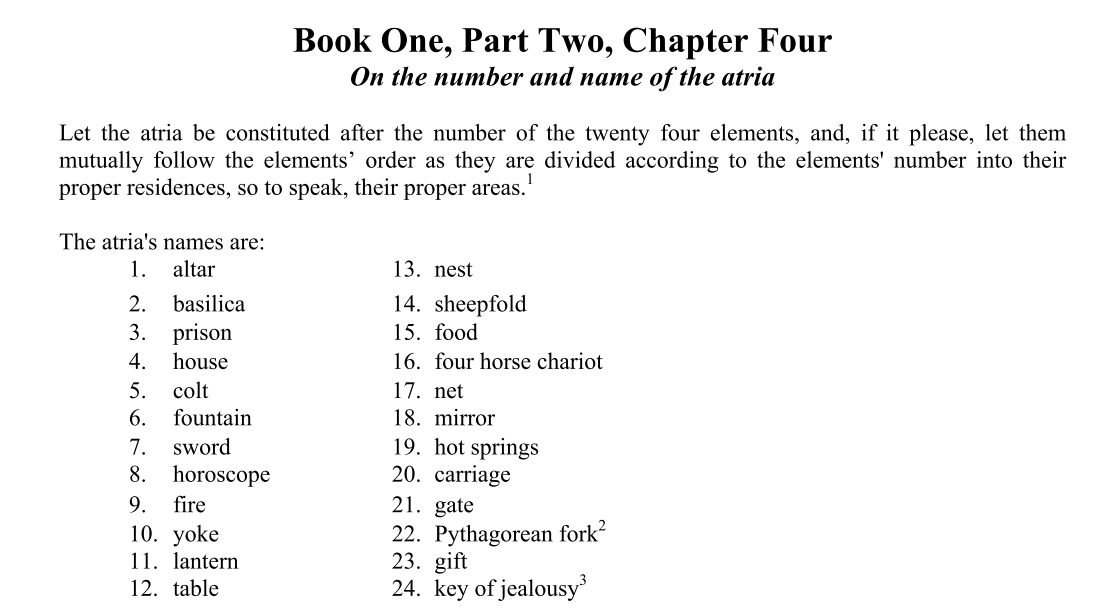
I have a couple of books by giordano bruno, but the truth, apart from trying to understand the text, the configuration of the places is an extensive task, in “De imaginum” he talks about these geometrical places, which in truth is an order of real places, with imaginary and real objects, it is a system similar to the list of pegs, but with places, it is a system similar to the idea that was had of how metrodoro de scepsis used the atriums.