Graphical analysis of performance: What to do about "recall vs. memorisation" times?

Hey!

I know this is nothing much at all, but I am happy nevertheless. After 26 journeys across 20 days of practice, I’ve reached the 5-minute-line for a deck of cards. Now, I’d like to pose a question for you guys on how to better proceed.

The image below shows a graphical depiction of my training sessions. The blue line shows the actual memorisation times while the green line shows the recall times. To the left of the red vertical line, I was using a “categorised deck of cards”, meaning that I shuffled each suit separately and then stacked them. So, it was obviously much easier to memorize than a fully shuffled deck. My intention was to go light on me, so as to not get frustrated and eventually quit practicing.
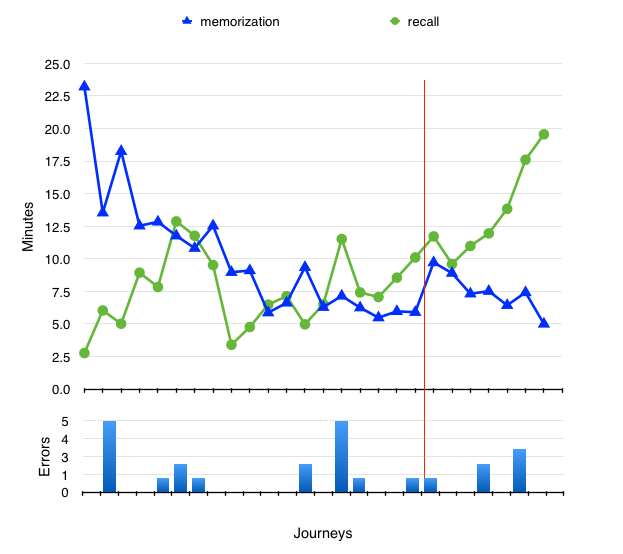
A brief analysis shows that recall time usually goes up when memorisation time gets lower. This is understandable, since more time spent memorising each card suposedly better imprints it in memory. A rare exception was on the ninth day (sorry, but I couldn’t put x-axis values in this weird Mac Numbers; I shall use R next time), when I managed to lower both my memorisation and recall times. Recall went well below 5 minutes, one of the three only times I got sub-5 min recall times.

On the 11th practice, I got a “local” best time of 5m52s and then stayed on an overall plateau (although reaching the best time of 5m 29s) until the 19th journey. What I didn’t like was that, although I was keeping my memorisation times reasonably low, recall times were increasing too much.

I then, out of impulse, decided to switch to a fully shuffled deck (to the right of the red line). As expected, my memorisation time went up again considerably, reaching 9m43s, but then kept going down. But that was on the expense of the recall times, which were skyrocketing. Yesterday, I had a worse memorisation time than the day before, got 3 errors (bar plot below) and had a terrible recall time of 17m36s. I thought “You know what, this recall time is so bad, I should just force myself to the 5-min threshold line.

And so I did. I found this online metronome and set it to 10 beats per minute. This would mean 5 minutes and 12 seconds, so I separated the last three cards and decided to use the 6 seconds I had for the 50th card to “rote memorize” the last 3 cards. That gave me exactly 5 minutes when the 51th beep sounded.

So, great, I memorised a deck of cards in 5 minutes. This is a nice milestone to reach. Now what?

The problem here is the recall time, which, in turn, is simply the reflection of bad memorisation in the first place. When I take my time and spend all the time in the world for memorisation (I did that only once during these 20 days and I used a different improvised memory palace for that), my recall is perfect, meaning that I actually see all the cards where they are supposed to be and recall them in order, one locus after the other. When trying to go fast, recall is a mess! I begin from the last memorised card to the first, but stop after around 30 cards and begin from the other way around. I leave many holes between cards, which I fill up by elimination and constantly re-running the cards in my head. I feel bad when recalling this way; it is not fun at all. BUT, I did memorise a deck in 5 minutes…

So, basically, what I would like to ask is how to proceed now. Do I keep the metronome in 5 minutes and just keep practicing? Do I take my time while memorising and try to recall in less than 5 minutes and adjust accordingly? What now?

Thanks in advance for any help! (and sorry for the long post)

Best!
Tammish.

Firstly, congratulations on the 5-minute mark! I remember how excited I was when I hit it. I love how analytical you are. I think it will do you well in this endeavor. I could stand to be a bit more analytical myself.

When you ask “What next?”, I ask you, “What are your goals?”. Are you doing this because you want to compete, or just accomplish a personal goal? If you want to compete, I’ll just defer to some of the great athletes on this forum. I will say, if you want to compete, perhaps you should begin simulating the competition rules, where you get 5 minutes to memorize, then 5 minutes to recall, and don’t go over those times. Make yourself go faster during memorizing using your metronome, and trust your mind to remember.

Hey tracym!

Thanks for your feedback and for the incentive words.

No, I don’t plan to compete, but I am using “competition challenges” because they provide great benchmarks for gauging my evolution. There has also been a lot said and done about them, so it is easier to get my bearings. Moreover, they force me to get better in all the necessary skills for any memorisation endeavour: visualisation, imagination, “mental spatial awareness”, etc. Well, I must also admit that I dream on improving my Blackjack skills, but this is a secondary objective.

What I really want to is to work on a system for memorising “everything”. I am slowly gathering the necessary bibliography and thinking more about this goal – I see it as a great life objective. Everyday that passes I get more interested in the Art of Memory.

So, I guess as far as my question “what next” is concerned, you can assume competition as the goal. I think what I will do based on your suggestion is to keep using my metronome on five minutes, but also set an alarm at 5 minutes during recall. When it beeps, I’ll then quickly count how many cards are left unplaced. This will be another good way to gauge my improvement.

What I did yesterday was the reverse though. I was tired, so I decided to take my time in the memorisation. That would also be good to confirm that memorisation and recall times are rather inversely proportional. It took me 10m20s to memorise and 6m27s to recall. Curiously, my previous attempt using the metronome gave me 5m for memorisation and 10m30s for recall – quite inversely proportional, don’t you think? It was much easier to recall and I had a much better visualisation of the cards. I’d say now that I can memorise a deck in 10m FOR SURE. That is also an interesting data point. I could never imagine doing that before.

Thanks!

What program did you use for the graph?

I think Numbers - Official Apple Support ?

LibreOffice is a free alternative that will run on non-Macs.

Yes, Numbers is the default spreadsheet program for Macs.

It is convenient, and the graphs are nice, but they are cumbersome to customize. I would rather export the data and plot it with R. It is an entire programming language though, so the learning curve is steeper, but the graphs are topnotch and 100% customisable.

And it is free and multi-platform.

Thanks for the thoughtful OP, it was a pleasure to read.

How about you keep the metronome where it is and memorize far fewer cards? Given the length of your recall time, you could get in far more memorization practice this way, as well as more (and better) feedback. Just do 18 cards to start. I know that’s a really small number, but best to start low just to check and make sure your recall is quick there. Within a few minutes, odds are you’ll choose to move up to 21 or 24 or more - just don’t raise the card count for no good reason, or if you have a reason not to.

If your recall is still really slow at 18 cards then they’re not being memorized well at all, and IMO there’s no reason to memorize more than that now. If that is the case then you are sure to bring that recall time down rapidly. And once it indicates sufficiently solid memorization (whatever that means to you), then move it up a little. You won’t get the satisfaction of a lower 52 speed card time right away, so this isn’t for you if you need that kind of instant bench-mark hitting gratification to stay excited. But if you don’t need that, this is clearly a more efficient way for you to practice, if nothing else. As you improve here, two directions will emerge, and I think you should take them both, and graph them both as well. It has always been more helpful for me to work on various aspects around the same time as each other rather than just doing one thing the same over across many days. You can add more cards to the 18, which you’ll probably do after your very first try since 18 is such a drastic reduction in quantity. And you can stick at 18 while increasing the metronome slightly and trying to obtain a lower Total time (memo+recall) than baseline by memorizing more quickly and not slowing your recall speed too much. Two more things to graph and improve at quickly that won’t waste the time you’re wasting on recall now. Plus, you said that having to recall like that isn’t even fun.

Just some leads to follow if they make sense to you. Keep the graphs coming!

Hey LociInTheSky!

Thanks a lot for your feedback!

Really useful stuff here. I’ll be sure to do just that. I’ll use my one-and-only memory palace for three daily memorisation runs using the reduced 18-card deck. Then I’ll practice increasing the metronome as you suggested. I will also finally do what I have been forever procrastinating, which is to build another memory palace. Then I’ll use this new one to keep increasing the number of cards to memorise.

It’s nice that you mentioned “total time” too. My graph analysis showed me that, because of the inversely proportional behaviour between memorisation and recall times, total time seems to be a better measure to gauge “real” improvement. At least, at this point of my performance when I am still trying to get within minimum competition requirements.

This kind of training will definitely be more fun! I’ll be sure to post new graphs eventually.

Thanks!

Best!

Tammish.