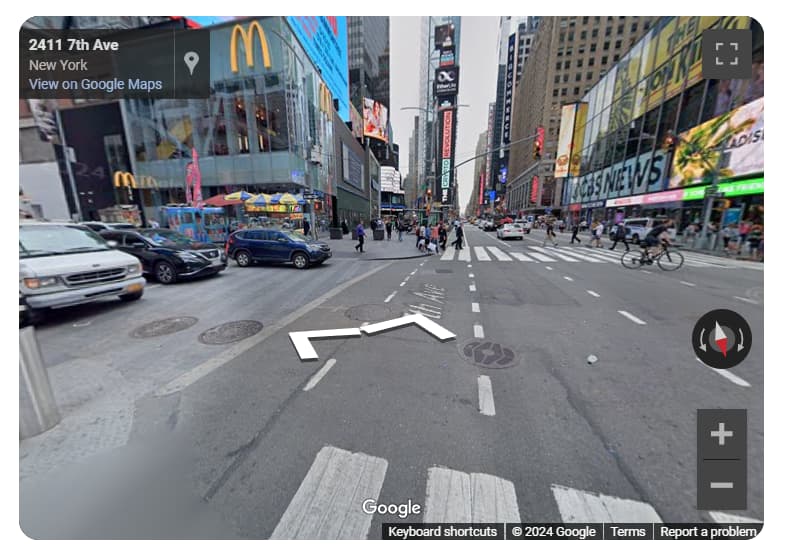
Google Map & Neighborhoods

I started to create a big Memory Palace for vocabularies with the neighbourhoods of the city I live in. I guess I don’t like closed spaces or rooms. Maybe it’s because I reach the limits too quickly, I’m not sure. Or open spaces are more suitable for me because I like travelling. When we think about the cities of Türkiye, each letter of the alphabet corresponds to at least one city, except for one or two letters. If we consider the shops located in the neighbourhood borders of each city, we can count around 1,000 shops, that is, words.

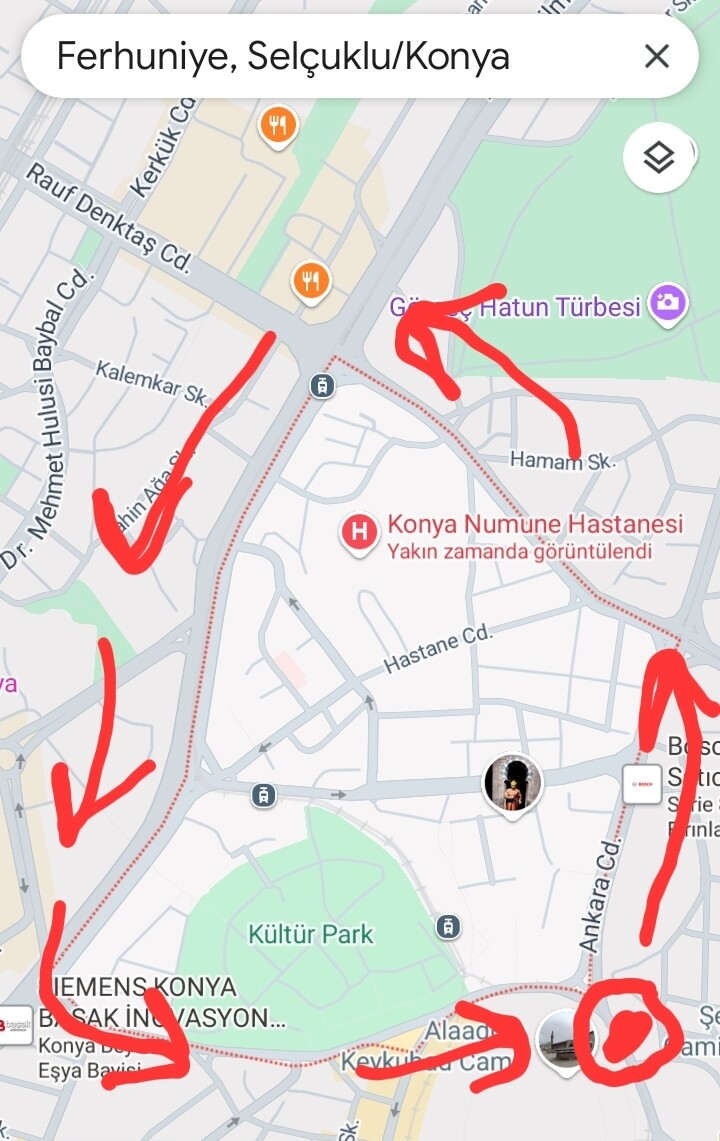
I started from the southeast corner of the neighbourhood border and moved in a counterclockwise direction. I identified each shop I saw as a place. When I returned to my starting point, I continued with the borders of the neighbouring neighbourhood. I followed the same route and starting point for my journeys. I plan to apply this method in different cities for each letter of the alphabet. This way I can work with all letters. What do you think about this idea? I would be grateful for your thoughts.

3 Likes

Can you please tell me how effective is using city neighbourhoods and their landmarks as a Memory Palace for memorizing vocabulary, and are there any tips for optimizing this method?

I tried several different styles of pao and similar systems. I used my own house as a memory palace. I see that I am progressing very slowly in word memorisation. I tried different houses, big luxury houses, but after a while I gave up because of the similarity of furniture and designs in the rooms. I don’t know about others, but it seems that the more the workload increases, the more likely I am to get confused. That’s why I’ve embraced the outdoors and walks, I’m a walker in real life too, so these open spaces seem more memorisable. I thought of a few ideas while memorising words, but I didn’t have the chance to try them. For example, I look at the word lists on paper and visit the memory palace for their meanings’ image simultaneously. Or I listen to the sound list of the words and visit the memory palace again. Another alternative would be to use my pao system that I prepared before. It was about transforming words into numbers and numbers into persons, actions and objects. Over time, I got faster in the system, I can directly transform the word into a person, action and object. This creates a story and I can place it in a store in the memory palace. In the next store, I can place an image that gives the meaning of the word.

2 Likes

I also like “street memory palaces” (outside places) a lot. Walking while you are memorizing (or at least memorizing on places you have walked in before), I feel that it reinforces the associations.

And I had a lot of problems with it in the beginning, but I feel I got the hang of it now, in a way that works for me.

One of my problems was that, if I use houses/shops, I tend to mix up the stations. For example, I know how to go to from my home to the supermarket, and I know that I’m going to pass a pharmacy, the shoemaker and the butcher’s on the way, but in which order are they? I can’t say.

I think it’s Lynne Kelly that recommended me to avoid straight lines and to think in sections/zones. And after practicing quite a bit I can confirm that the most twists and turns a route has, the better I’ll remember it.

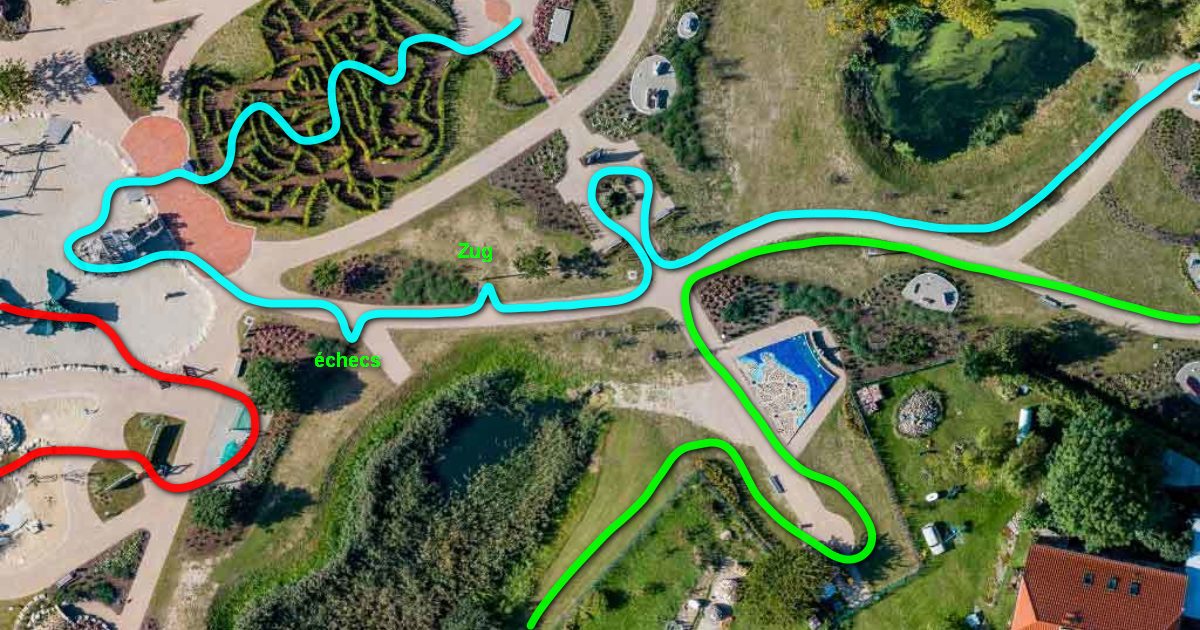
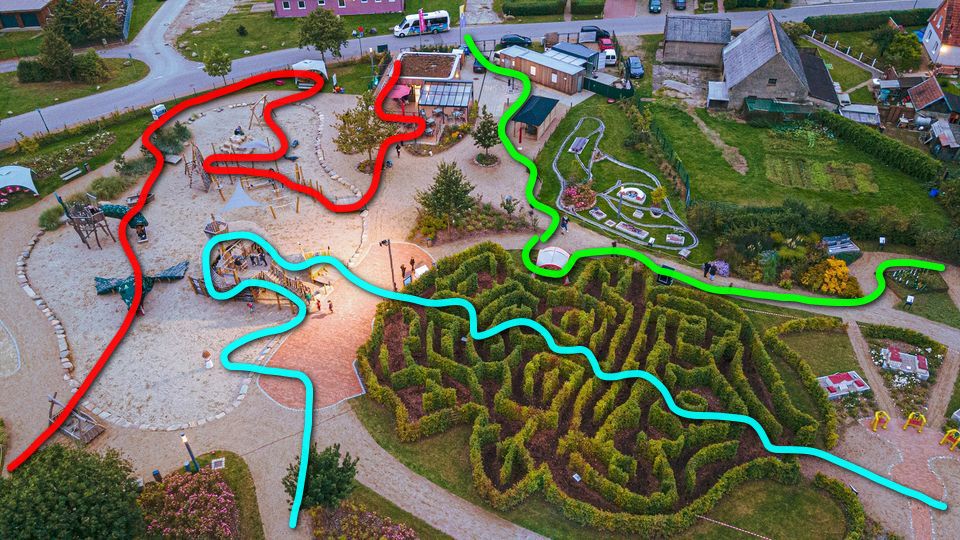
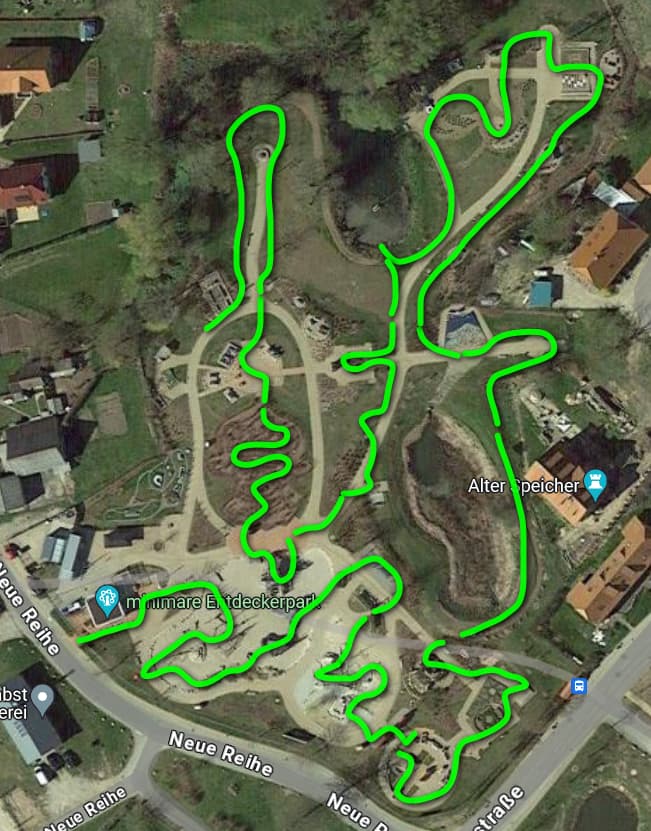
Here’s an example of playground/open air museum in Germany. I was only there once, but we stayed a few hours (children enjoyed the playground) so I had time to walk around and take a lot of pictures.

Later I went on google maps (drone pictures work really well too) to trace a route that would take me through all the things I had noticed. The main playground is the center with the other parts sort of radiating from it, and the journey goes 3-4 times through it (each time in a different zone: big pirate ship, water playground, dragon’s den, small ship and island).

It’s not that big of a park, but it still provides 145 stations. And, if I had been more careful/precise while I was there, I could have had even more, but it was quite hot and meh… I just wanted to enjoy my ice cream.

The best for me is to use places near my home, because I know them better and/or I can easily go back and walk there. The better you know a place, the more detailed you can go (more twists and turns, more stations/loci).


2 Likes

Thank you very much for your suggestion. I will think about it. There is something I wonder about this subject. Isn’t it more useful to think of shops and items as stations to associate them with the subject we have memorised? Or are we limiting ourselves by thinking this way? In other words, how will we construct the relationship between the region itself and the thing to be memorised? Can a relationship really be established with each turn? Based on my own example, when we think regionally, for example, I would associate playing games between a park and the keyword I want to memorise. Because I would ask myself what to do in the park and I would say play games as an answer. But aren’t street corners or intersections all the same? Wouldn’t that make me feel restricted? Shops made sense for this reason.

I may not have fully understood you, for which I apologise. I am not very familiar with the terminology of memory palaces. If it is not too much trouble, could you explain it like a recipe using an example? I like concrete examples more than abstract concepts.

On shops:
I don’t like them too much, because they feel too temporary (it’s a real pain when a supermarket changes the shelves and/or the decorations and you don’t find anything anymore) and also they don’t feel distinctive enough (I’m not sure I can distinguish one shoe shop from the other, especially if they change the decorations/shop windows regularly). But it’s a personal preference perhaps?

I suspect a lot of these things are down to personal preferences. I like to be in parks and that’s where I notice the most details. If you like shop windows and building facades and notice the architectural details, go for it! It may well be the way it works best for you.

But I’m not sure I understand your question exactly… I’ll give another example of a “street palace”: I have the problem in English that I’m often unsure of my prononciation because I don’t know where the stessed syllables are.

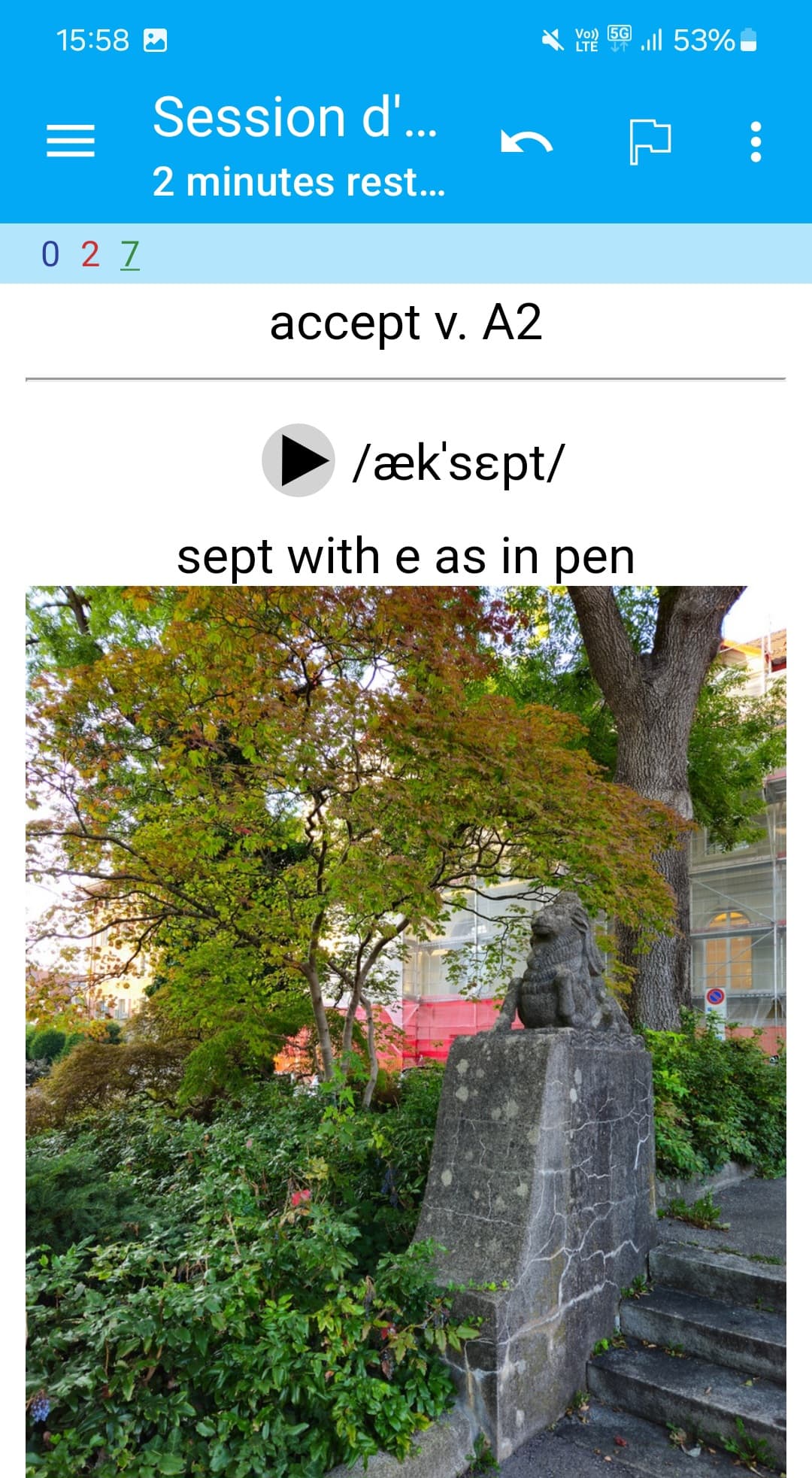
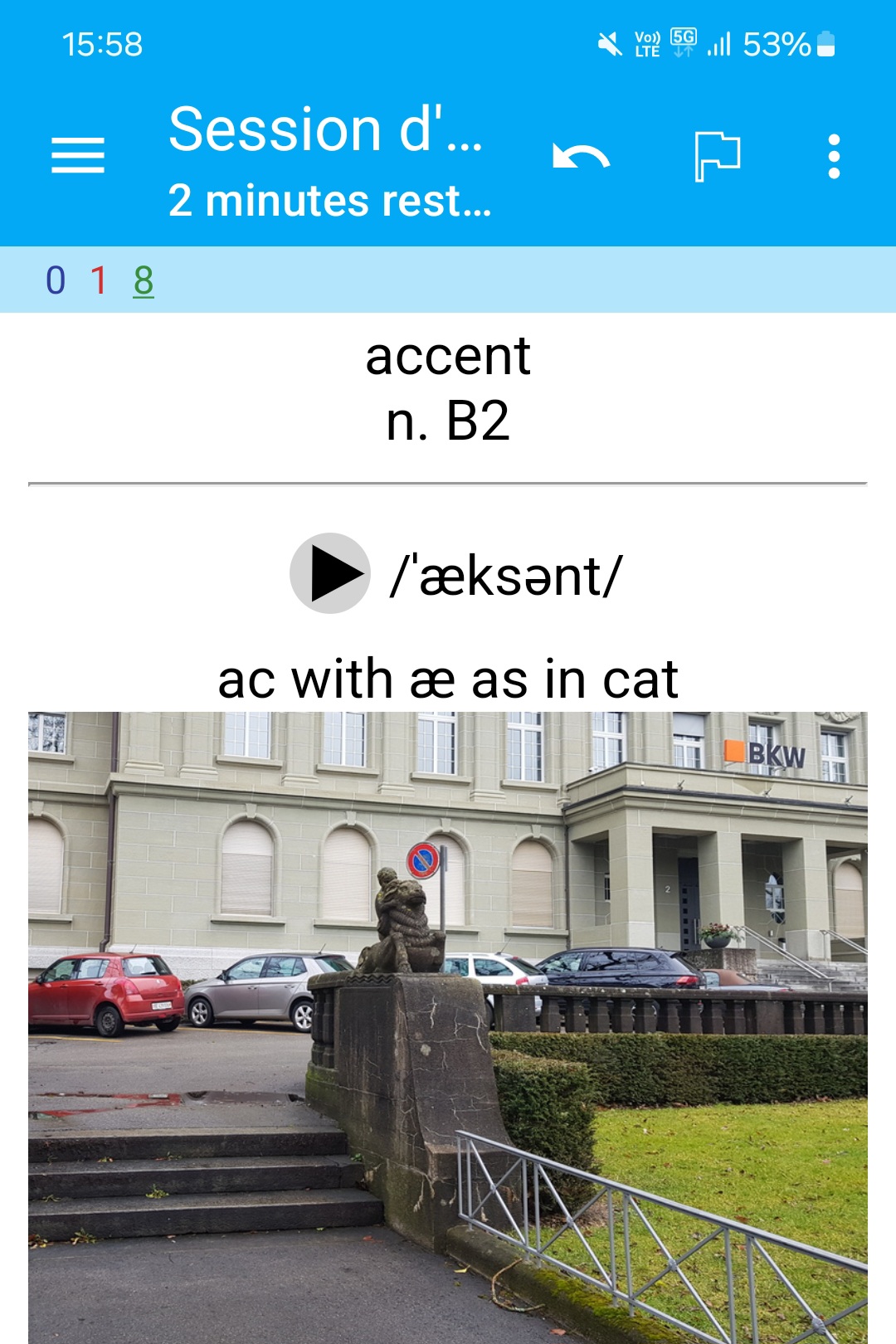
So I took a frequency list and went on the street near my house. I didn’t choose the location thematically or anything, just walked around and placed the words on elements on the street in alphabetical order, one after the other.

My thought is: I have 5000 words I want to place that way, I have no time to be difficult and choose a place that symbolises the words or anything. If there are no obvious associations, I’ll just invent them.

So we have the word “accent” on the statue on the right, what I want to remember is: the first syllable is stessed, with the vowel /ae/ as in cat. So I imagine the statue is an angry cat with an axe, furious that you made fun on his accent.

Next station, the little tree near the statue on the left wears the word “accept”, stressed syllable is the second one, sept with /e/ as in pen. So the poor tree is sick with septicemia and I take my pen to mark it down to be felled.

I’m just going as fast as I can, placing words with the first associations that come to mind, no matter how dumb they feel sometimes. Otherwise I feel I could be at it forever and I’ll never be finished.


3 Likes

I don’t go inside the shops, I just look at the windows and pass by. I place the words in front of the shops. I also saved a photo of each shop from the front facade in excel. I did this for precautionary purposes in case of a change. I set a goal of a maximum of 100 words a day, which can sometimes be less and sometimes more. The directions I will go and return every day are clear. This may sound monotonous and boring, but nothing gets confused. I go counterclockwise and turn left when I reach the neighbourhood border. I like your method, but isn’t it likely to get confused for learning sequential information? Even if your list is alphabetical, will you be able to remember the route you took? What I mean is that you seem to follow a different and random route every day? Do you remember the turns to the right or left? 5000 words is a long list. It seems to me that there is a possibility of confusion of the order and the route travelled. How many words do you study per day? Do you take notes, maybe this prevents confusion? Do you write down where and how you go, whether you turn left or right?

I realise this is a lot of questions. Please forgive me. I would like to thank you again and again for your time.

1 Like

I don’t mind questions at all. Quite the opposite, forcing me to explain my projects to people helps me gain more clarity. And sometimes reveals (potential) problems, which I’m grateful for.

Because I wanted to keep it short, I simplified things, which was probably misleading. In fact, It’s not entirely random.

At the beginning of the project I took a map (on paper, to draw on it) and chose the order of the zones I wanted to use: this square, then this street section, then this park, then this street section with the playground on the side, then this section of street with the shops, then the botanical gardens, etc. I basically just went through all my favorite/most well-known places around where I live.
I did it as quickly as possible, I just wanted to make sure I could have a route going through all of them.
I’ve no idea if it will be enough to get all 5000 but if not I can still prolong it later by crossing the bridge and going in the next neighbourhood.

So everyday I know to go to one of these zones, I know where I should enter the zone, and where I should go out of it. When I’m on site, I go more or less randomly inside the zone, but with the ideas of having the maximum twists and turns to get the maximum number of stations. It’s also something that I got better at with practice.

I can remember the route because either it’s logical (loci are in a row, one side of something, then the other side) or if it feels I could go either way while making a turn, when I take the photo on the locus I make sure the next one is in the background.

But also… I don’t stress about it. It’s useful for building the system, because it forces me to walk and move my body while memorizing the first time. But my goal is not to review sequentially. Since every word is an anki card I know they are all going to be reviewed anyway. Even if they come up out of order, I don’t care (I mean I’m not going to use the words in alphabetical order irl anyway).
And in the end, the whole point is to have it so well in memory so that I will forget the memory palace entirely so stressing out about making it perfect, isn’t a good use of my time.

And if I really absolutely need to navigate it alphabetically I still can go back to make “checkpoints” shine: a to ab words are in the triangle with the picnic tables, ac words are on the rest of the square, etc. (I still have the excel file used for the import in anki anyway).

Then I’d say you find something that works for you, so keep at it! Our brains are different so what we do is going to be different. I always find interesting to read about other people’s way of doing things. I may not use the same things as them, but the more ideas I can learn about, the more chances there is that I’ll find ideas to improve my own practice.
2 Likes

Google Street View

1 Like

Thank you. This explanation helped me understand better. Take care of yourselves. Have a good day.