Hello everyone!
As my administrative law exam draws ever nearer I’m motivated to procrastinate by writing up some of my thoughts on studying the miriad of smaller laws (about 80-300 paragraphs) I am being confronted with, in the hopes of eventually finding a streamlined process with which to work. Do note that some of the legal vocabulary used below may not be entirely accurate to its usage in an anglophone legal context. You can find some english translations of austrian laws on the federal law information system website.
Please note that this is a very rough first draft of what I hope will be an ongoing and evolving effort.
To start with, I’ve managed to outline some common features of austrian administrative law texts, drawing from things like construction codes, nature protection laws and administrative business laws while ignoring the purely procedural ones:
(These can, of course, be further subdivided)
- Scope: All of these laws cover a well-defined range of real circumstances, by which we can discern whether or not to apply a law to a given case.
- Subsidiary recognition: In lieu of establishing certain things themselves, laws will often defer to others, such as the General Procedural Law (AVG) for certain (often procedural) regulations while only writing down what regulations they want to differ from the law which ist being deferred to.
- Legal definitions: What even is a building? What even is a business? These will normally be among the first paragraphs, right after the scope is established.
- Objects: All laws are in some way concerned with producing some legal action or other: Whether that be a permit, a fine or an arrest, the principle remains much the same. It is important to know which “objects” there are and what one may need them for.
- Proceedings: How may one produce these objects?
- Remedies: If the proceedings go “wrong” at some point, how can that mistake be remedied?
- Penalties: How are deviations from this law punished?
- Costs: Who bears which costs concerning the proceedings? (Largely irrelevant in an academic context)
These can be ordered on a lullian wheel and combined, both with each other and with propositions such as ‘Party A’, ‘Party B’, ‘What does…entail?’, etc. to help you consider all angles in the legal process. Ie, you may, in solving a case, ask ‘What is the proceeding for getting this object?’ or ‘What does this object entail (ie what concrete legal form does it take)?’ or ‘What is the definition of…?’.
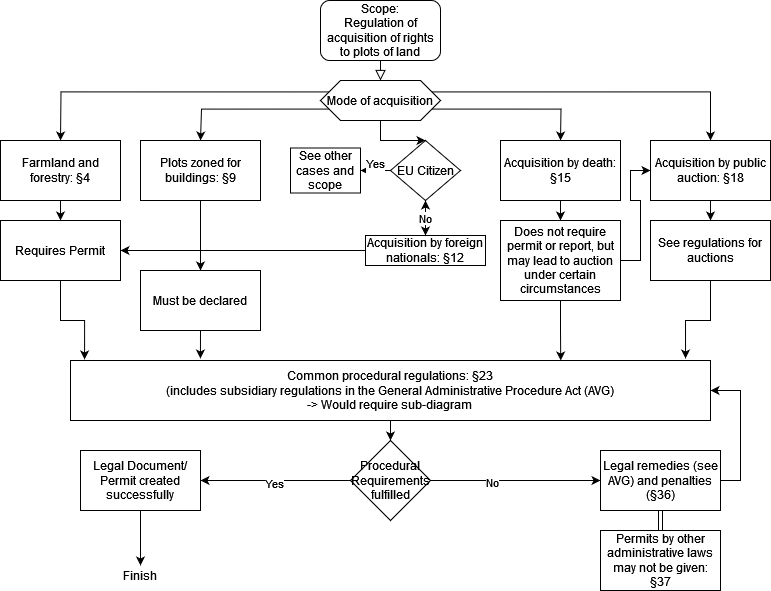
Now, as to actually studying law: I’d go with a quick skim-through of the text at first. Try to get a feel for its structure, and keep an eye out for regulations which do not (seem to) belong in their position. Identify ‘crossroads’, that is, places in which different paths in the procedure would diverge from one another (ie a shopping center will inevitably require a different building permit process from a brownstone). Map the convergences and divergences out in a flow chart if you need to.
You can now create a memory palace for your procedural divergences according your findings. For example, in building law I may have three neighbouring loci:
- Requires no permit or report
- Must be reported, but requires no permit
- Requires a permit
After creating an image (preferrably of a person, combined with the action/object for the paragraph number of the ‘crossroad’) for each of them, I would combine that image with the image of a nested memory palace to indicate the next step for each. Given that the paths will converge again eventually, it is not necessary to go multiple layers deep with these. Alternatively, I’d found that one can put the ‘nested’ loci in the same memory palace by imagining the same object or person at two places, then asking yourself ‘Where else have I seen…?’. The efficacy of this strategy may vary in practice. Within these nested palaces, you would then have the paragraph numbers you’d need in order to conduct whatever legal tests you need in order to rejoin the main ‘road’.
It is, of course, advisable to have the scope as the first locus on this route, and perhaps have the most frequently needed definitions ready in a separate palace. Here’s a simplified visual representation of what the whole thing may look like (excuse my MS paint skills):
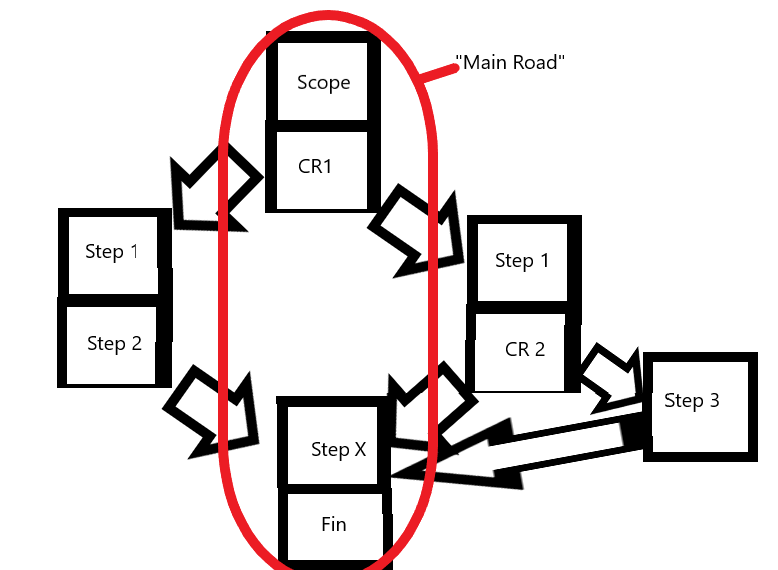
In essence, you would be ‘programming’ your system of memory palaces into a rough ‘map’ of the law. Quite similar to a real map, it only helps you find your way around the terrain. It does not contain every last exception and requirement, the same way a geographic map does not contain every rock or tree along the way (unless you want to put in that much effort).