Hi, I’m quite new in memory training and I have couple doubts about effectiveness of method of loci. It is even possible to remember so much informations in short amount of time? Can it be applicated in things such as biology, chemistry, history, etc. and how much time can I save with this method? I’m so sorry if these questions were silly.
Some background information that will help you:
- The best scores in most competitive memory events were attained by someone using the method of loci. For example, memorizing packs of playing cards.
- Top medics, chemists and historians are not using memory palaces, partially because it would not save them time (and partially because they might not be aware of the technique anyway)
1 Like
Depends on what you mean by a short amount of time. It is not like you make a memory palace, make some images for numbers or whatever, and you are a pro memorizer. A lot of conventional methods require less effort to set up and use, but more work to memorize the actual information. The method of loci as we use it often requires more time to set up and use, but less time to memorize the information.
It can. Biology and Chemisty are pretty much stories of their own, and generally pretty visual on the different scales. An example that I saw a lot some time ago was the “walking” of kinesin across a microtubule, but there are way more examples.
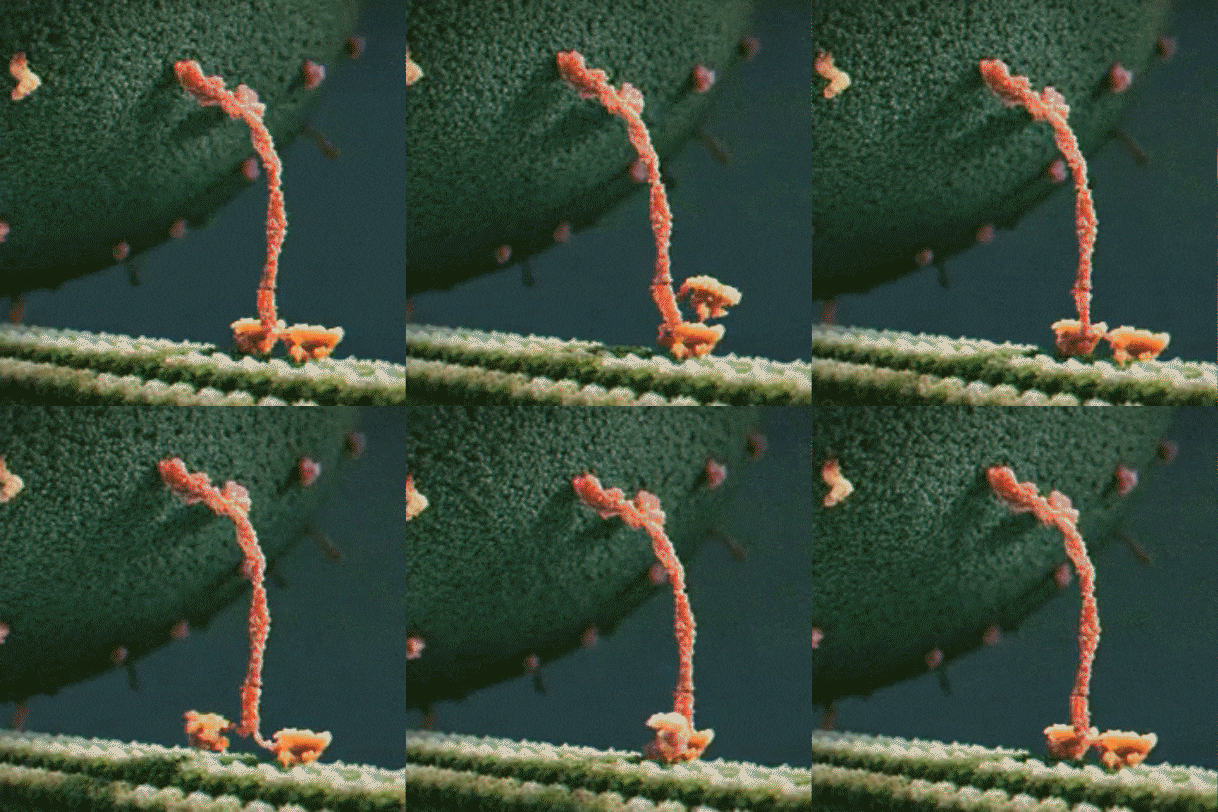
History of course is stories, and stories are great for memorizing. In fact, back in my school days I had a history teacher who always dressed up and explained things in a most theatrical way. It worked great.
Nothing, at least not in the long run. Speaking of running, lets use it as an analogy. I can walk to the train station in 15 minutes, if I run, I might be able to do it in 5. So that saves me 10 minutes, right? Wrong.
If I want to be able to run that distance and save those 10 minutes, I need to train my running. I will need to spend maybe an hour each run, three times a week, to train my running. So in order to save 10 minutes a day, I have to spend also 3 hours a week.
Memory works the same. In everyday life, there is near-zero use to the method of loci. Why near-zero? Because you use it more than you realize. If you walk around in the supermarket, you look at your list and you see “potatoes”. You immediately know where they are and you grab a bag. That is essentially the concept behind the method of loci.
However, at those potato shelves, you meet a lovely man/woman/helicopter and get a phone number because of your impressive memorized knowledge about potatoes. What do you do with it? I would put it in my phone. I can even add the name. There is zero need to memorize that phone number, and even less need to spend three hours a week training just to save yourself ten seconds of phone number adding (which you will still have to do later anyway).
4 Likes
Your questions aren’t silly.
Yes and yes
Mnemonics can only save you time in memorizing with high certainty and precision. You’re not going to save the time to read/listen/watch the material and not one bit the time to understand it. However, the memorization process can and highly probably will become faster, the more you do it, if it is of the same kind even more.
What you need to ask yourself is what do you need to know for certain and shouldn’t google? These are the things needed to be memorized.
For tests:
- YES, use the method of loci.
- BUT take the same time you would use for study or even more than usual. Some things need to be memorized verbatim, some don’t and figuring out what’s worth studying for the test will take time.
- Try to get information of your teacher what exactly may appear in the exams. (Good teachers tell you exactly what)
- Surprisingly it tends to be math teachers who tell you what exactly to expect in the exams. Where there’s a lot of math or calculation to be done, the teachers will be more reasonable and tell you: this exercise type will be in the test, and so on.
- History: dates, authors of, protagonist of events, entire narratives, etc. These can be memorized with high precision, which you need to. Make sure, that what you’re studying will be in the test.
- Biology: who discovered this and when, what are the classifications. Again, I wish I could do high school again, so I could get 4 GPA and apply for an scholarship overseas. Yeah… I’m that guy who found out about these too late.
- Chemistry: the same… everything that will be in the test can be learned, the step by step of how to solve problems, the nomenclature and more. Just take your time.

Thank you for your answers. It gave me motivation to start training but how? I don’t know where to start and what to do at the beginning.