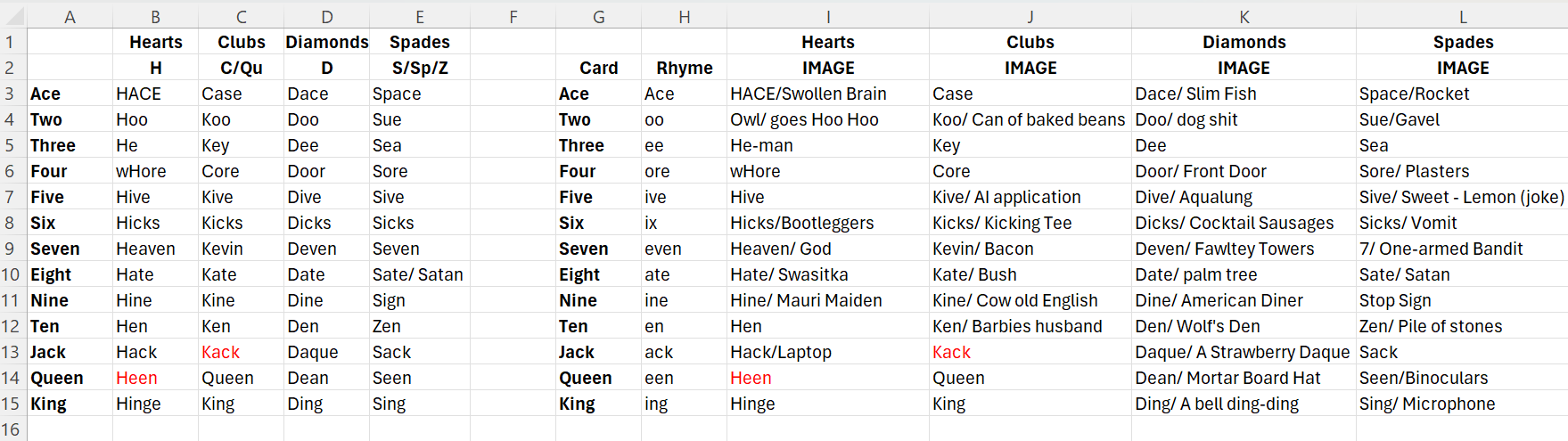
Point taken about ■■■■■ as a rhyming word being inappropriate for children. A possible substitute word would be 4 of Hearts would be a donkey. Donkies “Haw”? or Haw could be represented by a stutter (i.e. uttering a sound representing a hesitation or pause in speech)?
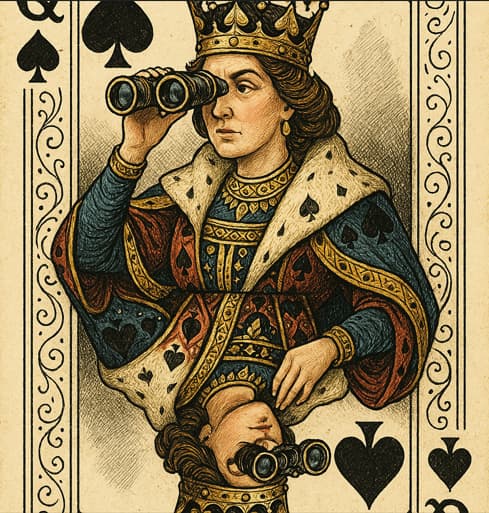
On reflection my original “Sore” for 4 of Spades would better be represented by the word “Saw” (a tool used to cut wood) as opposed to the verb “saw”. My Queen of Spades is binoculors (derivered from the substitute word "Seen), so a carpenters “Saw” works very well for the 4 of Spades in my opinion. You are correct that Koo are a brand of Baked Beans in South Africa. For “Sicks” I imagine “vomit”. A little grotesque but it works for me. Grammatically possibly not the best English but that’s the beauty of mnemonics, use whatever works for you. The list I posted for the playing cards is merely a work-in-progress list. I will go through the words and think of better images than the ‘placeholders’ I have on the list already. I just think the idea of having a rhyming deck is something that one can use on the fly.
In response to other issues you’ve raised:
I don’t understand the meaning of this sentence. What are you comparing here? Are you implying that your method is the easiest to learn playing card method (easier than for example the Ben system) or that the easiest way to start learning about memory techniques (for numbers, playing cards, shopping lists and so on) is learning your playing cards method first and then perhaps the Major system for numbers and so on?
I guess what I am trying to say by “Easy way” is that the system is not complicated. Ben System for cards requires C-V-C if I recollect the system, which I have never used but have obviously read about. Major system requires coding playing cards as does the Dominic System too. I think as a quick (hack if you will), rhyming cards works very effectively, but you can of course beg to differ?
“If your system is very easy to learn (I think that it is) then that is a positive feature of the system. But if after some amount of practice other systems would allow you to memorise cards faster then that raises the question “what is the point of promoting this system to beginners?”. I think that you are imagining a beginner as someone (like a child) who doesn’t want to invest much time in their system or who has no ambitions other than memorise a deck of cards once or twice in the near future and then do something else”.
As mentioned above my suggested course of memorizing a deck by rhyming is a “hack”. Of course there are a gamut of far more sophisticated systems aimed at individuals that want to compete in memory championships or whose sole aim is for speed. Whislt I admire such individuals, very few of us will ever reach such pinnacles or possibly even have the desire to do so?
“Joshua Foer was a beginner one year before winning the US memory championship; Would you recommend this system to a beginner with similar ambitions? If you do think it can be a competitive system for usage in memory competitions (I don’t think you actually think that), then in my estimation you would not promote it specifically as a system for beginners”.
I certainly would not have recommend this system to Joshua Foer to compete at the highest levels of competition. From reading his book “Moonwalking with Einstein”, it was clear that Joshua Foer had a mentor/coach in the English memory grandmaster, Ed Cooke, who taught Joshua his system of how to memorize playing cards.
“If you do think it can be a competitive system for usage in memory competitions (I don’t think you actually think that), then in my estimation you would not promote it specifically as a system for beginners.”
Short answer to the above questions are: “I don’t, and I do!”
“I hope you are not disappointed by me stating that the system isn’t all that original. Using (part of a) number/suit pronunciation to create a 2 digit or single playing card word has been tried by multiple people including myself. For example, 8 in Dutch language is “acht” so 18 = lacht, 28 = nacht, 38 = macht and so on.”
Not at all. Not in the least bit.
"I tried your system with an actual deck of cards just minutes ago and even though it is easy in the sense that I know the rules of the system it feels really awkward at first. In order to read hearts as an “H” I have to learn to see hearts as the letter “H”, which is not that difficult with some practice, but I might just as well have chosen a letter for hearts that actually looks like a heart for example the letter “M"or “W””.
Point taken. Whatever works best and resonates with you is what you should use. So if M or W represents the suit of Hearts better for you, by all means use it, you would be foolish not to. I am not trying to be prescriptive to anyone wanting to use any particular card system, merely pointing out what I think is a sensible and easy quick way to “read the cards” from their faces. When I see a 4 of Spades, I immediately see a carpenters “Saw”, which is a very strong image for me.
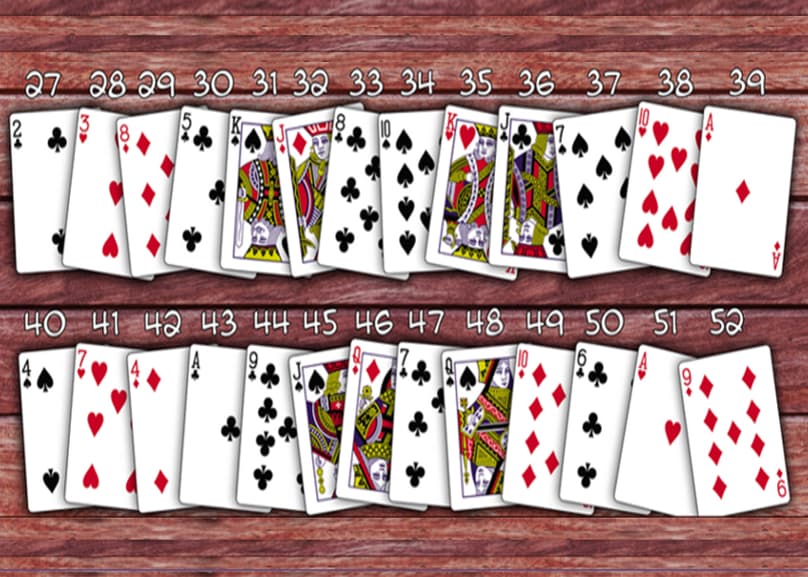
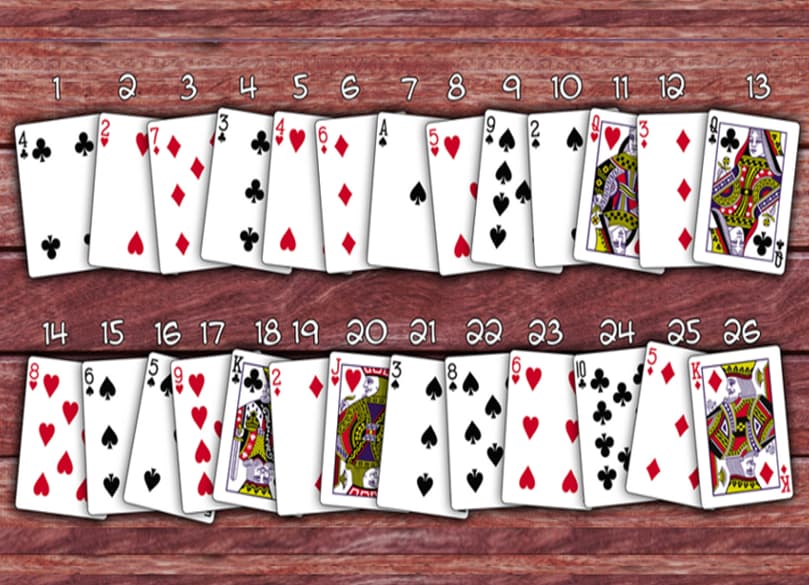
For example, if confronted with the following order of playing cards and using the “Errol - Number - Shape System”, I would see a “Concrete Mixing Truck” = Position 40 being “Sawed” in half by a giant carpenter’s saw (4 of Spades);
“I feel that the more training you are willing to invest in becoming good at memorizing playing cards with this system, the more you would want to replace parts of it with something better. For example translating 7 as “eaven” gives you two syllables. That is an obvious shortcoming of the system.”
Agreed but my suggested rhyming card system is pitched at the ‘novice’ level, children (aged 7 and above). Anything can and will ultimately be improved upon. e.g. as you pointed out my original 4 of Hearts (■■■■■) is not age appropriate, so throwing in a donkey called “Haw” (substitute word), problem sorted, well at least it is for me? For example, a donkey on the end of a gigantic Fishhook (Position 5) is memorable to me, meaning that the 4 of Hearts (“Haw”) falls in position 5 below:
“If you had chosen a consonant sound for every card value, as many memory competitors have done, you would be much faster in my estimation after as little as one day of practice, mostly because the average length of the pronunciation per card would be much shorter.”
Agreed but not what I was intending to do from inception, so whilst I unreservedly agree with your point of view, my suggested “rhyming deck of playing cards” is deemed “fit for purpose” by me as a hack for non-competitive people who merely want to dabble a little in the power of simple mnemonic systems.
**"Instead of hace, core, deven, queen , you might get something like hi, ku, dow, koo . I admit that whether or not you end up with words that you can associate with a meaning depends on the language(s) you speak, but it is obviously shorter."
100**% agree with you there and thank you for your inputs!

 = A (like in “day”) (spade is pointy at the top like an A)
 = O (like in “go”) (heart is rounded on top like an O)
 = E (like in “be”) (left side of the symbol could have a slightly stylized E overlaid on it)
 = I (like in “bike”) (straight line from top point to bottom point)