I think it would be really interesting to know if it makes a difference for these issues between a letter or image based alphabet?
2 Likes
As I get further into learning Chinese, I have realised how context based it is - you often can’t translate a word unless you know the rest of the sentence. It is a fascinating language. At first, it seemed so complex that I thought that this can not possibly work as a language, but over a billion people show that it does! So I persevered. Love it!
I lean the characters by identifying components, because my aphantastia means that I don’t easily recall an image of the entire character until it is very familiar. But I gather most Chinese people do the same.
5 Likes
Absolutely, context is needed to undestand Chinese… I’m talking even for native speakers.
I made some questions to DeepSeek, to “confirm” 
Question; With all the homophones in Chinese, context is a necessity to understand what one is hearing right?
So it would be correct to say they talk using phrases more than words.
Answer: Yes! You’ve nailed a core feature of spoken Chinese. Let’s break it down:
1. Homophones Demand Context
Mandarin has ~400 syllables (without tones), but ~1,300+ with tones—compared to ~8,000+ syllables in English. This creates massive homophony:
- Example of “shì” (4th tone): 是 (to be), 事 (thing), 市 (city), 试 (test), 室 (room), 视 (vision)… and dozens more.
Solution?
- Phrases over words: Speakers rarely use monosyllabic words alone. Instead, they combine them to disambiguate:
- “Shì” → 城市 (chéngshì, “city”), 考试 (kǎoshì, “exam”), 电视 (diànshì, “TV”).
- Even 是 (“to be”) is often paired: 是不是 (shì bu shì, “is or isn’t?”).
2. Why Chinese Feels “Phrase-Based”
- Disambiguation: Single words are vague; phrases add clarity.
- “Wǒ yào shuìjiào” (我要睡觉, “I want to sleep”) vs. just “shuì” (睡, “sleep”), which could sound abrupt or unclear.
- Cultural preference for rhythmic flow: Bisyllabic/trisyllabic phrases sound more natural (e.g., 吃饭 chīfàn, “eat meal” instead of just 吃 chī).
- Grammar relies on word order: Phrases (not inflections) convey meaning.
3. Exceptions & Nuances
- Poetry/classical Chinese: Uses monosyllabic words heavily (context + literary tradition fills the gaps).
- Colloquial shortcuts: Close friends might drop phrases (e.g., “Zǒu!” 走! for “Let’s go!”).
- Tones help, but aren’t enough: Even with tones, homophones abound (e.g., mā 妈 “mom” vs. má 麻 “hemp” vs. mǎ 马 “horse”).
Key Takeaway
Spoken Chinese is “phrase-driven” out of necessity—it’s how the language compensates for homophony while maintaining efficiency. This also explains why:
- Learners struggle with listening at first (single-word focus doesn’t work).
- Puns/jokes thrive in Chinese (homophones = endless wordplay).
Fun test: How would you distinguish these in speech?
- Yīshēng → 医生 (doctor) vs. 一生 (a lifetime)
- Lǐzi → 李子 (plum) vs. 礼子 (a name)
(Hint: Context! “Wǒ shì yīshēng” = “I’m a doctor,” not “I’m a lifetime.”)
Question (well, not really): And that’s why Chinese couldn’t adopt another writing system, letter based
A: Exactly! Chinese couldn’t realistically switch to a purely letter-based (alphabetic) writing system without losing critical layers of meaning, efficiency, and cultural continuity. Here’s why:
1. Homophone Overload in Alphabetic Systems
- Example: The syllable “yì” (4th tone) has over 100 characters (e.g., 意 “meaning,” 义 “justice,” 艺 “art,” 易 “easy”).
- In pinyin: All written as “yì” → Meaning collapses without characters.
- Real-world consequence: A pinyin-only text would require constant guesswork (like reading a 10-page document of “yì yì yì yì…” with no visual cues).
2. Characters = Visual Disambiguation
- Radicals provide instant clues:
- 请 (qǐng, “invite”) vs. 清 (qīng, “clear”) vs. 晴 (qíng, “sunny”) → All pronounced similarly, but their radicals (讠"speech," 氵"water," 日"sun") reveal meaning.
- Compounding works visually:
- 火车 (huǒchē, “train” = “fire” + “vehicle”) makes sense in writing but would just be “huoche” in pinyin, losing the logic.
3. Efficiency Loss in Alphabetic Systems
- Dense information per character: A single character often equals 2–3 English words.
- Example: 中国 → “China” (2 chars) vs. “Zhōngguó” (8 letters + tone marks).
- Reading speed: Studies show skilled readers process characters faster than pinyin because they recognize whole units of meaning.
4. Historical & Cultural Barriers
- Shared writing system across dialects: A Cantonese speaker and a Mandarin speaker can’t understand each other’s speech but read the same characters. Switching to letters would fracture this unity.
- 3,000+ years of literature: Classical texts (e.g., Confucius) are already hard for modern speakers—transliterating them into pinyin would make them unreadable.
5. Failed Experiments
- China’s 1950s simplification push: Even though Simplified Chinese reduced stroke counts, pinyin was never adopted as a replacement—because it couldn’t handle homophones.
- Japanese example: Uses kana (syllabic) + kanji (Chinese characters). When kanji are omitted, comprehension plummets (e.g., legal texts become ambiguous).
Could a Hybrid System Work?
Hypothetically, yes—but it’s unlikely:
- Chữ Nôm (Vietnamese): Historically used Chinese characters + locally invented ones. Abandoned for Latin script due to colonialism, but Vietnamese has far fewer homophones.
- Zhuyin (Bopomofo): Used in Taiwan alongside characters for pronunciation help, but never as a replacement.
Conclusion
Chinese is “stuck” with characters because they work. An alphabetic system would:
- Destroy readability (homophone chaos).
- Slow down reading/writing (more symbols needed per word).
- Cut access to history/culture (ancient texts, calligraphy, etc.).
Fun thought experiment: Try reading this pinyin sentence without characters:
“Tā de mùbiāo shì yánjiū yǔyánxué.”
Is it 他的目标是研究语言学 (“His goal is to study linguistics”) or 她的木雕是研究鱼盐学 (“Her woodcarving is to study fish-salt science”)? 
2 Likes
Yes it is. It is amazing you are learning Chinese! Back in childhood, we need to handwrite Chinese basics if not thousand hundred times because it is a form of a punishment when you are naughty in schools
2 Likes
Thank you, Vector. That was really good. I have enough Chinese to recognise it all. Plus my memory palace is based on the radicals. And I love the characters. I really appreciate this response.
2 Likes
Thank you - I do love writing the characters, being careful of stroke order. it is almost mediative.
2 Likes
您对汉语这么感兴趣,真让我感到亲切。
我喜欢学习中文,尤其是汉字。
For non-Chinese speakers, I used very simple Chinese (because I can’t do anything else!) to say that I love learning Chinese, especially the characters. But for everyone’s sake, I’ll stick to English now.
I must take this opportunity to mention my obsession with Chinese handscrolls, and their role in recording history (and other stuff) in highly memorable formats.
I am trying to adapt the format to contemporary memorisation.
Lynne
4 Likes
Hi, I just run into this TikTok account posting videos of traditional Chinese calligraphy. I get that TikTok might not be your usual spot, but… just in case, here’s the link
Apparently those little guys are writing the same character in 100 different ways
(from a comment “福”字的100种写法" ) in this video
Greets.
2 Likes
Chinese handscrolls are truly beautiful—I love them too! My favorite is a calligraphy handscroll by the Chinese calligrapher Liang Shizheng. It features a poem written in xingshu (a semi-cursive style of Chinese script). I’d love to share it with you for your enjoyment!
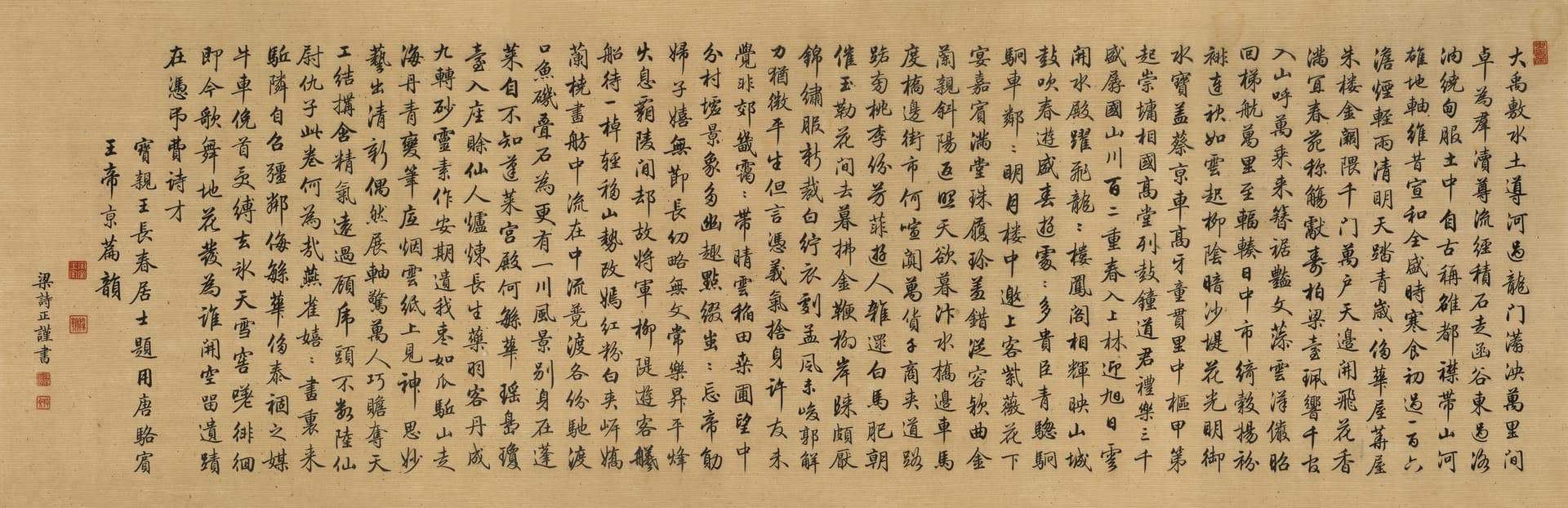
2 Likes
Gorgeous - I have replicas of some calligraphy handscrolls but can’t read them, although I am starting to identify some characters. These are also Traditional.
I wonder if my ability to recognise calligraphy is affected by aphantasia because it is much harder for me to pull the calligraphy characters apart into the radicals and components.
The handscrolls I know better have images, such as the most famous of all, Along The River in the Qingming Festival.
Love it! Thank you!
1 Like
Are you the real writer?
I am definitely real and I write books, including The Memory Code and Memory Craft, so I am that real writer.
2 Likes
Current research provides specific prevalence data for Japan, while data for China and South Korea remains limited to clinical observations or broader regional estimates.
Japan
Recent large-scale studies indicate that aphantasia rates in Japan are consistent with global averages, though strict aphantasia is slightly less common than in Western populations.
-
**Strict Aphantasia (VVIQ = 16):**Approximately 0.07% to 1.4% of the population.
-
**Broad Aphantasia (VVIQ ≤ 32):**Approximately 3.6% to 3.7% of the population.
-
Self-Identification: When relying on self-identification rather than test scores, the rate rises to roughly 12.1%, suggesting many Japanese individuals perceive their imagery as weak even if it does not meet the strict clinical cutoff for aphantasia.
China
Specific statistical prevalence rates for Chinahave not yet been established in peer-reviewed literature.
-
Clinical Context: Awareness is growing, evidenced by the opening of China’s first clinic for spatial and mathematical learning difficulties (including aphantasia) in Shanghai in late 2024.
-
Estimated Rates: Medical experts in China currently cite the global estimate of 3% to 6% for visual-spatial deficits, but no distinct national percentage has been isolated.
South Korea
There is currently no specific published prevalence data for aphantasia in South Korea.
- Regional Context: South Korea is often grouped within broader “East Asian” or “Southeast Asian” datasets in multi-cultural studies, which generally show imagery scores comparable to Western populations, though some studies suggest slightly lower mean vividness scores in East Asian cohorts compared to Western ones.
And why is that? The education is more practical or what?
There isn’t anything definitive, but take a look at the nations ranking highest in math and science scores based on the most recent global assessments from PISA 2022 (for 15-year-olds) and TIMSS 2023 (for 4th and 8th graders).
PISA 2022 Rankings (Age 15) - Assesses real-world application of knowledge.
Mathematics Top 10:
-
Singapore (575)
-
Macao (SAR, China) (552)
-
Taiwan (547)
-
Hong Kong (SAR, China) (540)
-
Japan (536)
-
South Korea (527)
-
Estonia (510)
-
Switzerland (508)
-
Canada (497)
-
Netherlands (493)
Science Top 10:
-
Singapore (561)
-
Japan (547)
-
Macao (SAR, China) (543)
-
Taiwan (537)
-
South Korea (528)
-
Estonia (526)
-
Hong Kong (SAR, China) (520)
-
Canada (515)
-
Finland (511)
-
Australia (507)
Considering Macao and Hong Kong are part of China, we can lump them together we ith mainland China. Taiwan could be also, but they are independent so I will consider them a separate nation.
So Singapore, China, Japan, Taiwan, South Korea are top 5 in Math & Science every year. In fact, Art isn’t considered an actual school subject, whereas Music is taken very seriously as it has a strong relationship to math.
So it is possible that this causes problems with visualization. I left South Korea when I was 5 and raised in the US. I have serious trouble visualizing anything. It’s colorless, amorphous, indistinct, grey and unclear. I also played chess professionally in my 20s and I could not visualize a chessboard to save my life. A severe handicap.
So my little exposure to the Korean educational system shouldn’t have had any impact on me. Also, I’m horrible at math, so it cannot be a genetic cause. If my visualization challenges came from genetics, my math ability should also be increased.
Also, there are 5 other, non Asian countries in the top 10 lists. I don’t think they have increased cases compared to Asian nations.
So who knows. What we do know is that China deems this issue so important that they have opened a center just to study this issue. Maybe cases have increased recently or perhaps reporting has gotten better.
Interesting. And if they or you are not good with images. How do do you use mnemonics? With words?
It’s really hard to describe and I have no clue if anyone else experiences it like I do.
It’s like I’m in a sea of black, completely immersed. I cannot see anything, even myself. There is no other senses such as smell, taste, touch.
Inside this abyss, things form when I try to imagine it. I cannot sense it, but I know it’s there. If I try to visualize an orange cat, it forms, and I can sense it and sense it’s features, but I am not using my senses. I just know. It’s still this inky blackness, but there is something in there with me.
If I syrain to my utmost, a sort of 2D image comes through, like a computer screen and I can move the object around, bit it’s not truly 3d.
2 Likes
Your experience, Ravendon, is exactly the same as mine. No senses at all. You describe it very well. Recent research that I have read on aphantasia, only about visualisation, says that we form the images, but the bit of the brain that transfers them to the visual cortex, doesn’t work.
That makes sense of my experience. I know about the image, I just can’t see it.
I have been involved in some research, given I have aphantasia and yet use memory palaces extensively. Seems I do it much more by story and concept than by images.
I am learning Chinese, as it is the hardest thing I could imagine. Maths, physics and IT are my strengths. For the characters, I have to break them down to components and create a story. I am still really struggling with them, but managing to progress, even if it is really slowly.
Pronunciation is the same issue because I can’t ‘hear’ what I have already listened to. I had the same issue with French, but that didn’t have the tones as well. For Chinese, I have to add in the tone to my story and location in the memory palace.
Thank you for all those who are contributing to this discussion.
3 Likes
I second your sentiment. Thanks to everyone who contributed. I, literally, had never heard of aphantasia until I stumbled into this discussion while googling for memory palaces. I thought I was the only one. Which just proves that exposure to many curious minds, whether through academics, travel or a simple, internet forum can educate you and expose blindspots in your knowledge and thinking.
2 Likes