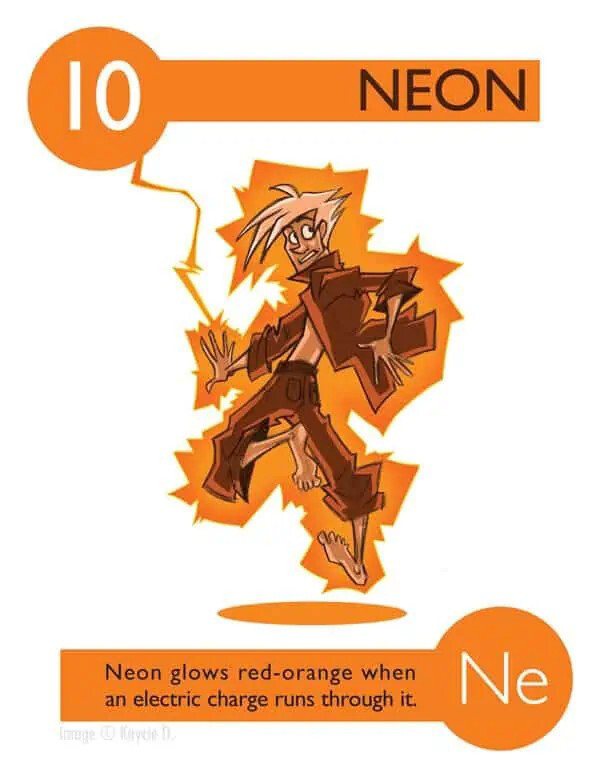
My daughter (10) is interested in learning the periodic table over this holiday season.
I was messing around with using AI image generators to personify the elements when I came across the following excellent resource made by a design student a few years ago:
112 elements, each imagined as a sketched character:
These are really awesome.
I like the art and I like that it gives interesting/concrete information for someone who is NOT studying chemistry. Because honestly I don’t see why the number of protons in the nucleus is interesting. But tell me what is flammable and which metal can I cut with a knife? That I’m going to remember.
I’ve been toying with the idea of learning the periodic table for a while and I sure am going to use this when I do.
When/if you go deeper:
The number of protons in the nucleus is interesting because it determines the number of electrons that hover around the nucleus.
The shapes of the “clouds” they hover in around the nucleus follow a patterned progression. So as the number of protons increase the electrons get added in patterned combinations which determines the shape of the outside of the “cloud”.
This shape on the outside determines how the atom reacts with others and determines the elements properties.
The energies and shapes of these clouds show up in the structure of the periodic table:
They group them in levels and by their shapes.
The first level has just one shape: a “spherical” shell that can hold two electrons.
So the first row of the table has two entries:
1 - Hydrogen, which has 1 electron in its outer shell (and space for one more electron in its outer shells)
2 - Helium, which has 2 electrons in its outer shell (and no space for an electron in its outer shell)
All the elements with full outer shells are unreactive and “standoffish” they end up in the same rightmost column.
All the elements with just one electron in their outer shell end up in the leftmost column and tend to have similar properties they are light, super reactive metals (excluding Hydrogen at the kind of pressures we are used to).
So if I understand you well… the composition of the nucleus tells you if they have place for other poor lonely electrons to stick to them.
And then it means they are open minded to interact with other elements.
And the ones with “full armour” are saying, sorry place is full, no vacancies, go somewhere else.
I think I can remember that
Great job! Transforming each element in the periodic table into a character is a fantastic idea, as our brains tend to remember people and living things much better than inanimate objects. By converting the elements into characters and placing them in a memory palace, accompanied by vivid actions, you’re creating a stronger, more memorable connection that’s likely to stick and transfer to long-term memory. This approach is both creative and very effective.