The universal images would be your own custom images for all the herb characteristics. I would start by curating all the herb terms you want to memorize and creating associated images and then make flashcard decks.
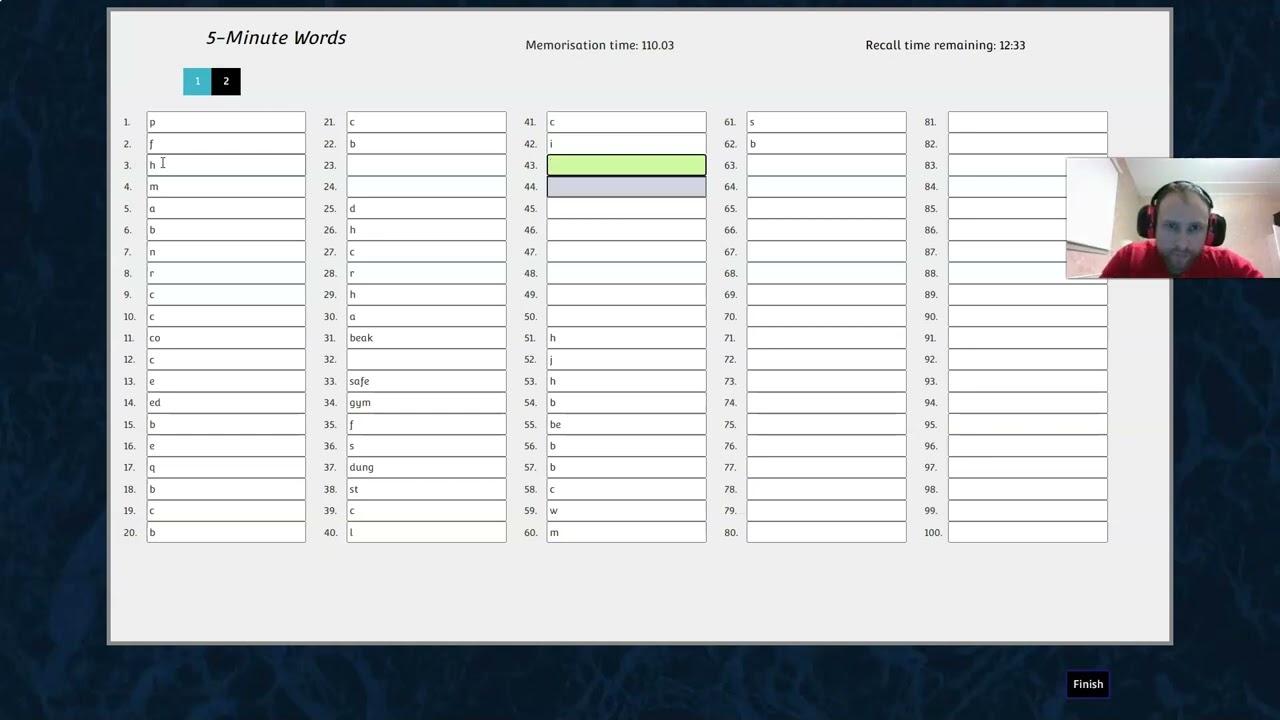
For random words either memory league training or else the slightly easier words on the IAM website under free training - words.
This is a video that resonated with me when I first started. A poem isn’t random words but it gets to the idea. You convert the words to images then have them act out a scene at your locus.
With random words usually you memorize 2 words per locus. Convert both words to images and the first word acts upon the 2nd.
If that’s the point, then even without any words training. We can able to handle words in real life too.
For example - allow => I just imagined potato for it. And it’s not like I trained this word before.
For me improving vocabulary is the best thing to improve visualisation. And the more vocabulary I have the better is creativity.
And only I know my vocabulary improved lot. When I look back in past I can see that I learnt a lot of word meanings.
@Bigdonnyv - you directly see the word, and because you already know the meaning of that word. You imagine images directly.
Let’s say, mango => you imagine it. because everyone know it’s the fruit.
and you didn’t break it down like man - go => a man is going.
Because I don’t know the English words in the first place, how I can imagine images directly.
I mostly see all words in parts, when I memorize words in ml. except the words that I learnt the meaning.
You will understand this by international names memorizing, for me words are like it. Only I can feel that. But because I learnt many English words in recent years, this problem decreased a little.
1 • you see the words. And imagine the image
2 • I see the numbers- and that numbers like flying in my mind and convert in a word (if I don’t know the meaning of the word, I learn it.) - imagine a image.
I learn lots of English vocabulary, thanks to numbers training if you ask me. Not by ml words training.
I used the peg system, the memory palace, and the story method to memorise 900 Chinese hanzi characters in 4 weeks, and the number is growing. Anki and other SRS don’t work for me. Using it was like hitting myself repeatedly with a 2by4.
That means Anki and other SRS don’t work for me, but it works for you.
The memory arts we discuss on this website are ineffective and don’t work for you. But they work for me and many others and have for millennia.
No two people learn the same any more than their fingerprints are the same. There’s nothing wrong with you, nor with us. We have different learning styles. C’est la vie.
I will never understand how can people say that mnemonics are useless…
If you are just a lil curious, if you learn new stuff, it is always useful. I have used millions of times mnemonics during my studies, at my work, I recently even change my work and learnt in a few weeks what other learn in years, thanks to mnemonics.
Just the ability to transform any thing into a mnemonic image is very useful, it allows you to remember anything that happens.
Remembering faces allows you to socialize better.
Remembering facts makes you more intelligent.
Remembering books makes you even more intelligent.
Remembering statistics is a nice skill whatever is your goal
Like mnemonics just allow you to be more free in your life, to not be dependant of your phone, internet, GPS, wikipedia, agenda etc… You keep your brain sharps and this will make you brain healthier longer and of course, you get to be smarter and people see you smarter, you make better decision because you were allow to remember all datas about situations.
My brother already asked me “whats the points of remembering cards, you never have to do it in your daily life ?” and I answered him that my fast ability to convert into an image and place in a memory palace is also skills that I use to remember 400 pages of a book or information at my job.
Of course, if you plan to never learn nothing in your life, just write down everything on your phone, yeah… mnemonics are useless. But if you wanna grow and faster that others, mnemonics will change everything. Up to you.
Mostly, yes. It is like asking a runner how often they find it useful to have practiced running. The act itself is not useful, the benefits that come with it are. It is a hobby.
I would argue that pegs or a memory palace should play a secondary role in language learning, and in my post history you can see that I always had this stance. Languages are a skill, and you can’t speak them fluently when you have to use a dictionary for every word. That is just what a memory palace is, a “book” in your head. You have to do, you have to practice, you have to apply.
Most of these questions are not as much being about great at memory, but rather at being mindful or in the moment. Usually when those things happen to me, I wasn’t ever paying attention at all.
Maybe rather than looking for a nail, you should extend your toolkit with a screwdriver You also mentioned forgetting some thigns regardless of memory training. So perhaps something else to keep an eye on is the realization that you in fact have this shiny hammer in your possession.
I for one memorize a lot of factual information. So that is one. In this I also noticed I started to view new information differently, more in images and stories. A part of memory training is names, faces and personal information. Surely the cards and numbers don’t often find use (apart from the few number lines we have in our lives, like phone numbers and bank ncard numbers), but everything relating to people does. Then there is the added boost to creativity that a lot here mention. However, it requires to be a habit if you want that.
Lets take watching the news as a practical example. You might see a whole lot of things going on in the world. Fires in spain, portugal and france, farmers protests in the netherlands, a still-ongoing war in ukraine. I like to understand what is going on, so for those news items I would have to also know where those countries are and the main parts of what is going on to determine how it will affect me.
Aside from the actual memorization of knowledge, it is fun to escape the world sometimes and just wander into a random memory palace only to see Pabbie (from frozen) cooking Barack Obama, using a chess pawn to keep him forcefully in the pot, and to remember that Obama was thus born on the 4th of august 1961.
Well expressed.
No one who speaks a language fluently (I do) thinks in another language then translates.
I’m not saying memory techniques aren’t useful for language vocabulary learning, but they are hopeless if still tied to the translation.
Thumbs up for that comment.
Yet there are those flogging such ideas to language students. Beware!
Humm… I appear to have offended some people with the question, although I knew it was controversial. But I’ll try to answer some questions people asked and make some observations.
I’m using these types of things (everyday occurrences) like did I take my tablets this morning or why did I come down to the kitchen, as examples of where mnemonics aren’t really of much use, although as people pointed out this is more an issue around being present and attentive. I don’t do things like stand in the bedroom repeating to myself why I’m going to the kitchen, because when I depart the bedroom, I fully expect to remember why I’m going to the kitchen.
Yes, that is the main thrust of this post. I have the tool, now what?
This is a use for which I might have, although now my work isn’t so much focused on the tactical implementation of things as strategic views. This is a great example of a use for mnemonics which isn’t a party trick or hobby but a good solid use of the ilk I was looking for.
I’ve been programming for a number of years, and I still abide by the quotation from Albert Einstein that you should never remember anything you can look up. I find this especially true in software when languages, libraries and arguments change on a daily basis. It is always better to look up the correct usage than rely on memory. Especially for rapidly changing languages like Rust or Flutter.
(This is also a potentially controversial view)
Yes, I’m different, I believe in writing things down because as the Chinese proverb says: “The palest ink is better than the best memory.”
Actually you didn’t go off my point, because I’m actually looking to see how people are using mnemonics “in the wild” for something other than memorisation of PI or cards, etc.
It isn’t that I don’t enjoy it. The problem is that I’m failing to see the benefit of the time invested in learning the techniques and I’m hoping for more examples.
Words or Numbers, the problem I have is the same. I can train for years to learn to recit back a million random words, but of what practical use is that to me, (or anyone else for that matter)? I can learn to memorise long strings of numbers (I already have) but other than remembering my credit card number the cost to benefit ratio is completely out of whack.
Actually, I didn’t say they didn’t work. I said they don’t appear to have much practical application. I memorise Hanzi the way that Chinese children are taught. I write them down on paper again and again. Repetition until I learn it. Then I put them in Anki, because SRS systems are to help you not to forget things you already know, not to learn them. If you don’t already know them, then anki becomes a torture machine.
I have used a memory palace to review all the letters of the Korean Hangul alphabet. I did this for a couple of weeks to remember the shape and the sound of the letters. But once I had done that I stopped using the memory palace, not because it didn’t work, but because of repetition it is no longer required.
OK, so what are practical examples?
Anyway, I’m not going to argue the point, but I don’t agree that memorisation of vocabulary is equal to language learning.
Actually, the more I think about it, the more the tool seems like an oddly shaped hammer which only works on specific nails with triangular heads made from brass and sold only in a small shop in Milan.
This!
===
So just to reiterate, I am not saying mnemonics are useless. I’m saying the areas available to the application of mnemonics seems to be very limited. I am hoping to find a use for mnemonics. I had actually forgotten ( ) that I’d used a memory palace for the Korean alphabet, which is basically a list of symbols.
I can see using it for checklists, that appears to be a great example of a practical use and could replace a lot of manual or difficult to use lookups. Although, I no longer work in a field which has a lot of checklists.
I’m coming at this from the perspective of a cost/benefit analysis. It takes a non-trivial amount of time to learn these methods and to get good at them. So I’m looking for a benefit which would give me a benefit greater than the amount of time I’ve spent learning the methods.
So if it takes 40+ hours to learn the technique and another 2 hours of review to remember X, or I can do rote memorisation for 20 hours to remember the same thing, then logic dictates I should do rote memorisation. Aha! You say, but if you learned the technique, then you could apply it to Y & Z as well. Which might be true as long as there is more than one thing to remember.
If my job were as an event planner then being able to carry around in my head for immediate recall details like costs, guest lists, décor, accommodation, invitations, schedules and so forth would more than pay back any time investment I might have made in learning peg systems, memory palaces, etc.
As a (former) programmer, I cannot imagine a scenario where I’m programming on a computer, and not able to use the computer to look something up. Other peoples experiences might be different, but in this example, the benefit ratio is lower than the benefit for an event planner.
For a hobbiest, remembering details about your hobby might be useful. For example, an electronics maker who has a memory palace decimated to resister band information or diodes would save time if you are frequently looking up resister values, etc.
I read through the thread Have You Used Memory Techniques in an Interesting Real Life Situation? and there was some good stuff in there. For example, remembering company process manuals, prepare classes/presentations, or remembering jokes to revisit when you’re sad. Although only the last one appeals to me personally.
Not wishing to fall afoul of the “sunken cost fallacy” and continuing to hone a skill I’ll never have a practical use for was what prompted me to start this thread. I know that each person is an individual and has their own interests, so I’m not going to get fired up about memorising the Periodic Table, or the list of British Prime Ministers. But your example of having memorised a checklist for work might spark an idea in me of something I might want to remember.
So once again I just want to say I’m not attacking the use of mnemonics or their effectiveness, I’m simply looking for use-cases.
Mnemonics will mostly benefit students in taking exams. It’s like having an open notes test. Parents should introduce the techniques to their children at an early age. For us adults, its a mental exercise that will sharpen our ability to recall information quickly and vividly as compared to a person with no mnemonic training.
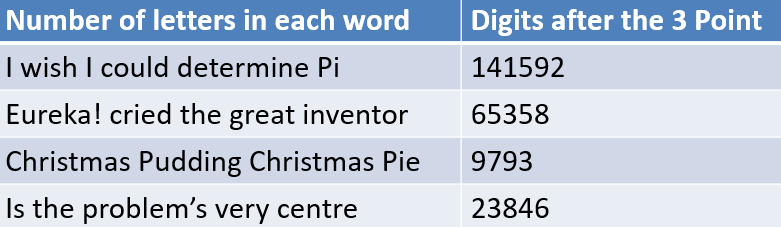
I know my calculator, cellphone and computer can all calculate PI too and are far more sophoisticated at doing so but you can’t beat the simplicity of the simple poem, I’ve recited to recall PI as: 3.14159265358979323846 (correct to 20 decimal places). Reference: How to Improve Your Memory by Robert Leach.
If I wanted to recall 100 digits of PI, I would need a different tool of mnemonics. Time to put my Hammer down (Poem) and look for my Monkey-wrench (or the PAO System) which I will use with a Number 19 Spanner (i.e. 13 loci in a memory palace to do the job for me). Mnemonic systems are a broad discipline. Not everyone is of ‘Memory World Championship’ material but that’s OK, just like is OK to play Club rugby and not International rugby. Different Horses for Different Courses. You can see from the diversity of answers given that mnemonics is a valuable aid or tool to have knowledge stored for immediate retrieval when the occasion is called for and many people are doing it for enjoyment purposes and self-development.
Not in my experience. Master (used to be around 2200 ELO in old money, probably 2400 these days with inflation though… I’m a bit out of touch) in chess is beyond all players who start COMPETING as adults and most chess clubs are full of people who started club chess as adults. They don’t aspire to winning the Master title.
And they are right to NOT aspire to becoming s master…
I might be wrong of course but I’ve personally never met anyone who took up serious club, organised league and tournament chess as and adult who has reached 2200 ELO. Talking about after the age of 21 when they started really playing… And I’ve met hundreds of players who only took up club chess as adults BUT they seem to aspire to being (what used to be called) a strong club player’s rating level of around 1800 or 150 BCF and the mega- keen around 2000.
There is any ENORMOUS DIFFERENCE between 2000 and 2200. (Plus any inflation) and realistically the vast majority perhaps 99% of active players have NO CHANCE ever of becoming a MASTER.
(Chess.com rapid and blitz ratings are utter Nonsense, I’m talking about League chess and tournament chess - weekend tournaments and congresses).
A master in chess I would say is equivalent to a professional international athlete (bit not a medal contender) or a squad member of an English Premier League football team.
I exaggerated a bit but huge numbers of players who solicit lessons from GMs hope to become master and people in improvement forums / discords or reddit posts are mostly aspiring for a NM title. NM is actually possible though with huge dedicated effort.
Most NM still have weak tactical vision so someone who solves puzzles for 1.5 hours daily over an extended period of time is likely to make NM strength.
If you frequent these forums you will see this asked weekly.
GM is nearly impossible. There are a lot of full-time professional player/coaches who are only IM. One of these IMs in a video pointed out there are more billionaires than Chess GMs.


 for it. And it’s not like I trained this word before.
 You also mentioned forgetting some thigns regardless of memory training. So perhaps something else to keep an eye on is the realization that you in fact have this shiny hammer in your possession.