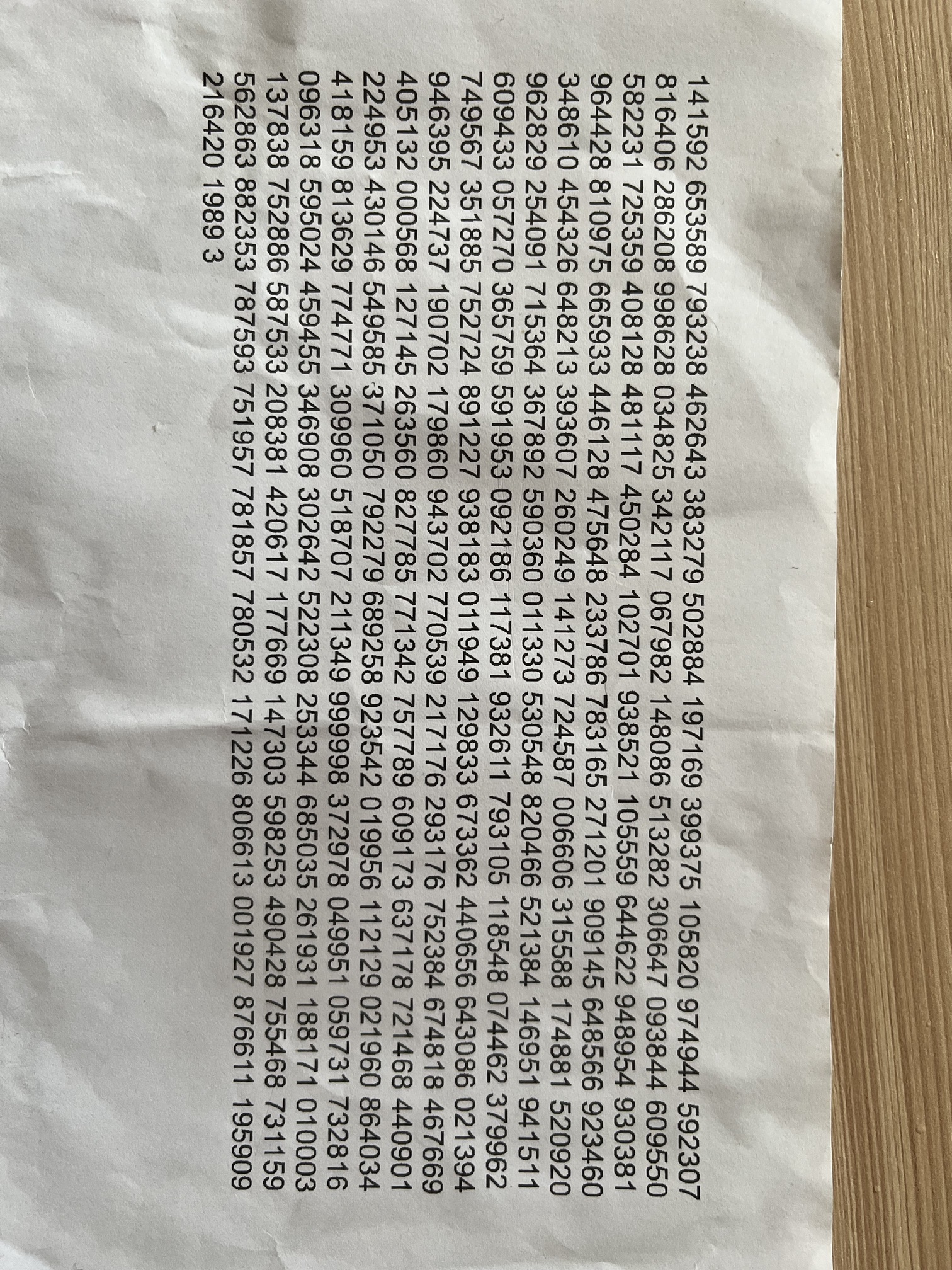
So imagine this: You have memorized 1000 digits of pi with the pao method. So every column of 6 digits, like in the paper below, will answer for on loci. Now if someone tests you with quoting a random column of digits, it will be pretty easy to provide both the column before and after the quoted one.
But how should you go about to memorise so not only can you provide the sequence of columns, but to know the sequence if someone asks you ANY random 6 digit within 1000 digits of pi, disregarding the specific 6 digit pictures that you memorized it with.
For example you memorise the first 12 digits like this: 149215 - 653589
How do you build your memory around it so you can respond quickly if the person provides you these 6 digits, and therfor breaking your pao system: 1 (49215 - 6) 53589
I may be wrong, but if you’re memorizing in six-number clumps, it would seem virtually impossible to do the kind of recall you’re describing, where those clumps are completely ignored.
There may be a technique I’m overlooking, but I think the only way to recall the pattern of any grouping of six numbers is to memorize the numbers individually. And that likely means using a linking system rather than a memory palace/journey, since you’ll need 1,000 locations.
I’m personally memorizing pi in six-number groups (not exactly PAO, but PAO-adjacent). It is very easy to add 5 groups (30 numbers) daily. So after holding at 120 for a couple of years, I decided to just flex my muscles a bit and see how far I can go with the palace I started with. So in just four days, I’ve doubled my total, to 240. I cannot imagine making that kind of progress by adding 120 individual numbers. (And that hardly seems worth the effort, since I think the number of people who actually are interested in seeing a display of “pi power,” such as you describe, are in a distinct minority!)
That said, I’m eager to see what other responses you may get!
Except the “before and after starting at any DIGIT” style that you describe is not really something that is done. Its more like taking specific X-digit chunks at a time and being able to recall the complete chunk before and after. So digits 1-10, 11-20, 21-30… 991-1000. By taking 10 per scene, they are almost all completely unique scenes and thus you can isolate where they are in your palace sequence and just navigate before and after.
Similarly, you can place marker indicators within your scenes or structure your palace sequence in such a way to allow you to navigate to a specific number digit. It requires a LOT of pre-planning and pre-structuring, but is not necessarily “difficult” to accomplish.
Jonas von Essen describes his work to memorize 100,000 digits of pi (along with the pi matrix amd digit place marking) on this episode of @RonaldJohnson’s podcast:
I’m not sure there is a practical way to memorize and recall the sequence as you describe (starting on any digit and recalling before and after). You won’t know which part of the sequence maps to the correct element in your memorized scenes. The only way I could see to do what you’re describing is to use a single-element single-digit system, which is incredibly impractical over the span of digits you’re talking due to hundreds of images appearing again and again and lack of variety. I think it could be done “easily” maybe with 100 or so digits, but much beyond that would be too repetitive and time consuming to keep straight.
So if your numbers are PP AA OO.
And they choose any six
you might end with:
PP AA OO
AA OO next PP
OO next PP AA
And more difficultly:
PA AO OP
AO OP PA
OP PA AO
So only one of the six possibilities has a full image.
Maybe just require more digits: 12.
There are still only six places to “cut” the six digits that makes a whole image - so one of the permutations is a whole image.
With 12 digits
PP AA OO PP AA OO
PA AO OP PA AO OP
AA OO PP AA OO PP
AO OP PA AO OP PA
OO PP AA OO PP AA
OP PA AO OP PA AO
So if you check for the six different starting positions you can always find a whole image
I know my 1046 digits of Pi back and forth.
I’m not sure if this is practised, but this is how I did it:
I — I open a list of 1000 digits of pi; squint my eyes and select around 6-8 digits; copy and paste them elsewhere, and then I minimise the pi window.
II — I look at the pasted digits and swiftly attempt all the possible combinations it could give me, which eventually shows me where the specified digits rest, specifically, in my palace.
— E.g.: we have the following random decimals: 5-8-2-2-3-1-7.
Let’s take the first 2 sets of digits and see what we can extrapolate.
58: Elf, Laughing, Lava.
22: Nun, Nannying, Onion. - Mix until there’s an imagistic match.
You can add the following digits into the mix to see if your hypothesis is true.
You can also begin from the middle.
Your goal here is to become swift at identifying the given fragments.
— A more challenging way to do it is to visualise the set of random digits in your own theatre (instead of having them physically in front of you like in II) and extrapolate in accordance, all the same.
To learn your digits backwards is as simple too, but it takes time. You just read them backwards. You’ll get faster and faster at reading them backwards the more you practice.
Now, let’s suppose someone ask the random 5 digit chunk.
23846 (238+846) =>>>> hooray, it’s the jackpot
You will always end up in these 2 scenario. either two from left side or right side. And then you just need to find your image in the location and rest is easy.