While I know that systems that use sound encoding to generate images are the state of the art to visualize numbers - I’m interested in alternatives.
I’m currently playing with the idea of using combinations to generate a realistically large set of visualizable images for number images that are suitable as a set of index images.
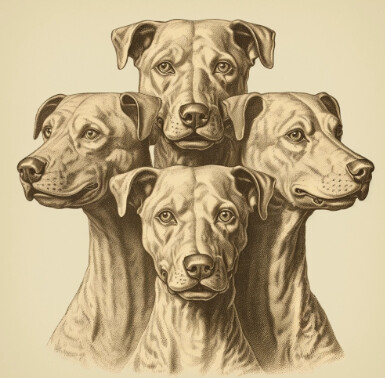
The plan is to have a set of 10 (later 16 for hexadecimal) base animal images and then to form a number between 0000 - 9999 by combining body parts into a “chimeral” creature according to the scheme:
Thousands - head
Hundreds - body
Tens - Left/front side appendages
Ones - right/rear side appendages
My current set of animals/creatures are:
0 - human
1 - spider
2 - praying mantis
3 - meerkat
4 - tortoise
5 - springbuck
6 - lion
7 - giraffe
8 - elephant
9 - butterfly
So for example: 2646 has the head of a praying mantis on the body of a lion with tortoise front legs and lion rear legs.
Does anybody know of similar systems based on combinatorics?
Or have other interesting tips, suggestions, feedback or advice.
I’ll let you know how it goes - so far I’m building on familiarity and speed on converting from the base animal to number and back.
A challenge you may run into is “sameness” in the imagery. 1234, 1235, 1243, 1134, may get muddled with their similarities… it will be interesting to see how you do with differentiating them!
If you have 2 or 3 animal options for each number, that might cut down the sameness?
Maybe each number is a “category” of animal rather than a specific one? 1: fish, 2: birds, 3: flying insects, 4: amphibians, 5: pets, 6: dinosaurs, 7: snakes, 8: mythical creatures, 9:…??? That way you’d have many options for each element while avoiding some of the sameness difficulty.
The major system uses consonants. These are atomic elements in that they do not individually form images but must be combined. This confers considerable flexibility and the user can usually choose from a great many images. Your system is restricted to permutations of the same images over and over.
One of the weaknesses of the Major is encoding repeated digits e.g. 8888. Does your system do better with this?
NG is disregarded as part of the verb tense ending “ING.” “high-FiVe” is the base verb. If you associate FooF with 88 and know its associated image is the Foo Fighters there’s no issue. But for purity sake, you could easily make FiFi your “person” and a FiFe as your object.
“FooFoo FiFi gives a high-FiVe to a FooFoo FiFe at a FiFa match.”
“FooFoo FiFi gives a high-FiVe to a FooFoo FiFe at a FiFa match.”
I’m never going to remember that. I don’t even know what a Fife is tbh. After googling it, apparently it’s an instrument.
I thought of almost exactly the same thing that OP was proposing, but for Pokemon. Pokemon are much more memorable, and confers the benefit of other associations, such as attacks, items, etc. The only downside is:
You have to know what Pokemon are
You have to memorize what the first 1-100 are to make your 00-99 list
Memorizing the first 100 was like butter just by virtue of them having such a strong association from childhood. (I’m a big believer in the philosophy of using your childhood interests as tools that can act as strong anchors of memory). This was achieved using 10 Vaughn cubes.
Convention:
The first 2 numbers would be the top half of the body
The next 2 numbers would be the bottom half of the body
You can make the next 2 numbers be an action (such as an attack), making a “PA” system for Pokemon, which I’ve done myself and works great as an alternative to my traditional PAO system
So in this case, 888888888888 would be two Grimers using sludge bomb on each other, the sludge bombs meet, and the resulting explosion causes sludge to fly everywhere.
That’s what makes this so interesting, and why ultimately you have to cater your system to what resonates with you. For me, I can vividly picture scenes like this. I memorized 4300+ digits of pi using this structure. But it doesn’t work well for everyone. There is no magic bullet universal technique because we all have own set of strong associations and styles of visualization. That’s why I say that the particular system matters less than the fluency that you develop with it.
That’s pretty awesome man. 4300 digits is incredibly impressive.
In terms of speed of encoding though, I think you would have to grant that at times it’s generally harder for people to come up with memorable scenarios with major system on the fly as opposed to a preset combinatorial system, almost by definition. Some combination of numbers for the major system are just unlucky, either one can’t come up with good words or they require a “stretch” for it to work itself into an image.
On the fly, without a foundation sure. But once you have fluency with a specific 2-digit pao list (or PAAO if you add adjectives) it’s almost second nature.
We seem to be attacking the problem in similar ways. At their cores both of our approaches take combinations of digits and turn them into elements that are combined in some way to form an image or multiple images that we then give life to as a little scene, almost gif-like. Some folks resonate with Pokemon, celebrity first/last names, phonetic prompts, etc, but it all kind of boils down to how many digits can you encode into a single element and then how many elements can you combine to form an image that you can accurately recall.
It’s cool hearing about what associations click for different people. There really is no right or wrong answer to many of these questions.
Yeah I see what you’re saying, though if you make a major system PAO you’re transforming it into a preset combinatorial system. For a second I thought we were contrasting combination systems with the major system at its most basic, oops. We’re an agreement there then!
Though I actually disagree with that last bit. Philosophically I think there are right and wrong answers to many questions regarding efficacy of systems and mechanisms of learning in the Art of Memory. It’s simply that much of this is yet unexplored territory just by virtue of technological limitations until the recent century, of which this forum acts as a great genesis. The history of memory systems were often kept in secret, or only available to the clergy or the rich, and emphasized a keeping of traditional approaches.
Great discussion. I’ll give that link a read in the morning! I’ll get back to you once I give some thought to the idea of there being a “right and wrong” system… My first thought is that our associations and instincts are products of our life experiences generally, but then there’s a nagging thought that the fundamental structure and function of neurons and connections in the brain are generally alike, which is why something like spacial techniques like mem palaces are so effective. That’s a good one for tomorrow. Have a great night! (Or evening, or morning, wherever you might be!)
I’ll weigh in on this one. Right and wrong pressuppose an absolute truth. What are the qualities that we should judge that truth by? If you don’t say, it becomes a subjective argument that will never get solved by argument, only by agreement to standardize the metrics that you use to measure the rightness.
So, I propose some metrics which are the metrics that have been used in business for quite some time but most people don’t recognize them until they reach an upper management level. They are efficiency and effectiveness. For memory systems, an effective system is one that gets the right answer every time no matter how long it takes you. And the efficient system is one that uses the least amount of resources like time, associations, dependent systems, etc. but it may not be that good at providing the correct answers.
The shape system is an efficient system because there is no sound involved and it requires one conversion instead of the two conversions the Major system requires (digits → sounds → consonants of a keyword) but it’s not very effective because the conversions are minimal and the images are repetitious leading to confusing images. The three-digit peg words are effective and very unique but not as efficient because of the learning curve.
Looking at @cedar’s combinatoric imagery for the four-digit chimeras, the system is low on effectiveness and higher on efficiency. It seems that when you increase one metric, you lose the other. And in this case, if you value flexibility and efficiency, then it’s a good system. I did a metric-based study of PAO and other peg systems just to put to rest many of these subjective arguments. And really, it’s a good system if you know it and use it successfully.
With memorization of the Major system encodings, wouldn’t the conversion become direct, e.g. digits → keyword?
I think of the encoding system as an intermediary between numbers (or cards) and some alternate interpretation of the numbers. To use it effectively, one must ultimately have a direct map between the two, which means memorization. The thing that links them eventually becomes less important.
Eventually it gets to that point. I’m finding that it also happens with other mnemonic techniques with enough review.
When I learned the U.S. Presidents, there were many that I couldn’t visualize, so I used the soundalike method for their names. Martin Van Buren was initially pictured as “Martin on a Beer Run.” But now when I go to review / recite then, I just know that at that loci is Martin Van Buren. The “beer run” image has basically disappeared. It’s an odd sensation, it’s like eventually your mind just starts to make the translation of “loci 8, grandparent’s porch, Martin on a beer run, Martin Van Buren” in the subconscious. There is no active sensation of going through those translations.
It’s starting to happen with card imagery for me now too. There are many card pairs where I just “know” the image now. I think it’s because I’ve drilled them enough times that my brain can start leaping to the conclusion without conscious effort.