China has a rich history spanning millennia. You might have heard of many of the dynasties that have come and gone. But do you know their order? I present to you a (seriously simplified) list to get started. I encourage you to read more on the dynasties. There were a lot of them. Thus I have to omit many of the minor dynasties. I’ve included the tone marks in case anyone is studying Mandarin.
Ancient China
Xià (~ 2070 BCE–1600 BCE, may or may not have actually existed)
Shāng / Yīn (~ 1600 BCE–1046 BCE, various dates have been given)
Zhōu (1046 BCE–256 BCE, split into the earlier Western and later Eastern with 771 BCE being the dividing line)
Spring and Autumn Period (corresponds to the early Eastern Zhōu, ~ 771 BCE until… there’s no defined end date. Usually, the end is listed as sometime between 481 BCE–475 BCE, with 475 BCE being the preferred choice in modern times.
Warring States (corresponds to the late Eastern Zhōu, from the end of the Spring and Autumn Period to about 221 BCE)
Early Imperial China
Qín (221 BCE–206 BCE, considered the first dynasty of Imperial China)
Chǔ-Hàn Interregnum (206 BCE–202 BCE)
Hàn (202 BCE–220 CE, interrupted into the earlier Western and later Eastern by the short Xīn Dynasty of 9 CE–23 CE)
Three Kingdoms (220 CE–280 CE, consisting of the Cáo, Shǔ, and Wú)
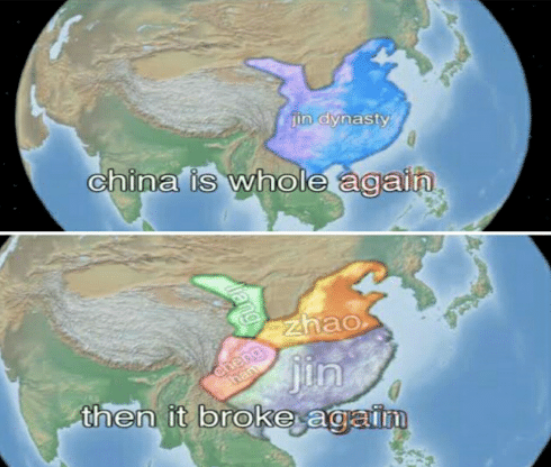
Jìn (266 CE–420 CE, with the earlier Western and later Eastern Jìn being separated at the year 317 CE, some cite 316 CE as the end of the Western Jìn)
Sixteen Kingdoms (of the North) (304 CE–439 CE, founded by the Five Barbarians of the North) (Despite the name, there were more than sixteen kingdoms)
At this point, Chinese history splits into the Northern and Southern Dynasties.
Northern Dynasties (386 CE–581 CE, divided into the Northern Wèi, which then split into the Eastern and Western Wèi, then the Northern Qí which was conquered by the Northern Zhōu (same character as the Zhōu above))
Southern Dynasties (420 CE–589 CE, divided into the Sòng (whose name and character is shared with a later dynasty, thus this one is often called the Liú Sòng to avoid confusion), Southern Qí, Liáng, and Chén)
Middle Imperial China
Suí (589 CE–618 CE)
Táng (618 CE–907 CE, with an interregnum of the Wǔ Zhōu between 690 CE and 705 CE)
Five Dynasties and Ten Kingdoms (907 CE–960 CE, the Five Dynasties are the Later Liáng, Later Táng (same character as the Táng Dynasty), Later Jìn, Later Hàn (same character as the Hàn Dynasty), and Later Zhōu (same character as the Zhōu Dynasty). The Ten Kingdoms is a misnomer - there were more than ten, some say eleven or twelve.)
Liáo (916 CE–1218, sometimes not counted as it is a northern Khitan dynasty which would later be conquered by the Mongol Empire. Most of it was conquered by the Jīn in the year 1125, but the west held out until the Mongol Empire conquered it in 1218)
Sòng (960 CE–1279, split into the earlier Northern and later Southern at the year 1127)
Jīn (1115–1234, located in the north and coexisted with the Liáo, conquered the Northern Sòng and hence the split into the Northern and Southern Sòng)
Late Imperial China
Yuán (1271–1368, one of the successor states to the Mongol Empire after its division)
Northern Yuán (1368–1635, minor rump state after the collapse of the Yuán, would be conquered by the short-lived Later Jīn (same character as the Jīn Dynasty) in 1635)
Míng (1368–1644)
Later Jīn (1616–1636)
Qīng (1636–1912) (renaming of the Later Jīn, would conquer the Míng in 1644, though rump states of the Southern Míng survived until 1662. Also the Qīng would be restored for less than two weeks in 1917.)
Modern China
Republic of China (1912–present, since 1949 only controlling Taiwan and surrounding islands)
Chinese Civil War (1927–1949, interlude from 1936–1945 due to Japanese invasion)
People’s Republic of China (1949–present)