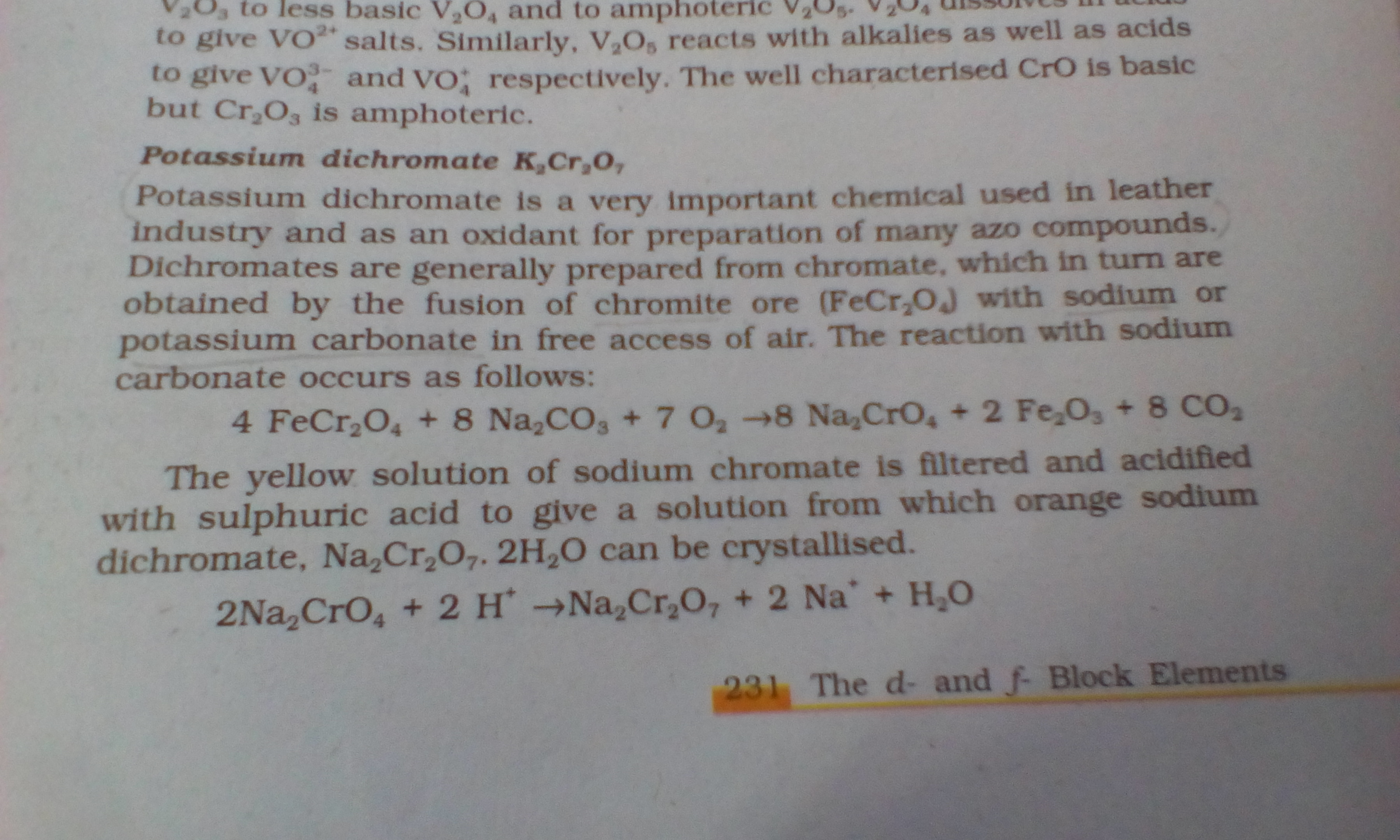
Can someone tell me how to make images to memorise this (potassium dichromate). I have been trying so long but cannot make images for it.
Should I try making images or adopt any other method
Can someone tell me how to make images to memorise this (potassium dichromate). I have been trying so long but cannot make images for it.
Should I try making images or adopt any other method
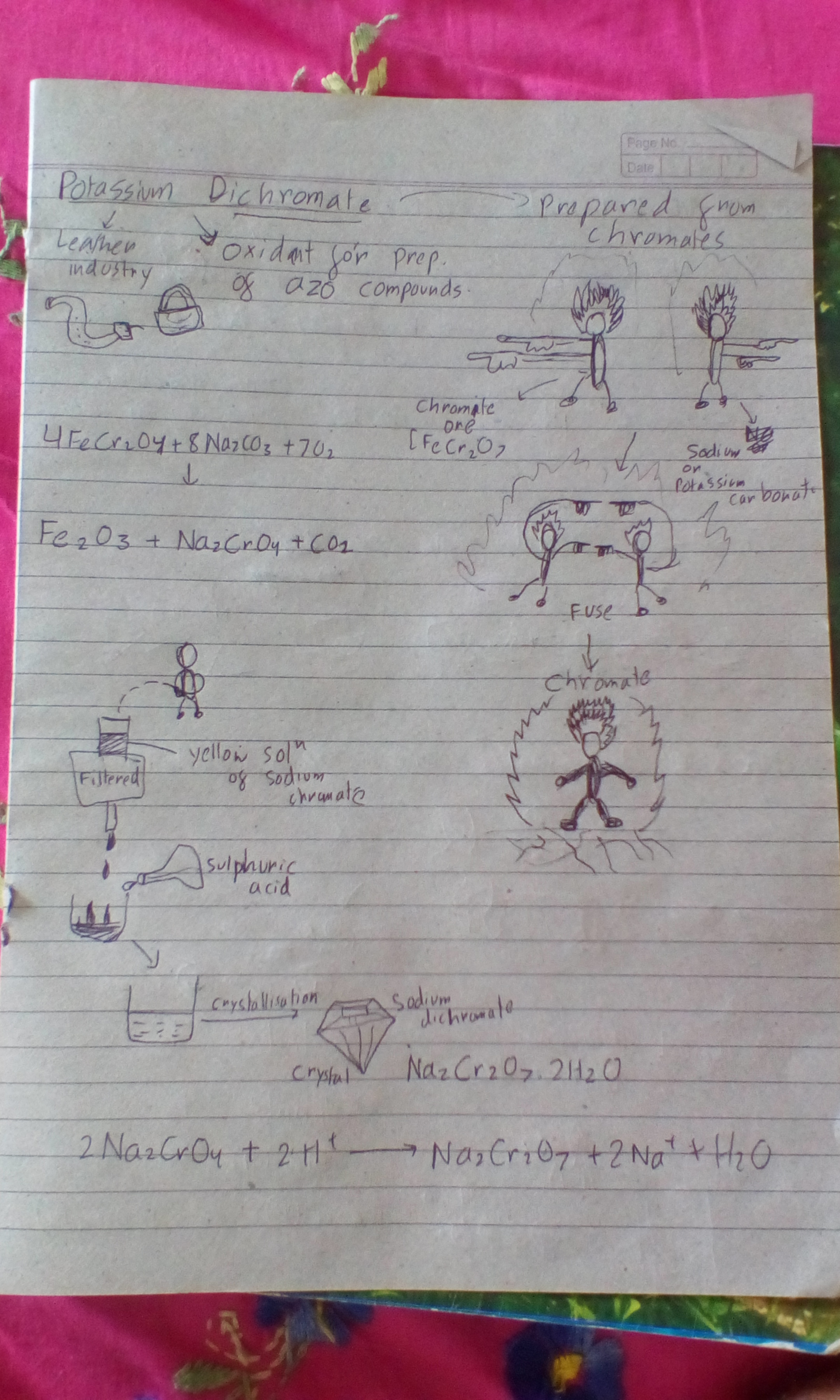
After a lot of effort I came up with this…(excuse my drawing skills as I made it on rough).
What do you guys think? Will this work? or should I try adding something more or try a different approach?
My only advice would be: try. If it works keep it. If it works partially, change it. If it doesn’t work at all, try… something else?
Something that works for you, that has meaning will not for me. Meaning can be very different from a person to another.
Only by trying will you experiment what is efficient and what is not.
When I took a chemistry class about 1 year back, I would remember chemical equations similar to how you would memorize numbers using the major system.
For example, to memorize potassium dichromate I would assign K with the hard k sound, all of the 2 subscripts have the “n” sound, Cr has a sound similar to the one in the word “cricket”, O has an “o” sound, and 7 has the same sounds as the major system.
All together, the resultant sounds would be K N Cr N O K/C/G. You don’t have to strictly use these sounds when actually memorizing the equation, but I’ll give you an example of how to do it with these sounds.
I would probably memorize it as:
“a cane (K, N) is being held by a crane (Cr, N) who shouts “OK” (O, K/C/G) at whoever walks by”.
Simple, easy, and everything can be memorized using quick linking.
I’m not sure if you need help memorizing the longer equation, but I’ll give you tips on how to do it. Firstly, you probably want to attach all of your images to some location, whether it be real or randomly generated in your head. Secondly, you want to come up with consistent images that you can use for mathematical symbols such as the addition operator and the arrow. You also probably want to come up with a physical “identifier” on how to tell if something is positively or negatively charged or not. For example, maybe you could have positive elements glow red, while negative elements glow blue.
My last piece of advice is to periodically review some of the longer equations you memorize, since sometimes they have a tendency to drop out of your memory at times. As you get more experienced in chemistry, you’ll probably be able to memorize the whole equation easily without much hassle, but you’ll only gain this skill by practicing memorizing. If you need me to elucidate some things further, you only need to ask.
That’s greatly explained, thanks.
Yeah I tried this, but the main problem I am facing is that there are many many such equations so creating images for each of them is quite difficult.
The method you are suggesting is efficient in memorising formulas of compounds but when it comes to a equation it gets quite complicated.(That’s why I wrote the equations as it is and didn’t made any picture/image).
Can you give me an example how would you memorise the equations?
I would go with something like @Vertexion’s sketch. Was in fact going to draw something until I saw his post.
Only thing I would add would be to develop a system of images that encode the elements. Oxygen might be an Ox, Potassium a pot, nitrogen, a bag of fertilizer or a bottle of ammonia …
It’s excellent. I was going to draw something similar.
Yeah, actually its quite fun when you get used to it.
I’m probably the last person who should be contributing to this thread, but…
In David Markoff’s “Memory Power System” series, he offers some advice that might be helpful. (Unfortunately, he completely ignores memory palaces.) There will be a learning curve at first, but I think his advice sounds very practical.
The secret is to essentially create your own memory approach before memorizing anything.
First, look at all of the symbols you’re going to encounter throughout all of the equations you want to memorize. Plus signs, minus signs, square signs, etc., etc. Figure out at the very start what images you’ll use to represent each of those symbols, then stick with them. For example, Markoff suggests, “Since ‘plus’ sounds like bus, we could substitute an image of a bus to represent the plus sign.” Maybe for the square sign you imagine a Rubik’s Cube.
Next, he recommends taking a similar approach with every letter of the alphabet. Use whatever tangible nouns come to mind. For example, he offers:
“a” is “hay” - the hay in a barn
“e” is “eel”
“f” is “half” - pictured as half a grapefruit
“X” is “eggs”
…and so on.
Markoff doesn’t go into detail, but you’ll also need images that denote superscript and subscript; maybe superscript letter/number images are all going up an escalator while subscript images are sliding down a fire pole.
Combining all of these things with letters (based on whatever system you prefer) should cover most of the bases.
It’s going to take a good deal of pre-planning to get comfortable with this sort of specialized system; it’s far more layered than the approaches most of us are using to memorize other kinds of information. But you may find it worth the effort.
Bob
Yeah originally before I came to know about major system and memory palaces I just used to draw and sketch to memorise things, I still use it now sometimes.
I used quite similar methods as you mentioned but face some problems.
Like the subscript and superscript part, as every chemical formula has some kind of subscript in it, I often end up imagining too many things going up an escalator which creates quite confusion.
In situations like this, one solution is to have an arsenal of several images you can use interchangeably. So if escalator means “superscript” to you, maybe for other superscripts in the same formula you could alternate using an elevator, a flight of stairs, a ladder—all of which still mean “up” to you but would offer enough variety to distinguish one from the other. Just be careful that you choose completely different images for subscripts (since all of these options move in both directions). That’s why I suggested a fire pole, which only goes down. Maybe another “down” image could be a fire escape, a parachute, etc.
Bob
Yes, exactly. I would invest a lot of time upfront developing the structure and encoding conventions before starting to actually memorize. My experience is that that exercise by itself leaves one with a pretty good command of the material.
Your ‘system’ for remembering the equations could be built as you go. And with every equations you transform in memorable images, it can be improved according to the results you get.
This is what I do. It is tough at first but man is it worth it!
It pays off quickly. Developing further the skills of transforming anything in images and placing them playfully in a palace…
It has worked much better for me then creating the whole system in advance.
Give me another one you need to remember, I could use a good challenge!
I essentially use the same method I laid out except I use a palace or a well thought out artificial palace to memorize the equations. When I used my method for long equations, I essentially did everything I laid out in the previous post, except I never had trouble with the method. I think that you should probably create your own system of memorizing the equations, it’ll probably work better for you than my method. After all, a good mnemonist doesn’t become a great mnemonist until he creates some systems of his own.
Sounds interesting, maybe I will try that
Glad you asked this question and it helped me understand this topic more. My daughter is appearing for CBSE XII and hence I have access to the book from where this screenshot came from.
I will give you my way of understanding and working on this concept. The text book passage you presented will not be enough for me to create a complete picture of the concept. My way will be to create my own Body of Knowledge for this topic and my current ways to do that will be noting down all the information available for this concept in some notebook which I will call my Body of Knowledge for this concept.
I will list out all YouTube videos which explain this topic. YouTube has become university for every concept now-a-days and my first source for exploration. Youtube search for potassium dichromate
Some examples of the videos I found (There are 20 more there in search)
Concept explained for JEE mains
Some basics in classroom setup
This in addition to the textbooks will provide a complete picture of multiple factors involved in the topic like
Once I have the topic in its comprehensive content with me in my notebook it becomes easier to create stories and images for the equations. If time permits I will add more details of the images which I will create for myself. In those images my state (Maharashtra) my native language and culture (Marathi) and influence of Indian Popular Culture play a significant role and hence it may not be directly usable to you.
Thanks for the links, they proved to be quite helpful.
The major problem I face with inorganic chemistry is that even after you understand the concept, remembering every small detail is quite challenging.
One of the reasons is that inorganic chemistry is very different from organic and physical chemistry, thus one has to do heavy memorisation as there are lot of facts and exceptions.
I asked my seniors how they approached this problem to which they advised to keep continuously re reading until some of it sticks.
Well I am working on to develop a system as @Readerly and @RMBittner mentioned,it will take time but I am confident it work eventually.
By the way, I am also appearing for CBSE class XII, so all the best to your daughter.
There are a lot of different strategies for this kind of material. If I find I have difficulty keeping the details attached, like subscripts, I increase the the level of interpretation until the detail is inherent.
For example, for a chemical compound I would use a diagram of the molecule and C4 would be a cluster of 4 carbon molecules arranged in a square configuration or perhaps even showing the valence bonds that make it a 4 pack.
If it’s a superscript, r2 I might associate that with surface area or I might see a double image with each at right angles to each other. For higher powers I might use triangles, squares etc. But often with exponentiated terms the power arises from some important relationships, as is the case with square laws and area, 3rd power laws and volume etc, and that comprehension can lock in the number.
A more abstract example, if you spot some form of n(n+1) in an equation you are likely looking at a triangle number which was produced by summing terms 1…n.
If you can find such insights you will greatly increase your comprehension and retention.
If I can’t find such organizing principles, then I’ll invent them. Perhaps make up a story about what happened when 4 carbon atoms came across a couple of bad hydrogen atoms.