Division of that skill into sub-skills(For example-The skill of memory)
100 hours of delibrate practice in a skill(Fro example the skill of memory)
Such practice that no one can dare to challange you in that skill.
The information above may not be fully correct according to my understanding however you can search about the 100 hour rule in Google or YouTube if you want to know more about it.
My questions are whether the 100 hour rule if it is followed for the skill of memory or memory skill make any one have world class skills in memory or memory skills(Each skill of memory may be needed to be practiced seperately while following the 100 hour rule to get world class skills in memory).
What is world class(Is it the top 1% of the people who practice a skill, For example-Memory Skills or is the top 0.1 % of maybe the few people who practice memory skills, What is the exact percentage of a person with world class skill in the people who are practicing that skill ? (Is it the top 5% or 1% or is the percentage higher or lower),
Those are different rules by following 10000 hour rule you can get mastery in a field whereas by following the 100 hour rule you can get world class skills in the sub-skills of a skill and a field or profession is maybe broader than a skill and having mastery in a profession or field may be different than having world class skills,
And you can search about the 100 hour rule if you want and can compare it with the 10000 rule,
I think it is possible. If anyone will correctly practice one memory sport discipline for 100 hours, he will be in top 5% in the world in this discipline. But it might be difficult to find the best way to practice, even with 100 hour rule.
I think there is not exact meaning for world class level or world class skill . But maybe GMM(Grandmaster of memory) and IGM(International Grandmaster of memory) titles show something similar.
If I don’t mistake, around 2% of all competitors(at WMSC - World Memory Sport Council) have Grandmaster of Memory title.(Seems like too many)
A 100 hour rule and all other such rules are not laws of nature. They are generalizations, and as such, almost by definition, they are of little value to individuals.
Perhaps they make these rules (whoever they are), to make ordinary people think that they can become someone extraordinary (usually with little effort). Kinda like a distraction from their ordinary lives such as winning the lottery is (reprehensible governmental behavior). I think all of this type of thing is a form of magical thinking.
I don’t think that 2.5 weeks of effort is going to make anyone a world class anything, all of the undefined terms (including mine) notwithstanding.
I will test this rule from today to know whether I will become world class at a skill in 100 hours of practice or not and I will share the results,
By doing that I might find out whether the 100 hour rule works or not and how good it works and I will share my accuracy at a subject Accouantancy which may or may not be world class however it may help in testing this rule which some of the richest and the most successful people in the world use.
I like this idea at its core. I think for memory sports the divisions in 100 hour skills would be fairly narrow and several 100 hour skills must be practiced to be used in tandem to be successful. Any one of those sub-skills could probably be developed to a competitive level in 100 hours of practice.
Some samples of the divisions in specific skills might be:
Creating effective memory palace locations, navigating them, and memorizing the loci (100 hours)
Creating major system images for 00-99 numbers and memorizing them (100 hours)
Creating associated images on the fly for random words and having 2 images interact in memorable ways (100 hours)
Memorizing random content attaching the images to loci and review while encoding in an effective manner (100 hours)
Creating and memorizing images for a 1-card system (100 hours)
Learning Names best practices and memorizing names practice (100 hours)
Learning Images best practices and memorizing images practice (100 hours)
To compete successfully in a memory league match it would require ~700 hours learning 7 different sub-skills.
To just memorize in the images discipline it would only require 1 and 7 so 200 hours.
Chess is very similar in it is a collection of several separately trained sub-skills.
Tactical pattern memorization
Calculation (I go here-he goes there, at the end of calculation you recognize a tactical pattern)
Positional play and piece placement
Openings memorization
Opening principles for if opponent deviates from strong opening moves you memorized
Endgame memorization
Practical endgame skill (play with few pieces leading up to theoretical memorized endgames)
You could be a fairly high rated chess player just practicing skills 1 and 2 but all 7 are required to be world class and some of the 7 take a lot longer than 100 hours.
I am a CPA (inactive) and studied 800 hours for the exam with rote memorization 12 years ago.
If it is similar to when I took the test they recycle all the exam questions verbatim from what is in the practice books. By the time I got to sections 3 and 4 I was completely ignoring the textbook materials and just spending all my study time on practice tests.
On the actual exams I would recognize verbatim questions repeated. This works for all the sections but FAR (because FAR has math based calculations that can’t be memorized).
I am not sure whether the FAST method by Jim Kwik which can be found on YouTube can half the 100 hours to become world class at a skill however I believe it can reduce the time it takes to learn a skill by 50%,
There are some methods in YouTube which promise to double learning speed and I belive that most of them are repetitive however I have found fast progress by taking all their different steps and following them in my order,
And I will post a collection of those videos with different methods afterwards along with their steps such as teach,test, prime, active note, mnemonics.
In total there are maybe 8 videos which claim to double the learning speed and although I was able to see a major improvement after trying the steps given in thake videos together I was unable to learn 16x(8*2) times faster however they gave me a major improvement in a short amount of time when ever after I practiced them after many days,
Although it is not worth it to watch every video whose title says “Double your Learning Speed” because the content in most of them is the same or or it is very similar and few videos give new information which take a lot of time to find however I will post a list of the videos giving new information along with new information and the total steps given in those videos to increase learning speed,
I’ve done an internet search for the 100 hour rule. It seems to originate from this blog entry. The author doesn’t claim that anyone can achieve world class skills with just one hundred hours of training. Actually it’s just an estimation of the time needed to become visibly better than a beginner. A quote from the site:
For most disciplines, it only takes one hundred hours of active learning to become much more competent than an absolute beginner.
Let’s say for example that you spend one hundred hours learning a 2-digit system and doing number trainig. As a result you can memorize 50 digits in one minute. That’s a skill neither a beginner is capable of, nor a person that doesn’t know anything about mnemonics. From their point of view you are an expert in memory sports. But that doesn’t mean you are world class.
Last but not least, I think that it also depends on the skill you are trying to learn. Let’s say you spend just 100 hours to learn how to drive a car. There are a lot of people that won’t be impressed by your skill level then.
But that’s just my opinion, and I can be wrong of course. Looking forward to read more about the results of the experiment
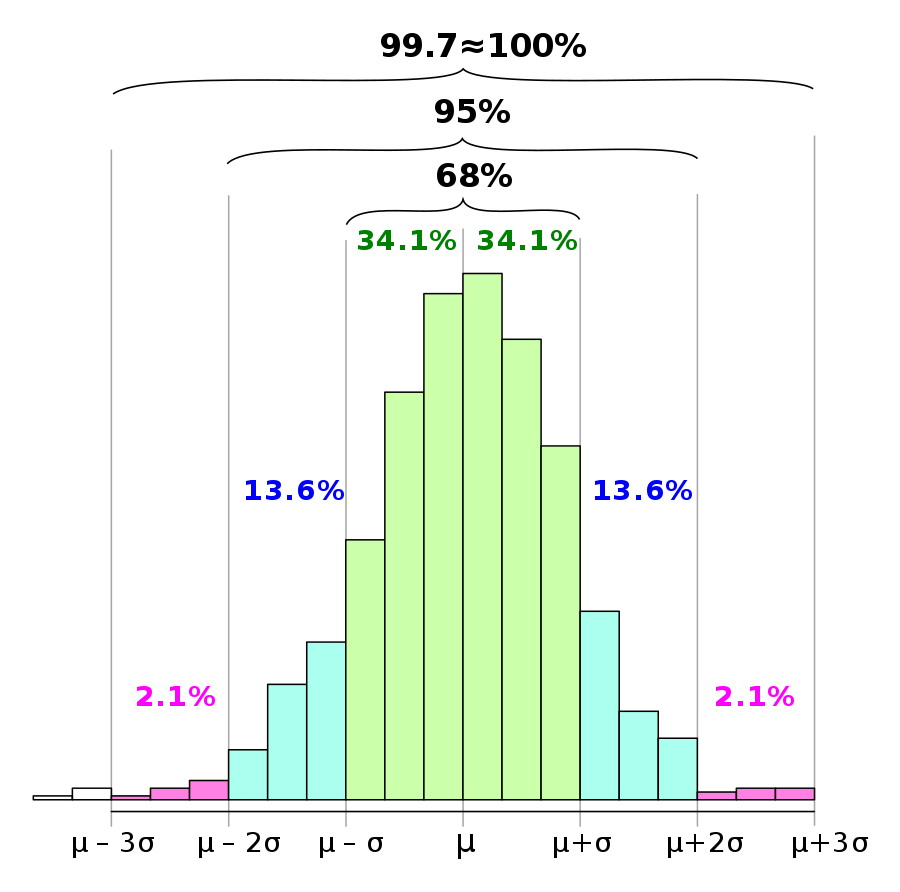
The “exact percentages” are 68, 95, 99.7 as in the three-sigma rule of thumb which can easily extrapolated from the link that @Finwing provided in his post above, in which the author states that:
To address this dilemma, I’d like to propose the 100-Hour Rule:
For most disciplines, it only takes one hundred hours of active learning to become much more competent than an absolute beginner.
…he goes on to say…
Since 95+% of people don’t know anything about most fields, it takes very little time to jump from “the naive 95%” to the 96th percentile. The long part of the journey is moving from the 96th percentile to the 99.9th.
…of course the fallacy here is to consider “all people” instead of the ones that are actually in the running. There are around 8 billion people in the world, so if you consider everyone… the 1% is you can the other 80 million people (i.e., the population of Germany).
If you are thusly is the 99th percentile of German speaker you’re at a native level. On the other hand, there are only about 2 million Esperanto speaker, so what does it mean if you’re in the top 80 million of 2 million???
What you can do though, is consider everyone whose ever learned French when assessing your level of French (probably what the author meant anyway). So that would be comparing against everyone in the running.
Consider the chart a representation of everyone who’s had at least a year of French (as a foreign language) in high school. Also, let’s say the average (\mu) is the level of French after two years of high school instruction… somewhere around A1/A2 on the CEFR to make it a bit more tangible.
To the left is everyone from the person in college pointing out that they had French in high school but majoring in something completely different, to the parents that can’t help their kids with their French homework anymore because they haven’t used it since high school. (What would be considered “false beginners” in a language school.) All the way to the person with only a year of French (barely passing) some 20-30 years ago in high school.
To the right, people who took French until graduation, did an exchange program, all the way to people who ended up working in a French speaking country after college. You could basically consider everything to the right of \mu+2\sigma a C1 or higher level with \mu+3\sigma a C2 level with native like proficiency.
While “100” is an easy-to-remember round number, it’s just an approximation. Some fields might require ten or twenty hours to achieve a level of medium competence, while other fields might require several hundred hours. Either way, that’s much less than the 10,000 hours required for full mastery.
Let’s quickly get this last point of of the way… the 100h hour rule might as well be the 20h rule of the 500h rule… this is no like the 80/20 Pareto principle… this is according to the “inventor” of the 100h rule just a catchy name.
So, is it possible to get from a \mu+1\sigma level (high A2) to a \mu+2\sigma level (high B2) in French in 100 hours? Like I said, the guy’s percentages are a bit made up… an absolute beginner could of course get to A2/B1 in 100 hours too. But you can’t call your advanced beginners level 95%+ just because you’re also considering people who don’t have the slightest intention of ever learning French… so the proposed high A2 to high B2 is a little more honest and realistic.
100 hours of French (A2 → B2)
Pick a 20 minute sitcom you’re familiar with on Netflix that has English and French audio as well as French subtitles. Watch one episode in the morning in English with French subtitles and focus on reading the subtitles. At night, watch the same episode in French preferably without turning on the subtitles; focusing on listening comprehension rather than reading comprehension.
Do that 6 out of 7 days a week for a total of 2*20min*6=240min=4 hours per week, and you’ll have 25 weeks of practice by the time you get to 100 hours. I don’t find it too impressive to increase from a high beginner to a high intermediate in half a year. Of course, if you think that you could do the same thing in just a week by studying from morning until night to get the 100 hours over with, you’ll likely be disappointed by the results.
100 hours of Speed Cards (5min → 2min)
A deck of speed cards is 5min memo and 5 min recall. Two of those in the morning and at night as many decks as possible in 10 min with 10 min recall. That’s the same 40 minutes from the French learning example above. Do that six times a week for half a year to get to 100 hours.
Anecdotal evidence
My very first deck of cards was 20 minutes. The next day it was 12 and the day after that 8 minutes. I took a few days to iron out what I considered weaknesses and within a week I managed to go from my very first deck in 20 to my first deck in 5 minutes.
Similarly, after reading the algorithm for the day of the week calculation, I needed 20 seconds per date, was around 15 the next day and then moved my PAO system into 7 memory palaces, so that I didn’t have to calculate the year code anymore and dropped to 5 seconds per date by simply changing strategies from pure calculation to calculation with year lookup.
Well, I already had my PAO in place before starting speed cards or weekday calculation. Took me two weeks to set up my PAO, 10 images per day and 4 days to rearrange and finalize. Less than an hour a day. Then 5-10 mins in the morning and at night for two weeks to be able to use it without getting frustrated because the image wouldn’t come to mind.
Well, first of all… in the blog the guy is not talking about becoming world class by spending 100 hours on a skill, he says “much more competent than an absolute beginner.”
I rank 331st in 10 minute cards, which is roughly in the top 20% these days. The score is from a 2016 competition and if you look at the people ranking better than I do, you’ll find that half of them got there over the past 6 years that I haven’t competed anymore. I think, back when I got this score, it put me in the top 100 for the discipline. Unfortunately, I can’t filter on the page, but you can count and subtract all the 2017-2022 competitions in the top 331 if you’re interested. Of course even back in 2016 Johannes and Simon already did 7 decks in 10 minutes but a mere 4 decks would still get you into the top 50, today it’s barely in the top 100.
So, what’s world class? Who knows… up to you to decide. I went to the World Memory Championships both years that I competed. By the time I was done, I don’t think that I spent 100 hours on speed cards yet. Is going to the WMC already world class or would you have to finish in the top 10? Is everybody who’s going to the Olympics world class or are they just the best in their country? Just the gold medal winners world class?
But I think its debunked, like the magic number of 7 that people can’t remember more than 7 digits at once, but memory trainees are breaking that everyday. same is with 10,000 hours rule.
Any skill you want to learn or any course on youtube is on average 50 hours and I feel anyone can learn that 50 hour course in 100 hours, I am not talking about perfection because perfection is an illusion.
I have been trying to learn different skills every month which I call “30 Days Challenge”.
and this year I have learned around 12 Major skills.
like coding, stock market, flute, harmonica, beat boxing, creating algotrading system design, learning songs in different languages , bo staff and more…
I don’t aspire for the perfection, I work on Pareto Principle or 80/20 rule.
I love this quote : " If you give yourself 1 month to clean your room, it will take 1 month.
but if you give yourself 2 hours, it will take 2 hours and that applies to every skill.
I made a method for solving numerical questions which I don’t know will work or not but I feel that sharing it will be good -
This method can be performed by-
a) Solving 5-10 examples given in a textbook of a practical subject(Ex-Maths, Accounatancy) without looking at their answer and journalling two things
1.What were you thinking when solving that example
2. Reality
You can even journal incompletely writing as much or as little as you want for each of two headings very seperately.
b) Read what you have written and analyse it(It might tell you what you know and) and write down the steps on how you commonly solved the examples in each chapter and then apply those steps in different examples which maybe the examples which cover your entire chapter and then judge whether by following your steps you could get the answer right or wrong.
Potential benifit-This may tell you how you solve examples of a chapter and which examples based on how you solved examples before.
Next Steps- You can make a list of the parts in the examples that you would have made a mistake at and then make up names for those parts or write their actual names down and then practice those parts only for sometime to increase your accuracy in those parts.
After which you practice those examples in which you think you might have made a mistake in fully and it maybe that you will be able to solve more of those examples than you would have been able to recently.
Potential reason if that happens- You practiced the parts of the examples in your book in which you might have have made a mistake in and because you have practiced them more depending on the amount of your practice you are less likely or not likely to make mistakes in them anymore and I think if there is nothing remaining in those examples in which you can make a mistake in then you will solve the complete examples correctly.
Maybe if your Calculation is good then you can skip the calculation part in the examples which contain Calculation since your calculation is already good but you must still solve calculation to retain your calculation ability(Adapted from a YouTube video whose creator’s name I can not remember now) but I do not know whether will work or not.
Potential Advantanges-
If it works I am thinking of calling it smart practice.
You may be able to skip examples which you know how to solve
You may only need to practice parts of the examples which you are likely to make errors.
You may find where you are likely to make mistakes without practicing that much.
You may not need to do the calculation part of the examples if your Calculation is good and maybe if your calculation is average and you skip the calculation part of the questions and still practice calculations seperately then depending on your practice this may work.
And also anyone wants an explanation of thiss comment then he or she can ask me in this topic ,
I think that some people repractice sums to fix a mistake that they make in a small part of that sum instead of practicing only that part of a sum for sometimewithout the calculation part if their calculation is good.
They can also create short hand abbreviations for common sentences and write n with a 1 above it for the first name that they want to write instead of writing the full name where n stands for name and 1 stands for the first and so n with a 1 over it stands for the first name which they can write instead of writing the first name they have to write and they can write n with a 2 above it for the second name they have to write and although this might not work in exams so unless more information is available on practicing practical subjects like Maths in short hand I do not recommand doing this and it maybe somewhat like solving a question paper in a second language instead of a first language if you practice with shorthand(with the person solving that paper being better in the first language(The language of English) than in the second one(Shorthand) although shorthand can also be in English.
By predicting which sums and their parts a person will not be able to solve and not solve and prioritising the parts a person may not be able to solve and mostly only solving them with proper and spaced revision of the parts of those sums which the person will be able to solve may increase the speed of the person learning the sums of a practical subject(Like Maths and Accounatancy)
What are the advantages and problems that you think are of practicing the way I have written above? Do you think it is better to practice the normal way or practicing using the ideas given above is better ?
Credits- I found one of the ideas in the method above in many YouTube channels of different teachers although their wording of that idea was not the same if I remember correctly(Maybe each teacher’s wording of the idea was different).
Note- And also maybe if those ideas are followed with the 100 hour rule then the time to become world class at them maybe shorter and I am testing a way to learn even faster although I may not be able to reveal it and my test might fail however if my test is successful it will lead to a faster learning of a skill but slower application of it as it will be equal to understanding how to find the answer of a question as compared to memorizing it and with understanding I can solve more problems but I maybe slower although learning a skill(Here for example Accouantancy that way) by using that way and then relearning that skill by practicing it the normal way or the smart way(if that way works) maybe equal to understanding something then memorizing it which have some benifits and credit to @user_7e some of whose language I have taken from and edited in this post on learning much faster,
I am skeptical of these simplistic rules. IMO you should be too. Especially when based on anecdotal evidence and then applied broadly to all individuals across all skills. As a rule of thumb it might be useful but rules of thumb are averages and averages blur out individual cases.
And such claims ignore the contribution of natural talent. People are not some kind of plastic that can be worked and machined into any shape. They show up with individual propensities and strengths.
I have tried my hand at many things and for similar investment of efforts I got widely varying results. In some cases I progressed much faster than most, in others, I struggled to learn in a year what most picked up in a month.