Can mental calculation improve one’s brain?
1 Like
I’ve heard it said that intelligence comes from solving problems. So yes, doing mental calculations will improve your intelligence. It will do a lot more than just passively watching TV.
Perhaps you might like to read or listen to some books called: The Brain That Changes Itself and The Woman Who Changed Her Brain. Both explain neuroplasticity - ie how the brain can change and develop.
5 Likes
The best way to improve your IQ score is to practice IQ test questions. Whether that would make you smarter in general, I don’t know.
I wonder about that IQ score and what it measures. We’ve had a couple of exchanges and that was not my impression at all. IMO IQ tests, test a kind of quick wit. To do well on those questions you got to see it in a snap. Some people are slow thinkers, not stupid, just slow often more accurate. Some people don’t test well. They underperform.
Do you like to read? Do you read for fun? If that’s available, I highly recommend taking up reading as a way of improving your intellect. Your verbal skills will improve and language is the basis for more thought. Your ability to think abstractly will improve. You will be exposed to new situations and ideas and want to think about them. And you will learn stuff. Read what you like, better writing is better but the most important is to read and enjoy it.
6 Likes
There are no known ways of actually increasing your intelligence. Like being tall, or like being a world class athlete these things are gifts. Can’t turn a Pug into a Pitbull. BUT, most people don’t use their gifts and a hard worker can often outperform most who have not put the work in. For example, I will never be incredibly strong,. but after 3 years of regular weight lifting I was stronger than anyone who didn’t lift weights. Strong guys who lifted weights for 3 years like I did were crazy stupid strong but I made couch sitters look very very weak.
There are a huge range of talents, strengths, and disabilities here and they have always been supportive of anyone that wants to try. Mnemonics rely on our monkey abilities to remember where bananas can be found and where the lions were. By thinking in concrete pictures and using our monkey brain we avoid the problem of not being smart enough to remember a bunch of useless abstract crap; lists, numbers, names.
Try practicing the memory techniques. You will be very surprised how incredibly smart your monkey brain is. I was shocked how easy it was to remember things when I did. It didn’t make me any smarter but it did make me realize that I had taken a knife to a gun fight for most of my life as a student.
4 Likes
When you say “Below average”: The average IQ is 100.
I’ve taught math at all levels to all sorts of people. In my experience, people with IQ 100 don’t get logarithms. It’s too many steps into abstraction. And most people would not even try to tackle the example you were reading. Your question about it sat in the forum with no response for a while - why would that be? You got stuck on an algebraic manipulation. Don’t you think you will spot that trick next time it comes up?
I’ve taught calculus many times. If you can grasp the concept of logarithms, you have all the necessary cognitive equipment. IMO it comes down to two things, strong algebra skills and a willingness to work hard with your brain.
Skill in algebra is only a matter of practice - a lot of consistent practice. Everytime you get stuck, you learn a new trick and you get a bit smarter. You also learn to expect what kind of moves are made. Part of the reason I got that identity when you didn’t is that I expected it. I knew what to look for - that’s just experience. There was day when I would try to read proofs ask “what the hell are they doing this for?”.
I’ll elaborate a bit on what @RobertFontaine said: Slow people have an advantage, - they are used to working hard for their skills. Naturally intelligent people have a lot of trouble with this. They are used to having things come easy but whatever your talent, the last few miles are always hard work and they often stall there. There are a lot of people with strong natural talents who don’t do the work to develop them. I myself have been overtaken by colleagues who were not as bright as me but worked harder and longer.
Where you start from is not that important. It’s how far you go that matters.
2 Likes
I believe developing skill with math - to any degree will have a “knock on effect”. There will be significant benefits. But you ask will it. I don’t make that promise. And I don’t know enough. I believe it’s a very good thing to do for your brain and once you get a little bit of skill, it’s fun even deeply rewarding.
3 Likes
What do you mean there no know ways to increase intelligence. Intelligence is hard to define. Is intelligence the ability to get along, or the ability to figure things out? And how does experience affect intelligence? Can a 15-year-old be more intelligent than a 50-year-old, given that the 50-year-old had the say IQ score when the 50-year-old was 15? I give this reply a thumbs up because the analysis on what to do with memory improvement techniques is awsome. I especially like that Robert Fontaine included how the brain can change; brain plasticity.
3 Likes
IQ statistically provides one of the strongest known indicators of future success. If I had only one tool I could use in hiring I would use an IQ test. IQ is not improvable through training. In this specific area, it is as genetic as eye color. Brain plasticity is not Intelligence. Yes, you can learn and happily, you can learn after the point that your brain has completed maturing BUT you cannot increase or modify your Intelligence via any known method. Mnemonics, skills development, hard work may all help you perform better in a situation but they won’t increase your intelligence. Intelligence is not hard to define. It has a clear and specific meaning. It is a highly inheritable trait and there is no drug or exercise that you can do to increase yours. You have to race what you brung. There is a misconception that you can be anything that you want to be. It is false. If you are short you cannot be tall. If you are uncoordinated you cannot be a world class gymnast and If you are mentally average you will not be a rocket scientist.
Intelligence is normally distributed around 100. There are a few populations with above average averages like the Ashkenazi. If you want to be a nobel laureate I highly recommend selecting your parents from the Ashkenazi stock. They score 0.75 to 1.0 standard deviations above the general European average, corresponding to an IQ 112-115. More importantly for such a small population they have a disproportionate number of off the scale genius. I think there are asian populations with averages sitting around 108. Not as dramatic with outliers though.
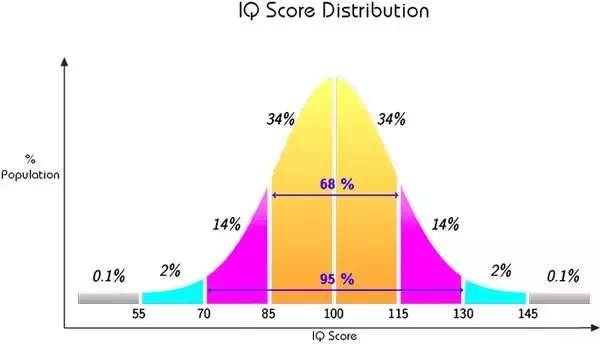
Stepping back, 68 percent of scores fall within one standard deviation of the mean (that is, between 85 and 115). This is what defines “normal” although I strongly believe that anyone much under 90 is going to have problems being taught to do repetitive labour. The intelligence gap is a real problem for a society that is rapidly removing manual labour as an effective way of putting food on the table.
The Worldwide Pattern of IQ Scores: East Asians average higher on IQ tests than Whites, both in the U.S. and in Asia, even though IQ tests were developed for use in the Euro-American culture. Around the world, the average IQ for East Asians centers around 106; for Whites, about 100; and for Blacks about 85 in the U.S. and 70 in sub-Saharan Africa.
As individuals, our intelligence is what it is but the genetic component is incredibly strong and all statistical data bears this out.
Please avoid playing race cards etc… I am neither Japanese nor Ashkenazi. I do worry about how we are going to manage in a society that requires a 135 IQ to work an information based career to pay the mortgage and food. What will 98% of the population do?
| IQ Range|Classification|
| 140 and over - Genius or near genius |
| 120-140 - Very superior intelligence |
| 110-120 - Superior intelligence |
| 90-110 - Normal or average intelligence |
These are very generous ranges. I would not call 140 genius and I would have a very tough time appreciating 90 as normal.
One thing I’d like to say is that it’s been shown that those who live in poverty show some dramatic drops in their IQ ratings. Is it no wonder then why African Americans and Sub Saharan Africans have such low IQ scores? Take them out of poverty and their IQ scores go up unsurprisingly.
Lastly, automation need not hurt people, so long as we provide for them. We can currently give millions of those in poverty a good standard of living without working. Alas, we won’t. What a shame.
3 Likes
I’ve come to the conclusion that IQ tests are a pretty blunt tool for defining and assessing intelligence. I have some friends who were in the bottom class at school (lowest of 7) and they struggled with reading. Now both of them are multi-millionaires through hard work and brains.
On the other end I know people who have high IQ but are spectrum-y and in some ways functionally retarded.
I’ve heard the arguments about IQ tests from Jordan Peterson and Sam Harris et al but I’ve come to the conclusion that it’s only useful in a very broad sense. I know too many people who demonstrate superior brain development in particular areas - like people who can compute incredible amounts of social information or display vastly superior physically abilities or demonstrate their brain development through music or art.
A test that relies on reading ability or deciphering squiggles doesn’t account for them so I hold the idea of IQ lightly. Consequently I find that I am surrounded by very intelligent people who demonstrate it in their own ways.
1 Like
IQ’s are a useful indicator of success in our society. That’s pretty solid. What exactly IQ tests measure is still unclear. Nor is it clear how much is due to nurture and how much to nature. You can however improve your IQ score. Simply by practicing those kinds of questions you will become more efficient at setting up the problems and the kinds of answers that are expected. Any test can be gamed to some extent.
As an Ashekenazi Jew of high intelligence with two sons who are college profs I am very skeptical about the idea that Jews have some common genetic factor which naturally boosts their intelligence. I might be inclined to believe a similar claim about a genetically homogeneous group but the European Jews and Jews in general are about the most diverse ethnic group you can find. My dad looked like an Arab. Dark skin, hooked nose always randomly selected at airport lines. I look generically ‘Mediterranean’. Two of my sons are blond haired and blue eyed. While there is a strong semitic presence in the gene pool, Ashkenazi Jews tend to look like the countries they come from. Part of my family came from Poland where you find blue eyes and blond hair. My two blond boys are at least as bright as I am.
It is hard for outsiders to appreciate the extreme value that Jewish culture places on learning. Academic achievement is valued too but it’s the scholarship that’s revered. In Orthodox communities rich merchants woo the best Talmudic scholars to marry their daughters - even though the man may never earn a penny. I started reading books off my Dad’s shelf when I was 7. That’s what everybody else was doing. My wife and I moved across the country and changed jobs in an effort to find the best schools for our kids. We were prepared to mortgage our entire financial future to get them into the right colleges. Home life was discussion about what you had learned and what you thought about it. I’ve met many very intelligent people who never had a chance for an education. This just can’t happen in traditional Jewish culture. It’s very unusual to find a Jewish mind that hasn’t had the opportunity and encouragement to develop.
Not only do the demographics not make sense, it’s very hard to see past this curtain of extreme cultural pressure and argue that it has some genetic basis. It also fails to give credit for the work that was done. If the Jews are to be noticed for this, I would rather that it be held up as an example of the difference cultural support can make to a child’s development.
It has not much helped the Jews to be singled out for their intelligence. It adds to the narrative that they are tricky, don’t deal with them - they will outsmart you and to the general image that they are somehow different from the rest of the human race. There’s something non human in the mix. Despite their renowned academic prowess they were denied entry to many subjects in American colleges even up to the 60’s. It was political pressure, not SAT scores that changed that.
I see the world through a different lens from most. Except for handful that migrated to South Africa, my entire European family went into Hitler’s camps and never came out. Many turned in by lifelong friends and neighbors who felt they were different enough that they could be disposed of like vermin. I lived through a war in which the stated intention of the invading armies was to exterminate us and our children. That day will come again. Time is not on our side. In these black times, when the world has gone mad and bad, any attention paid to the Jews is very unsettling.
4 Likes
Funny enough, in the 1900s-1920s Ashekenazi Jews tested below average on IQ tests. But as their material conditions improved, their IQ scores “magically” went up. A similar effect has been noticed in Kenyan children within a timeframe of 14 years, too small a time for one to conclude significant genetic change.
3 Likes
I have heard it said IQ cannot be improved. I’m a bit skeptical of that but perhaps so. What does that mean for you? It certainly doesn’t mean you can’t get smarter at math if you work at it. I’m sure you can improve your memory with techniques offered here. You can do a lot for your brain just by reading prose, preferably fiction or biographies. Books of facts are good but not the same thing at all. There is something important about following a story.
If you are enjoying the math, you should celebrate that and go with it. I said it before, most people turn their eyes away from anything that looks like math.
3 Likes
Interesting and terrifying. Even though I know about the history of the Jews, I cannot properly understand the current experience, just as I cannot understand the experience of Asians or any other group in society.
Anyway, I’m not so sure that culture can be cleanly separated from genes. I have French genes and I’ve always wanted to learn French. I studied it all through high school even though it was hard and I wasn’t good at it. At a family reunion I asked my relatives if they too were interested in learning French and all of them said yes though none of them speak it or have any exposure to it down here in New Zealand (except for my cousin who has a French-Moroccan girlfriend).
My point is that my family’s interest in French seems to be entirely biological. There is no cultural influence. A long time ago I watched this documentary about the influence of genes on people who thought they were 100% English.. So when it comes to nature vs nurture, I always think that it is a really complicated mix of influences from the past and present.
1 Like
It’s very hard to tease out the different effects of nurture vs nature. To date it has been virtually impossible to design experiments which can distinguish the two signals.
It would be idiotic to argue that intelligence has no genetic basis. Were that the case, we’d be living like chimpanzees. It makes sense, considering that the human race shows varying adaptations to climate and environment that intelligence should should have adapted too. After all, the brain is hugely expensive and cognitive power doesn’t always pay off. In some environments it may have been better to develop less brain and thus require less food or to be tougher rather than smarter. There is also evidence from separated identical twins suggesting that quite detailed behavior, like marrying women with the same name, can be linked. Perhaps there is a gene for wanting to learn French?  But it’s a perhaps.
This is an argument for plausibility - lot’s of things that make sense don’t pan out in the real world. The human race is genetically young, there has not been time for deep diversification and very mobile making it hard to find populations that are genetically homogeneous. In the case of the Jews, this is extreme. They have been an extremely mobile population and the results show. My sons’s fair complexions did not come from the ME.
To ignore, as some have, these plain, indisputable facts about the Jewish population and still insist that the Jews are carrying some kind of magic smart gene suggests very strongly an agenda intent on setting the Jews apart whatever the facts. Obviously, I am keenly sensitive to this.
The problem is that this is a fraught subject and one that is too easily distorted to support racist agendas. It is important to tread cautiously, and not venture out to speculation simply because things ‘might could be so’. The bias in the other direction is just as bad too. Those intent on proving that all men are equal bend the data their way too.
These kinds of consideration apply to other populations about which general IQ statements are made. Contrary to what most people seem to think, Africa has an enormously genetically diverse population. It would be so just by merit of being the oldest reservoir of human population but also there has been tremendous amount of movement, invasion, a partial return to Africa from Europe. Skin pigmentation is just one of ten thousand elements that are controlled by a person’s genome. We don’t see the shape of a man’s spleen or his resistance to malaria.
We don’t really know exactly what intelligence is nor really what an IQ test measures - merely that it is strongly correlated with success in a modern society. What of innumerate cultures? Amazon tribes whose languages have no words for numbers above 3. I don’t see how one can, by any modification, try to get meaningful IQ measurements of a population that has to solve a completely different set of problems.
I urge discipline and restraint. We don’t yet know enough. The work is yet to be done. Resist the urge to jump to appealing, glib conclusions. Getting this stuff wrong has very grave consequences.
4 Likes
I should have said please try to avoid taking this in the mud on racist OR appeals to some liberal form of social justice that assumes all dogs are the same, that a pug can be a pitbull or that you can be Michael Jordan if you just try hard enough.
The tiny range of averages all essentially fall within the normal range of human intelligence ignoring the malnourished and primitive. I’m not terribly impressed with 90 or 110. 68% of the population fall within 1 standard deviation of the mean (give or take a bit).
I understand the sensitivity of our jewish mathematician but there is something there far beyond the simple cultural, paid for it, tried harder argument. There are a small group of dogs here that crush fluid thinking. I am not saying that a genius cannot be a failure rather I am saying that intelligence is an inherited trait that we don’t individually have any control over and that has been shown to be significantly unaffected by education or training. About the only known way to “slightly” game the system is to practice taking IQ tests and gaming the system will not improve the intellectual traits being measured only your ability to score higher in the game.
Another kind of evidence is that Ashkenazi Jews have had success disproportionate to their small population size in a variety of intellectually demanding fields, such as science, technology, politics, law, and commerce.[[10]]
(Ashkenazi Jewish intelligence - Wikipedia)[11] Only about 2% of the U.S. population is of full Ashkenazi Jewish descent,[1] but 27% of United States Nobel prize winners in the 20th century,[1][4] 25% of the winners of the Fields Medal (the top prize in mathematics),[8] 25% of ACM Turing Award winners,[1] a quarter of Westinghouse Science Talent Search winners,[8] and 38% of the Oscar-winning film directors[6] have either full or partial Ashkenazi Jewish ancestry. Jews comprise up to one third of the student populace at Ivy League schools[10] and 30% of U.S. Supreme Court law clerks.[11] In Great Britain, Jews are overrepresented among Nobel prize winners by a factor of 8.0.[4] In Hungary in the 1930’s, Ashkenazi Jews comprised 6% of the country’s population, but 55.7% of physicians, 49.2% of attorneys, 30.4% of engineers, and 59.4% of bank officers.[6]
I don’t assert this in terms of race or religion but rather of family or tribe if you will. There are a bunch of guys who are all related from some medieval village in Eastern Europe that became Jewish either before or after they arrived that represent a far higher group of the outlier genius in the world than is random. That education is incredibly worth investing in for them and that it pays off extreme dividends for the family is clear. Culturally an excellent decision.
Those of us with an atypical neurological diagnosis will, literally, not have typical neurological paths of thinking. In the DSM-4 my diagnosis was Aspergers, but with the DSM-5 I’m on the Autistic Spectrum. Oddly enough, and likely because of atypical understanding of language and social conventions, when I was in elementary school (in Los Angeles) and my classroom tested for I.Q. scores, mine was a little below average. Maybe it’s because the teacher said not to turn over the page until she said it was time, and I literally waited while the other students started their tests because the teacher used different words instead of “it was time.” Maybe it’s because when I came to a puzzling question, I fought with the puzzle to answer instead of skipping to another question. About ten years later, in high-school (in the same school district) the school called in someone to re-test my I.Q. because I was not functioning at the retarded-level they expected (straight A’s and tutoring others in Algebra and English). The school policy did not allow them to divulge my I.Q., but they did say my test showed it went up twelve points. About forty years later, stress at work and other worries may have affected my health and I hoped it was anything other than a stroke, so I went for neurological tests. I was in my fifties when I got the Autistic diagnosis, which included an I.Q. test. This time, my test showed an above average I.Q. without adjusting for autistic factors, and adjusting for factors sent it above that.
My experience shows that I.Q. test scores never show the same result. Your experience may differ. My experience shows that my stronger scores are language, logic, and memory, weakest scores are math and of course I have trouble remembering faces. My experience has been that logical thought helped me when I was in an algebra class, but geometry class did more to teach me how to think (even though I almost didn’t pass the class).
What is intelligence? It is a descriptive title assigned by society for a quality falling someplace between the borders of Wisdom and Memory. If a test using culturally-specific and language-specific questions is taken by an outsider, will the newcomer test highly? When a test asked me what is meant by A.M. and P.M., was I so terribly wrong when I remembered the planetarium presentation and proudly answered, “ante meridian and post meridian!” when the “correct” answer was morning and afternoon? I got that one wrong.
To answer the question “improve logic and other IQ tests?” my answer would be, devote time and attention to cultivate your weaker areas of knowledge and exercise your weaker strengths.
Oh, and as for the discussions about genes, mark me as Dutch+German+French+English+Scotch+Walloon, and maybe some Irish in there somewhere.
6 Likes
How exactly did you get that one wrong???
Firstly, meridiem is the accusative form or meridies… derived from medius (“middle”) and dies (“day”)… quite literally mid-day (i.e., noon). Prefixing either ante (“before”) or post (“after”) makes it beforenoon (morning) or afternoon, respectively.
Essentially, your answer is equally right… if not more so, because the abbreviation am and pm comes from your Latin answer and not the allegedly correct English answer.
2 Likes
Robert, my post was not a direct reply to yours. As a group, Ashkenazi Jews score high on IQ tests. 'Tis a fact nor could I object to your saying so. I apologize. Reading over the thread, it does look like I was gunning for you. I got a bit hyperfocused. I apologize. I am sorry for that.
I agree, if I were hiring (for certain kinds of jobs), an IQ score would carry a lot of weight. I believe that correlation is well established. The root causes are not. In fact there’s not much you’ve said that I would disagree with - perhaps a small issue about the extent to which IQ tests can be ‘gamed’
On the other hand, this is a very fraught topic that has had the most appalling consequences. and you waded into it rather carelessly - on an open forum. I am indeed very sensitive on this subject. I make absolutely no apologies. Everybody should be very sensitive on this topic. It has caused us enormous destruction
I am intent on heading off unfounded, glib inference that usually follows. The whole subject of IQ and intelligence is a complete muddle. We do not properly understand what’s at play and it’s very hard to get solid statistically significant data. When there is a confused mess like this, one is not entitled to draw strong conclusions with far reaching significance. In fact there are almost certainly contradictions present and when that is the case it is possible to prove almost anything you like.
Here’s the problem:
Axiom 1: IQ is innate and cannot be changed.
Axiom 2: The Ashkenazi Jews, as a group, score exceptionally high on IQ tests.
==> Ashkenazi Jews are innately more intelligent than the general population.
==> The Ashkenazi’s have some innate, congenital difference
You did not say that. Nor do I assume that you necessarily think it so. But it is widely accepted as a conclusion and even when not actually voiced, it doubtless runs through people’s minds. I felt your comments 'might invite this easy conclusion and wanted to head it off. It is indeed pernicious.
As your pet “jewish mathematician” let me point out that this amounts to a proof by contradiction. The assumptions lead to an absurd conclusion, that a demonstrably, genetically diverse population has maintained genetic consistency in this one aspect. This is almost certainly nonsense. But few make this last step.
This is a clear sign that something is amiss with the assumptions, which in turn is a consequence of trying to build too tall a building on a foundation of mud. Someone did mention mud.
Much of my professional work had to do with the extraction of faint signals from noisy backgrounds. This requires the applications of statistical techniques. Scientists routinely use statistics to asses their data but the stuff I worked required fairly deep analysis to tease out the information. In such situations it is very easy to fool yourself and find the results you are looking for. One has to be very disciplined.
Psychology as a field is a very mixed bag. There are indeed practitioners who are disciplined and careful and should be taken seriously but too many of them play fast and loose. They pull stunts with their data that no scientist would countenance. They draw far reaching inferences that are not warranted by the strength of the signals. I have some sympathy. The data is very hard to get. The experiments are very hard to design. It’s almost impossible to design experiments that isolate individual factors. You can do what you like to electrons but people are a different matter. And there are very pressing questions that everybody wants answered. But in the end, as Feynman said of them, “They haven’t done the work”. It may not be possible to do that work.
Obviously intelligence is hereditary. That’s why I don’t have a chimp’s brain - I have a genetic difference. Obviously environmental pressures must have caused some variation between groups. I argued just this. But what exactly is inherited and how much of it is hereditary is not understood and we are not in a position to draw conclusions.
And that’s a problem. Wanting answers is risky. We are prone to find them even when they are not there. We look at clouds and see ducks and camels. When faced with serious question, the worst strategy is come up with answers for the sake of having them. We are very much prone to this. We hate uncertainty. We hate doubt. We want answers and sometimes will have them at any price.
And when it comes to the topic of racial differences, there are very powerful emotions at play on every side of the debate. One has to be very careful to avoid thinking with one’s dick.
I really wish we as a society could have an honest conversation about this. It’s dominated by dogma. One side refuses to even consider the obvious possibility that there are significant differences in IQ between population groups, the other side insists that this is so patently true that we need to establish some kind of caste system.
Do you remember the reaction when the book ‘The Bell Curve’ came out. Perhaps before your time. It layed out arguments for the existence of innate differences between ethnic groups. The general reaction was hysteria. I make no assessment of the quality of their research but the standard of dialogue was appalling, consisting almost entirely of character assassination. There was little attempt to consider their arguments on the merits. They were lynched for it.
For the past 50 years at least, the West has been in the grip of the Liberal agenda and adopted, on faith, the premise that these apparent differences in between populations are based entirely on a history of social injustice. Remedy this and the problem goes away. There has been some success but we are still stuck with communities whose living standards seem intractable and score consistently low in IQ tests. We’ve spent enormous resources trying to change this and we don’t really know if its possible. In fact the ultimate cruelty is to take a man of limited ability and try and steer him towards work that he is not suited for. You set him up for a failure. OTH, if it is possible to make profound changes and we don’t, there is a great cost to the entire population.
What’s going on there? I don’t know. We badly need answers - that doesn’t mean they are available. The more there is at stake, the more careful one has to be about the conclusions one draws. There are powerful emotions pushing us one way or the other, yet another reason to exercise restraint. In light of a long history of catastrophically bad mistakes we should tread even more lightly. The experts themselves can’t even propose a coherent description of what we are dealing with and the standard of their discipline are not consistently rigorous.
If you were a juror in a trial where a death sentence hung in the balance, how careful would you be with the inferences you make? At stake here are the lives of tens of millions.
There is worse. Worse yet to come and, I expect, soon. For a variety of reasons, are almost certainly headed for very hard economic times. When that happens people become desperate, irrational and start looking for scapegoats - they are never hard to find.
2 Likes