Simply put, Bruno’s Wheels are an extended PAO for memorizing the constituent letters of a given word or sentence, meaning they are used to encode those letters into an image, which can then be placed into a memory palace.
Let us start with one of its simpler forms, which has three wheels:
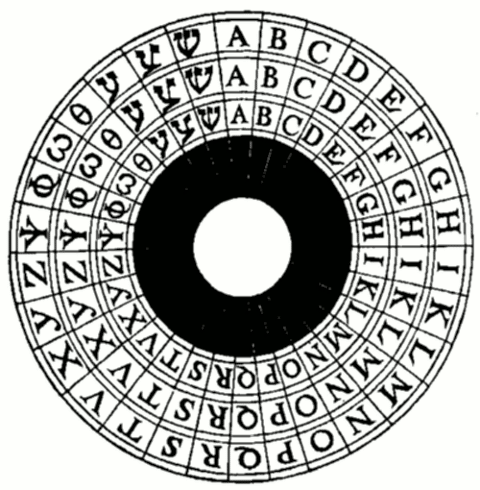
Notice the 30 letters containing ones borrowed from the hebrew and greek alphabets. Bruno was fascinated with this number, as evident in his other works such as ‘Thirty Seals’ and ‘Thirty Statues’. The outer ring holds people, the middle actions, the innermost objects, each assigned to one of the letters. Bruno gives lists of such combinations inspired by characters from Ovid’s Metamorphoses. A few examples:
A Lycaon - feasting - in his chains
B Deucalion - ploughing stones - wearing his headband
C Apollo - with the Pythoness - wearing his belt
Now when using the wheels, we turn them against each other. The easiest way to visualize this would be to imagine them not nested within each other but rather beside each other, like the wheels on a combination bike lock. So if your code was ‘ABC’ you’d turn the first wheel so ‘A’ is facing toward you, then do the same with the other wheels. In our example, this leaves you with ‘Lycaon (A) ploughing stones (B) while wearing Apollo’s belt (C)’.
Bruno then adds on two more wheels signifying an attribute and a circumstance (or rather, another object to add to the scene). He then enlarges each wheel to hold not 30 individual letters, but 150 combinations of the letters and a vowel. So now you have not A, B, C but AA, AE, AI, AO, AU, BA, BE, etc, which allows one to memorize far more letters in a single image. The resulting wheels look like this:
Now you’re probably wondering what to do when you have to memorize a word like ‘wondering’, since the ‘nd’ part could not be easily memorized with the letter-vowel structure we have now. For this, Bruno recommends the use of an additional figure (person) added to the locus, which is sitting, standing or lying down depending on whether its consonant is in the first, second or third two-letter combination of the word.
So for ‘wondering’ we would, judging from Bruno’s lists, have something like (to use modern examples, as Bruno recommends coming up with your own images) 'Wonder Woman (WO) nestling (NE) herself inside a ring (RI) that is gooey (G-) while Donald Duck (D-) is sitting down on the ring (denoting the position of his letter after ‘NE’, the second letter-vowel-combination).
And that is Bruno’s memory wheels in a nutshell. He also uses wheels in the llullian fashion, that, is, to combine questions and statements about metaphysics, but I imagine you’re more interested in the mnemonic side of things. Hope this helps!
