Hi. Any tips for using the Major System for memorizing sequences of binary numbers?
Many thanks.
1 Like
I use what I think is a pretty cool and very effective system.
As a prerequisite, you’ll need to have a pre-defined peg list based on the Major System, something like a PO (person/object) or a PAO (person/action/object) is ideal, but even a single element list can get you started. You can do this with a 1, 2, or 3 digit list.
You’ll also need to be able to quickly convert a binary sequence of three bits into a single digit number. Fortunately there are only 8 sequences to learn and with some practice you can get fast at it pretty quickly. The conversions are as follows:
000 = 0
001 = 1
010 = 2
011 = 3
100 = 4
101 = 5
110 = 6
111 = 7
If you have just a single digit peg list, you’ll take each converted triple binary bit and visualize its associated single digit element. Place the first element at the first location in a memory palace route and then move to the next loci and convert the next binary set. (If you have a PO or PAO system, you’d continue converting and combining elements to create scenes at each loci, which lets you encode up to 9 binary digits per loci.)
Here’s an example using single digit pegs:
P:
(001) → (1) → (Di) → Princess Diana.
PO:
(001, 110) → (1, 6) → (T/D, J/SH/CH) → (Di, Shoe) → Princess Diana sitting in a giant old shoe.
PAO:
(001, 110, 000) → (1, 6, 0) → (T/D, J/SH/CH, S/Z) → (Di, CHewing, Saw) → Princess Diana is chewing on a big metal saw.
If you have a pre-defined 2-digit system, you’d convert in the same way, except for every two sets of three binary bits, you can translate those into a single 2-digit number. You’d place your element(s) in the same way along a memory palace journey. This doubles the number of bits per element. Now we’re really getting somewhere in terms of data compression!
Here’s an example using 2-digit pegs:
P:
(001-110) → (1-6) → (T/D - J/SH/CH) → TaSHa (maybe Tasha Yar from Star Trek)
PO:
(001-110, 000-010) → (1-6, 0-2) → (T/D - J/SH/CH, S/Z - N) → (TaSHa, SuN) → Tasha is falling into the sun, burning to a crisp.
PAO:
(001-110, 000-010, 111-011) → (1-6, 0-2, 7-3) → (T/D - J/SH/CH, S/Z - N, K/G - M) → (TaSHa, SigNing, CoMb) → Tasha is signing her autograph on a giant plastic comb.
If you get really advanced and build out a 3-digit major list, you can take this even farther and convert three sets of three bits into a 3-digit number and encode 9 bits of information into single element. Combining elements can get you 18 or even 27 bits of binary info per scene!
3-digit peg example:
One element:
(001-110-000) → (1-6-0) → (T/D - J/SH/CH - S/Z) → (DiSHeS) → a pile of dirty dishes.
Two elements:
(001-110-000, 101-011-010) → (1-6-0, 5-3-2) → (T/D - J/SH/CH - S/Z, L-M-N) → (DiSHeS, LeMoN) → a pile of dirty dishes falling over onto a giant lemon, squishing it and spraying juice everywhere.
The 3-digit / 2 element method is what I use to memorize the binary red-black order of a deck of cards, including the 2 jokers, which I can do in a single pass in about 15-20 seconds on average. Using a 3-digit list, it takes only 6 elements combined into three simple scenes to encode 54 binary bits.
Hope this helps!
3 Likes
Awesome. Thanks very much!
2 Likes
Note: I don’t compete, but I do do binary. That said…
Two other options:
- Use the Major system 00-63
Or - Add another 28 on top of 00-99 (therefore 00-127).
00-63 allows for an individual image for every 6-bit sequence (example: 111010 = 60 [sixty])
00-127 allows a single image for each 7-bit sequence (example 1101111 = 111 [one hundred-eleven])
To translate the numbers quick, use flash cards (I use anki cards).
Eventually even 6 and 7 bit numbers become quickly recognizable.
2 Likes
Many thanks!
When programmers use binary, and they need to look at the data, it’s often grouped into groups of 3 digits (octal) or 4 (hexadecimal). If you already have a PAO set up, you probably just want to go with octal, but if you don’t maybe use hexadecimal. Since hex-digits already use letters it’s suggests something like
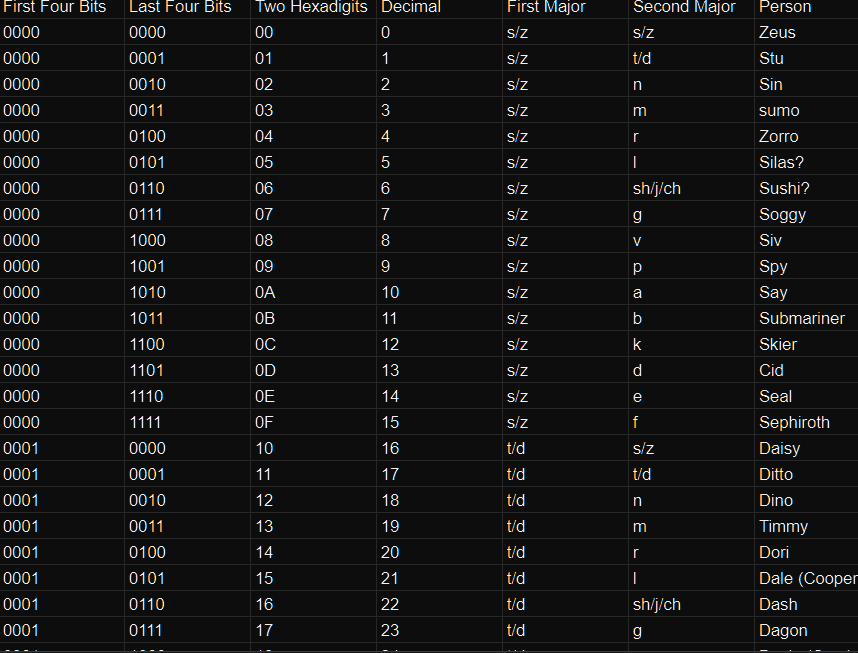
Some concerns are: going above 4-digits seems actually pretty hard to group together by eye, unless your going to use some software to group them for you. Also, while it’s common for people to use 2-digit PAOs and 3-digit PAOs have been used with success, 4-digit PAOs are almost not a thing. AFAICT, because of the shear difficulty of remembering 10,000 characters and training to deploy them effectively. This suggests that, whatever you decide, while a 7-digit PAO (0-127) is probably not too bad, and an 8-digit (00-255 (FF)), 9-digit (0-511), 10-digit (0-1023) are all in the realm of what’s been done before, at around 13-digits (0-8191) or 14-digits (0-16383), you’re headed into a space that really hasn’t been used effectively.
1 Like
Amazing stuff. Thank you.