I have decided to start this thread after having read some advise that I found to be quite profound concerning a memory technique written in the book: “13 Steps to Mentalism” by Corinda (11th Printing).
I will come back to the advise I read, but the purpose of this thread is to enquire from fellow forum members as to “what” is the best advise you have received from a memory book/ or other book concerning ‘the art of memory’?
I will start with advise given in the afore mentioned book which is aimed primarily at ‘mentalists’ but covers something I found to be of immense value to myself as someone interested in mnemonics.
The advise is contained in the 3rd step to ‘mentalism’ headed mnemonics and mental systems and concerns the effect known as the “Giant Memory” where audience members are asked to list 30 or so items and the mentalist is able thereafter to effectively recall all the objects (items) selected by the audience and recite it back to them with a 100% degree level of accuracy. In coaching (teaching) aspiring mentalists, the books’ author Corinda states: "Don’t try and fool yourself that the ability to do the “Giant Memory Feat” is an outstanding achievement. It is not! Any person of average intelligence could do it with twenty or so words after a few hours of study. The only thing you have mastered (that the layman hasn’t mastered) is the knowledge (and ability) of knowing how to do it and demonstrating it can be done! - and if you keep the technique a closely guarded secret - “the effect will remain - a masterpiece!”
The first stage of performing “the amazing memory test” is to commit to memory the following “keywords” where:
number one is a ‘gun’
number two is a ‘poo’
number three is a ‘flea’
number four is a ‘saw’
number five is a ‘hive’
number six is ‘tricks’ … etc. etc.
…
number twenty-eight is: ‘arrives late’
number twenty-nine is ‘on the line’
number thirty is ‘dirty’
The second stage having memorized the afore mentioned key words is to then create a picture corresponding to each number that cements the image even further into your memory.
Corinda demonstrates this technique with number 6 where the keyword is “tricks” - with the corresponding “action key” related thereto being a magician pulling “something” out of a top hat. Of course the “something” will be what the audience has selected as the item or object placed in 6th position.
Other examples of corresponding keywords and key actions are:
One is Gun = always shooting at something with a gun
Two is Poo = always pooing on something
Three is Flea = always an image of a flea hopping around on something
etc…
Thirty is always something you must give a good wash to with detergent because it is “dirty”.
Once you have mastered the ‘key words’ and ‘associated key actions’ corresponding to each ‘key word’ memorizing a given list of 30 items given to you randomly by the audience is quite ‘straight-forward’ and is actually child’s play.
Here are my first two examples for #1 and #2 of keywords and keyword actions:
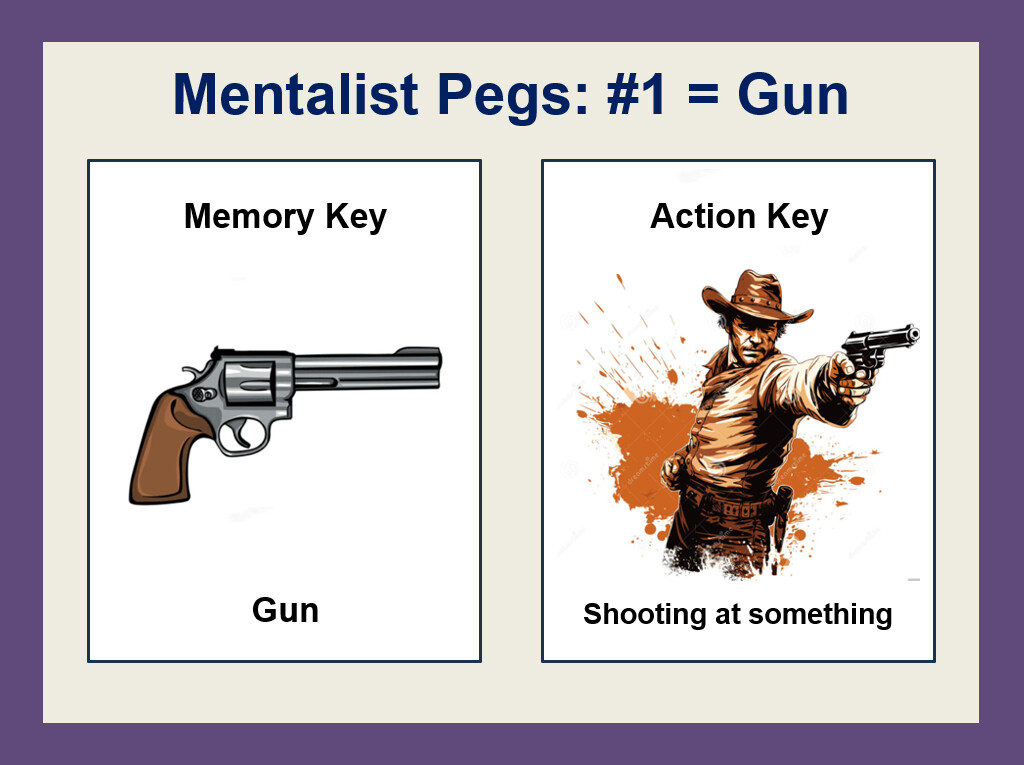
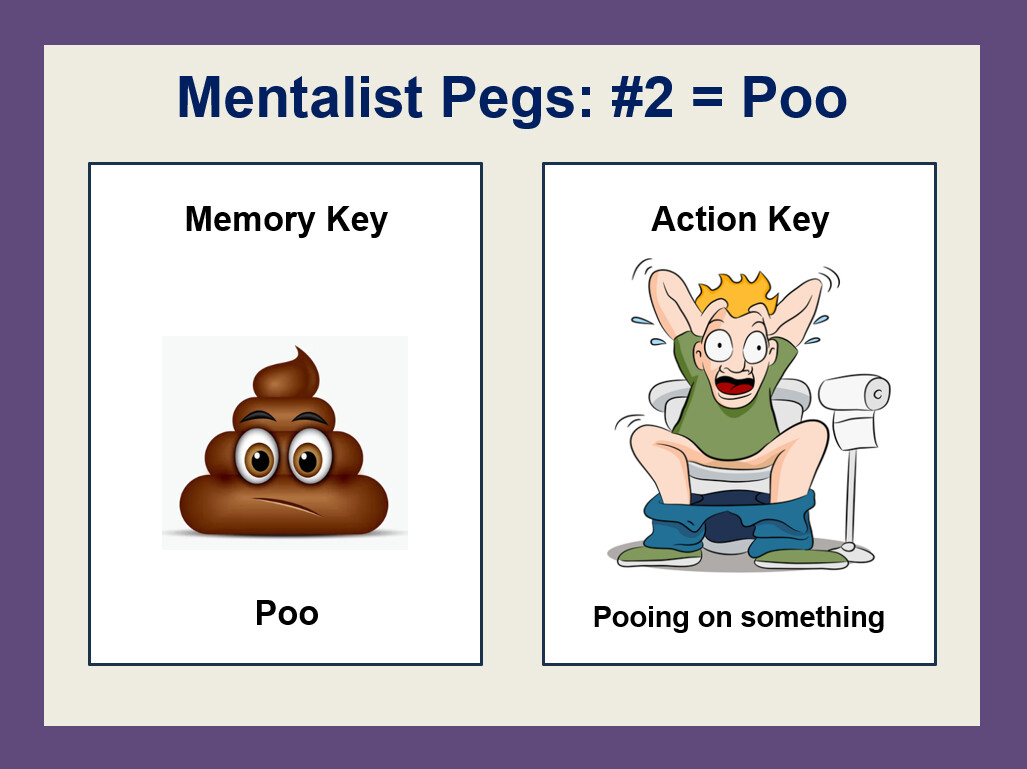
Note: All keywords rhyme with their corresponding numbers themselves, so for instance #30 keyword = “Dirty” (rhyming with thirty). The corresponding action keyword is washing the “dirty something” with detergent. Of course the “dirty something” = the object that the audience has presented to the mentalist as their 30th item to be recalled!
Back to my original question then … what is the best advice that you have received from a book, concerning the technique or topic of memory?
Note: there are no correct or incorrect answers to this question - merely your own personal experiences!