Auditory Equivalent to "Memory Palace" Technique?

Hi! You know how we are told that auditory or visual learning is a made up oversimplification?

Yeah well I am definitely an auditory learner by experience. My visual imagination is too weak to do a Memory Palace technique. I have done it many different ways. I have practiced it on hundreds of Kanji. It does not work. Rote rehearsal works better for me at this point but I want to do better.

Is there an audio equivalent for the “Memory Palace” technique?

If there is not can you make one up and post it here as something to test?

I can hear the audio I imagine very clearly. I can remix the audio in my mind easily to be whatever I want it to sound like. I do not work with instruments or have a particular interest. This is how my brain naturally works. I want an audio equivalent to the Memory Palace technique. Please find pieces of existing techniques that might come close. Please post ideas you have for a way of doing things that might work better.

I can imagine audio ~97% clear when I try to imagine or remix it as long as I have heard it enough times in the past. That number is not hard it is a guess based on how things sound. I can imagine visuals ~25% clear. Dark images like I lack a backlight in my brain even with the lights on around me. They lack crispness and lack clarity. So I really need these memorization techniques catered to words not art. Audio not symbols.

1 Like

Note that people report different levels of vividness when visualizing things.

Note that the human brain can only deal with a small amount of information (in RAM) at a time, so it can’t store a full-HD image of anything. Instead, you know what is supposed there and can focus on small details at a time. That’s enough for a memory palace.

Personally, my visuals are quite ephemeral. It can feel almost as clear as if I were looking at the real thing, but only for a moment before I think about it consciously, and I think I mostly visualize things involving elements that I’ve seen before.

An extreme case of poor visual imagery is aphantasia. People with aphantasia claim that they do not see any visual imagery, don’t really understand what that would even mean, and may be surprised that anyone else can e.g. “imagine a beach” or “imagine an orange rolling down the stairs”. I’m not personally sure to what extent this is represents the lower end of the scale of how vividly people report visualizations, or whether it’s a separate attribute that some brains have. But it has real consequences.

Lynne Kelly (@LynneKelly on Art of Memory) has aphantasia and is a memory expert. You might find some interesting ideas that avoid visual imagery on her website, perhaps starting from her article about aphantasia.

Thank you for the tag, Daniel. Hi Jack!

I have no visual imagery at all but use memory palaces all the time. I have been interviewed by Aphantasia researchers for that reason - they thought people with aphantasia couldn’t use memory palaces. I do, but I seem to do it much more on stories, than images. Plus I always encode ‘on Country’ as my Aboriginal colleagues would call it. I almost always go to the physical location in my palaces, except when I am doing it in competition. Those palaces I need to have walked a lot of times and reduced to a single image. So the post office is just the clock tower, and that reduces to clock or time as the key I link to.

I have practiced it on hundreds of Kanji. It does not work.

The palace I use most is for Chinese vocabulary and characters, so that is Kanji, except I have tones as well. I have been working on a system for Chinese - long story and I am writing it up. I add to that palace every day - it is now my primary example for using memory systems.

So my memory palace gives me the pinyin, character and tone for every word I add to it.

How did you set up the memory palace?

I set mine up based on the radical of the character - the component used for indexing. I won’t waffle on and on, but I find it is working a treat.

I put a lot of work into setting up the memory palace and in using a Person-Action system for the vocabulary in pinyin - one PA per syllable, which I am not sure will work for Kanji. I am sure I could not learn Chinese without the memory palace.

I have never tried an auditory palace, but I do use songs as part of the integrated system I am copying from Australian Aboriginal Songlines, which is a complex version of a memory palace.

I’d love to hear how you set up the memory palace for Kanji, how you encoded and why you felt it didn’t work. I am going to write up my system fully - I am still testing and working with some other testers. It is fascinating to hear what happens when others try it.

I want to try reading Japanese when I have Chinese more under control!

Lynne

2 Likes

@JMVIII,

I think that’s an easy question enough. A palace is just a set of locational pegs. What would be a set of auditory pegs? Why, any memorized grouping of tones. A short song, a three-movement symphony, a full opera.

The problem is not the palace but in the conversion of the information to store at the pegs. Random digits convert to random notes and are not compatible with ordered notes creating noise that is not resolvable like a bizarre visual image can be resolved through imaginative narrative logic.

When I hear or replay a composition in my head, visual images appear in my mind and it’s those that I would attach visual images to. The notes themselves do not evoke any value for a peg for me. But some people do have an association that would work for them I believe, it’s just not that common.

Doug

This is my reading as well. I use the example ‘every noun in these lyrics’ as a set of pegs. Calling it a ‘Memory Song’ is as valid as calling the method of loci a Memory Palace :slight_smile:

1 Like

My brain works exactly like yours. I am aphantasic when it comes to visual imagination and hyperphantasic when it comes to auditory imagination. I’ve used a number-to-musical-note conversion system for years to memorize phone numbers, even before I’d discovered memory training. Now that I’ve spent some time developing a PAO system, I’ve done pretty well linking 6-digit PAO groups with 4-digit melodies. (for example: 132435583472 would be encoded as a PAO group for 132435, a 4-note melody to connect the 3558, and then another PAO group for 583472).

I’ve also tried using a musical piece as a “memory palace”, and it did work, though I found it rather time-consuming to “replay” the music in my head to find all the stuff I’d put there. What I did was to take a piano piece I know well and attach “memory pegs” to various parts of the piece. (What I ended up with was a ragtime song encoding the Twelve Labors of Hercules, which was … interesting)

But also, another thing I’m finding very helpful to make up for the aphantasia is just to use memory palaces for the places where I’m physically present. Then all I need to do is just look around to “find” all the stuff.

2 Likes

The Quran is still memorized by hundreds of thousands of people. What helps is that the Quran is recited with tones and ebbs/flows of tension which come across almost like singing. I imagine this would aid in the memorization of any verbal material. There’s no special strategy afaik for verbally memorizing the Quran apart from repetition and investing emotionally in the text. I have never heard of any singer employing a sophisticated strategy for memorizing text, and I know several opera singers who have told me there’s no special strategy. Lastly, there’s no evolutionary reason for why humans would have a strong ability to memorize sequences of words, versus the evolutionary advantage of memorizing spatial representations, object positioning, and stories.

This comment really interests me because I am heavily involved in research on the evolutionary foundation of knowledge and memory. I’d love to hear more of your ideas on this topic.

I am not sure why you would say ‘versus’ in there. Isn’t there an evolutionary advantage in both? But the idea of memorising ‘sequences of words’ rather than the advantage of using language is different, but I am worried that I am misinterpreting you.

The research I am involved in with US academics looks at the FOXP2 gene mutation way back in prehistory, which granted the potential for language. We are using a similar research methodology, but the gene mutation we are working on, dating back over 300,000 years ago, seems to have given us the potential for spatial skills and music, which are fundamental to the way knowledge has been stored for tens of thousands of years before the relatively recent advent of writing. The research is really robust.

So humans did remember sequences of words, but by retaining them in songs, not prose.

Is this anything like what you are saying?

Love to hear you expand on what you meant, cabinmoose.

Lynne

2 Likes

That is very interesting about the FOXP2 gene, I’ll have to read more about that.

It seems to me that sound itself would not have nearly as strong an evolutionary pressure for storing long sequences in memory. Sound “in the wild” would have a cue->response component and not an elaborative component. You hear a wolves’ howl and know there is danger, or you hear the sound of a current and know there’s water. It’s very a “simple” sense (in regards to storing complex units of information), when you hear the sound there is no “navigating” involved to obtain a reward or flee from danger.

Now with sight and spatial awareness, the evolutionary purpose is storing in memory complex maps of many different objects as they relate to each other (sound has no such intrinsic interrelation and mapping). You might have to memorize where a herd of animals are a dozen miles away, requiring you to have memorized different geographical features. The locations of water, food, materials, and so on all require the “navigation” of memory, which lends itself to complex interrelated memory. You would have to think back on where your village is located, but you wouldn’t have to think back on what the wolves’ howl sounded like.

1 Like

What fascinating logic. That makes total sense. Thank you.

I don’t know about that. Humans think in stories and poems and songs, and a song or poem or story can contain a lot of information that you might need. To be good at finding food or materials, you don’t just need the location - you need to know how the weather and the season interrelate with the availability of different species of animals or plants, how to tell when it’s time to go hunting or fishing for a particular species, how to tell when a particular species will be plentiful, how to prepare whatever it is that you find and what the dangerous things are and what they do to you, how to treat whatever medical problems it is that you might incur while looking for all those things. You can’t encode all of this visually, but it’s very easy to do that in a story, or a song, or a poem, and music helps memorize all of this much better. This is why every culture has songs.

Also, all of these poems and stories and songs encode cultural memory - what is the story of our people, what is the story of our family, what is the story of our ancestors, what is the ritual that we perform with our families at this particular time. Those rituals help social cohesion, which is vital for survival.

So I wouldn’t dismiss auditory memory quite so readily. It’s vitally important.

I agree - but that’s not the way I read Cabinmoose’s comments. I may be way off track.

I took cabinmoose’s comments to refer to ‘storing long sequences in memory’ more than storing any language sequences. Most of the Indigenous songs and stories I know of tend to be short - not epics - although they may be linked into longer sequences. They don’t tend to be memorised word for word for long sequences.

I may well be misunderstanding.

I’m just thinking that our brain appears to be wired for sound as well as location. Storing long sequences in memory can include songs and melodies, and even a short song is still a lot more than just an animal noise. You wouldn’t think back on what a wolf howl sounded like, but you would think back on the song you know about what it means to hear a wolf howling at such-and-such a time, or the song/story you know about how to treat a wolf bite. I don’t think that transmission of cultural knowledge is possible without language, and language (for people with normal hearing) is all about sound sequences.

1 Like

Exactly, and some American researchers have identified the gene mutation which gave the potential for exactly that. It took a while for me to be convinced, but I am now and we are working together to look at how this works with memory systems. This gene mutation gave humans, or at least hugely contributed to, musicality - meaning the ability to use rhythm, tone and tune together and adapt it for developing a stock of songs encoding meaning. The same gene also gave us spatial ability and attention span.

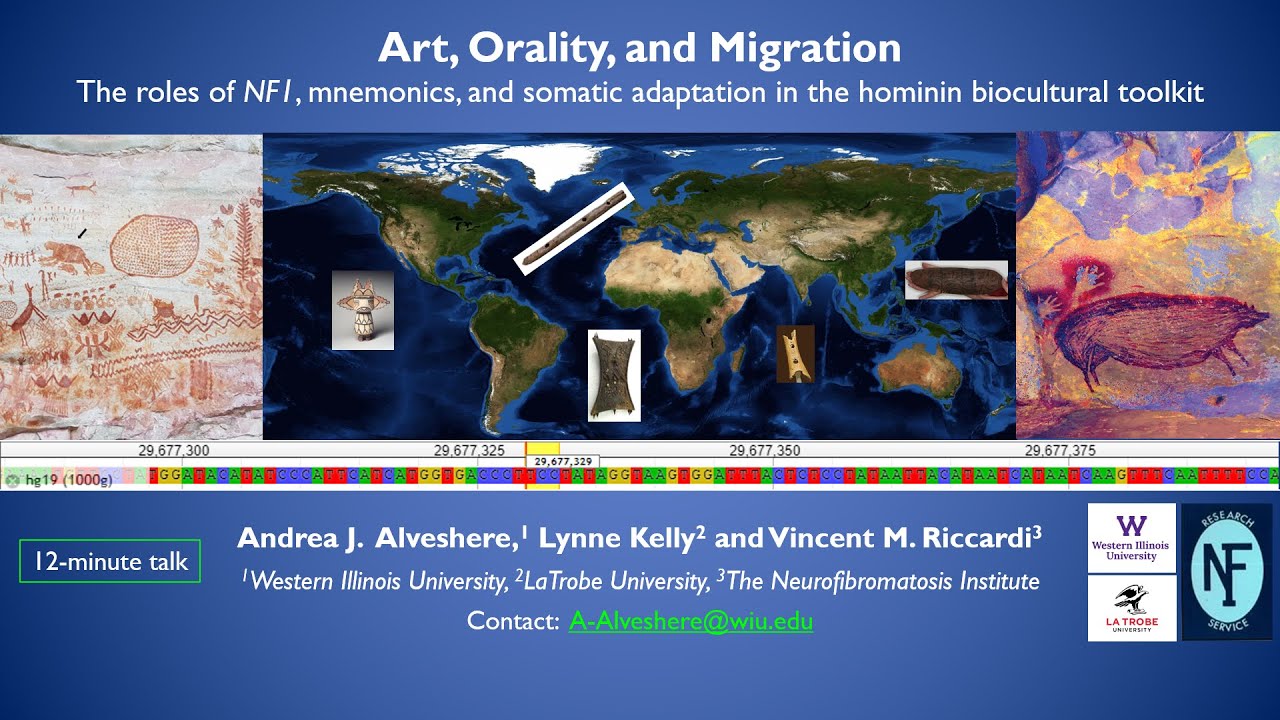
I am sure I have pointed to this before, but this is the video component of a presentation of this research, but it starts with a lot of hard core genetics - it was for the genetics stream of a biological anthropology conference.

So I am convinced that we are absolutely hardwired to link sound and location. The language bit comes from the FOXP2 gene (all of this interacting with other genes).

We are looking at the archaeological record for music, spatial links with art and performance to trace the Indigenous memory methods way back in human evolution. All very exciting, but challenging and difficult. That’s what makes it fun!

1 Like

I think this video : https://youtu.be/2NyFQJGwnJM?si=IjeaFwY9OJnVRFL2 could bring you a clue to your problem, in this video the artist managed to combine 4 references with a music. Certainly it is not the simplest method, even less the easiest to access because you need to have a minimum of experience in the field of music but in my opinion it is what comes closest to this what you are looking for is a way to associate new auditory information with previously known information. (I am French-speaking and I do not express myself very well in English, so I used Google translation and I apologize in advance if there are any errors in my text)

1 Like

I have tried this few times and failed. My brain does not work in this way. I suppose for more musical people it would work very well.

1 Like

2 thoughts:

  1. As a dyslexic the only way I can remember the alphabet is running the alphabet song through my head.
  2. Do certain songs not have a resonance much like certain smells. “Were all going on a bear hunt!” makes me think of camp fires. “The Gambler” makes me think of my Dad.