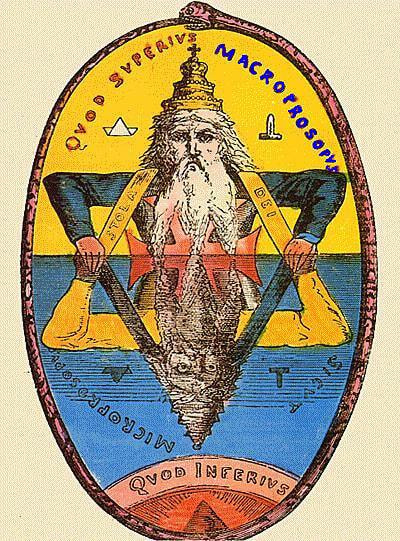
As Above, So Below: Turning the Memory Palace Into a Computational System

So, all of this started with the goal of doing complex calculations using the memory palace technique at super-fast speeds. I know, I know—we already have calculators and the technology available to us to perform such calculations. But my goal was to explore the possibility of doing these calculations mentally.

As I moved toward the goal of performing mental calculations, the first problem I encountered was figuring out how to convert abstract symbols, operators, and numbers into something that could be visualized and stored in a memory palace.

So I started with something very abstract, like the Star of David, or a hexagram, and tried to figure out how I could visualize it within a memory palace. Then I stumbled upon the image attached to this article, which uses a very unique process of converting the human body into symbols and shapes. By superimposing shapes and numbers onto the human body, it becomes much easier to store these images in a memory palace.

The more you use these images to perform calculations, the more proficient your brain becomes at associating the images with what they represent. In the beginning, the association process might look something like:

Number 1 → Find the image → Multiplication → Find the multiplication image → Number 3 → Find the image for 3 → Equals operator → Find the relevant image.

Basically, you are retraining your mind to use images directly for calculations instead of relying on the abstract numbers and symbols you have memorized.

For example, instead of memorizing 1 × 3 = 3 as an abstract equation, you could represent it inside your memory palace as a sequence of visual objects:

  • 1 → A huge golden statue standing like a soldier, holding a gun, representing the number 1.

  • × (multiplication) → Leonardo da Vinci’s Vitruvian Man, representing the multiplication operator through the human form.

  • 3 → A golden statue making an illuminated triangle/Illuminati symbol with his hands, representing the number 3.

  • = (equals) → The Lady Justice statue, representing the equals operator.

Eventually, the goal is for the brain to stop consciously translating these symbols into images. With enough repetition, the images themselves become the symbols. Instead of thinking “1 × 3 = 3” and then searching for the corresponding images, you begin manipulating the visual representations directly inside the memory palace.

In other words, the memory palace stops being merely a place for storing information and starts functioning more like a computational environment—where visual objects represent numbers and operators, and their interactions represent the process of calculation.

1 Like

Hi,

Yes…memory transference from short term to long term & more or less immediate transformation of information and then computational processes.

The issue is is that based on the intelligence of a person and rapidity of the ability to transfer from short to long term the above, your processes will be dampened.

Stefos

I like your ideas, I have thought along these lines as well but the question is, how much memorization will you need to do?

I mean, your objects for 3 and 2 will likely not combine in a logical way to give 6, so you’ll still have to transfer all your basic arithmetic knowledge to the image form, at least that is what I think (please correct me if I am mistaken). I will say, as far as we’re going for memorization, will it not be better to memorize the things we do not already know and cannot already calculate quickly?

I thought of an idea for multiplication using factors as building blocks for the image of a number. The best ‘complex’ image I could think of was a book. So I started from strips of paper to represent 2, a page to represent 4, 2 pages to represent 16, a book to represent 256. I don’t think the images really have to ‘build up’ anyway (a transformation method should work just fine) but I think going for factors and being able to combine them effectively will be a good approach for multiplication. I will play around more with this idea.

Looking forward to hearing more from you.

Interesting idea.

I’d be curious to see an example of a calculation that is very difficult using Classical or soroban methods, but relatively easy for someone who has developed and practised a system like this.

1 Like

Not sure this is feasible solution. To imprint it in memory you need some repetition but the number of sheer possibilities is too great. To do this feats you could be better of just by learning quick calculation tricks and just training

I guess it would make sense if you had limited calculation options. e.g. you pick the multiplications you may need like 24 x 30 (hours in month) and skip the rest.

Maybe I’m not getting something about the method :sweat_smile:

1 Like

Yes, I think you are right. This post is mainly focused on the first step: converting abstract arithmetic characters—numbers, operators, and symbols—into visual representations that can be placed and manipulated within a memory palace.

And yes, at this stage, the visual representations themselves do not interact with one another in any inherent or logical way to produce the answer to a multiplication, addition, subtraction, or division problem. In that sense, you are correct that we would still have to transfer the basic arithmetic knowledge—such as the multiplication tables from 2 to 10—into our memory system. That would obviously take time and repetition.

Your point about factors is particularly interesting because it addresses the next problem: rather than simply assigning an arbitrary image to every number, perhaps the images themselves could contain some of the mathematical structure of the numbers and therefore be capable of being combined or transformed in meaningful ways.

For now, though, my approach is largely speculative. I’m essentially trying to explore whether a memory palace can be pushed beyond its traditional use as a system for storing and recalling information and potentially used as a computational environment. The first experiment is simply to establish a visual language for arithmetic. Whether those visual representations can eventually be made to interact in a way that actually performs calculations is the much harder—and more interesting—question.

I really like your idea of using factors as building blocks. I think that could be a promising direction for the next stage of the experiment.