April '24 Study Group: Organizing for Long Term Retrieval / Mnemonic-Data Structures

Edit: If you already selected a time, click it again.

__whoops__

:no_entry_sign: :no_entry_sign: :no_entry_sign: [Old Scheduling Poll was here] :no_entry_sign: :no_entry_sign: :no_entry_sign:
Edit: whoops, forgot to set this poll to public to see the results. See below.

Greetings Mnemonistas

Beau here.

We may or may not have interacted yet, but this is an invitation to you.

Study Group Details:

This is an exploration of methods to organize information mnemonically for long term retrieval and comprehension.

About me, Beau:

I’m several months into my own research.

I memorized large portions of Python Programming Documentation and Network Engineering details/concepts starting at the end of last year. Before that I’ve used mnemonics for language learning, script memorization, martial arts, and a varied assortment of other topics and lists I’m interested in.

To keep it all organized (beyond anki flash cards), I’m building a “Global” mnemonic palace (one Palace to rule them all, a main access point to all my organized knowledge).

Are you interested in exchanging ideas?
Let’s do it. That’s what this is.

So far I’ve dug into a number of texts/materials ranging from the Information Sciences—to Modern mnemonic methods—to Historic methods (eg: G. Bruno)—to programming, data structures, and sorting.

And most importantly I’ve experimented and memorized a lot.

I experiment and I take notes.


Below are 2 scheduled events.

Join whichever appeals most to your schedule (or both).

They’re both within a day of each other.

  • Length = 30 Minutes[1]
Registrant Cap / AKA Max participants limit

The cap is 9 folks per call TOPS.
No 30 person conference calls, good lord.

I’ll contact you directly (via the forum) to confirm.


Study Group Times (multiple choice):

aka, the Scheduling Poll that works correctly.

Answer below here :arrow_double_down: :arrow_double_down:

I can see these results: :stuck_out_tongue:
(tap the date to change/check various timezones)
:arrow_double_down: :arrow_double_down:

  • 26th Apr, 16:00pm Coordinated Universal Time—2024
  • 27th Apr, 1:00am Coordinated Universal Time—2024
0 voters

— —You may also DM me. — —


Other options that may interest you:

  • I am interested in receiving follow-up resources after each session (e.g., summaries, further reading).
  • I would prefer to receive pre-session preparation materials in advance to better prepare for the discussions.
0 voters

Call Details:

The call service (Zoom, Google Meet, Jitsi) is To-Be-Decided.

I don’t have a paid for account on these platforms, so I’m open to suggestions. If there’s no preference, I’ll pick something and keep folks updated.

Who’s it for?

Frankly, anyone legitimately interested.

I expect a fairly small group. And that is preferable to me.

I’m capping both calls at 9 confirmed registrants.

Cost

It’s free, y’all. I don’t have a product to sell.
I’m in this to seriously aid and expedite my own personal research and to share with others.

Ideas/Feedback/Questions welcome and encouraged. :cowboy_hat_face:

Regards,
Beau


  1. I originally had it as 1 Hour, but I figure if we’re having that good of a time–and we will–we’ll just stick around longer or schedule another. Easy. ↩︎
5 Likes

I have been exploring something like this as well.

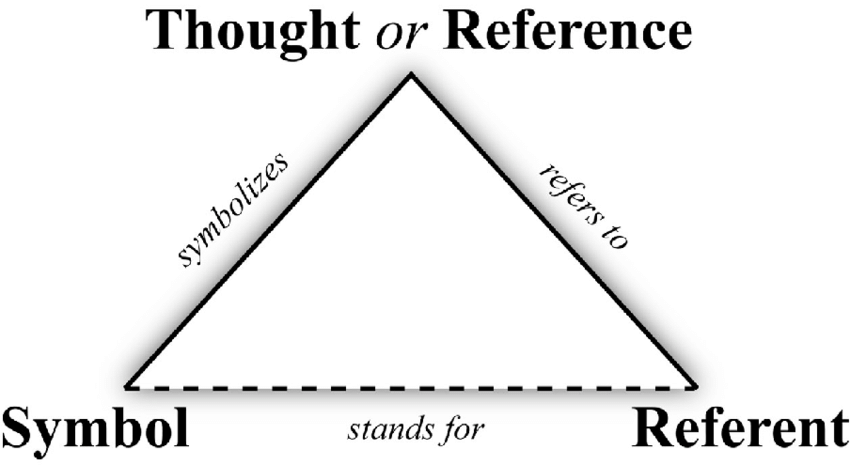
This is the semiotic triangle:

The idea is that our understanding of the meaning of symbols (at least in the sense of what they refer to) is not direct, rather it is mediated by our thoughts or conceptions of a given referent.

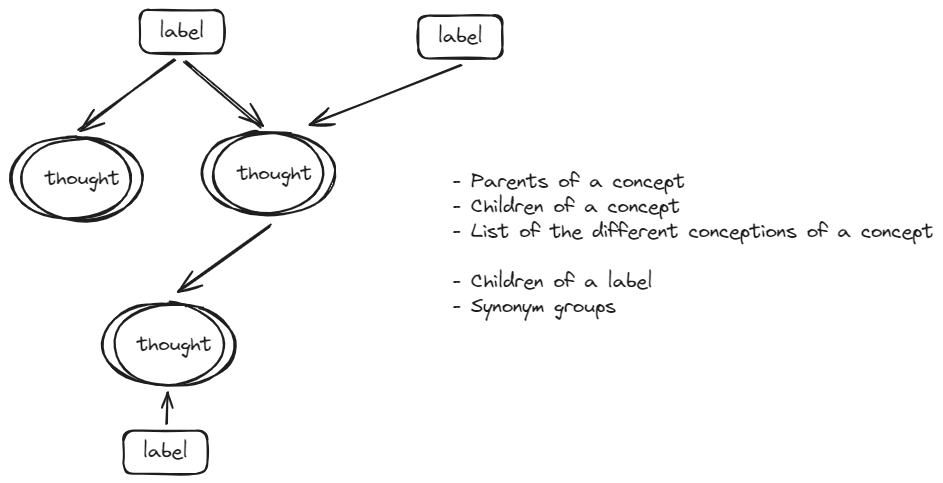
Inspired by the semiotic triangle, my current model is this:

To me “label” is the “symbol”, and it could be anything, not necessarily a piece of text.

A thought is actually the thought and the referent together, hence why it is repeated. My train of thought was that I could have as many thoughts as required in order to catch the actual referent. So, the different sub-thoughts are in some sense refiners, though all equally important.

The list represents meta stuff about the model that I might want to keep track of (the arrow represents dependence).

Obviously this whole thing has a graph structure, and besides a graph’s local information and its metadata, one might also want to memorize the space of all nodes i.e. without paying attention to the details.

1 Like

Introvert here, can I join just to listen to discussion

2 Likes

@myothersherlock
I like that meta-list. It’s good.

Each of those could potentially be contained in one (or more) mnemonic indexes.

And I agree with the spacing as well. I’ve been mapping out memory palaces on graph paper recently.

Journeys have “shapes” of their own, I notice.

I like the semiotic triangle. It reminds me a bit of Object Oriented Programming, which I find almost endless overlap between the concepts of Object-Oriented Design and Mnemonics.

I’ve been meditating on using Python programming to build a database of my personal mnemonic “objects” that each include referents and references to other “objects”, including “locations” which are another type of “object”, and “scenes” which are yet another, and any “object” can contain or be contained and reference or be referenced by others.

@mystic_cultivator I relate to your comment a lot, LOL. You officially have “fly on the wall” privileges!
(whatever those might be!)


Edit: Also, if you’re following this topic, I had to reset the Scheduling Poll so I could make it public (aka, see who clicked).
Please try again!:sunglasses:

the problem with the meta list is how quickly it could degenerate into something unmaintainable for a given topic.

first, with respect to generality. for example, addition is a special case of a binary operation. so, should the meta lists of both concepts refer to concepts that depend on addition?

if not, we also have second problem with respect to number. A LOT of things in the math that we study today involves binary operations.

1 Like

I’m a little confused. If the concepts are different, then the imagery (ie what represents the concepts) would be different, no?

yes, but concepts relate or are defined in terms of each other, so that the meta list of the children of a given concept will contain anything that relates to it (at least that is how i define it).

(a+b)+c =a+(b+c) is a fact that relates to addition
a(b+c) = ab+bc is another
d/dx(f+g) = df/dx + dg/dx is another
and the list goes on and one

should children(addition) contain all of the above?
should children(binary operation) contain children(addition) since “binary operation” is a generalization of “addition”
or should children(addition) only contain concepts that are individual to it, and are not necessarily properties that any other binary operation exhibits

in all cases, the size of children(X) will be huge for some Xs, in which case pruning it makes sense, but the cut-off is not obvious

is this better? i realize that i restated what i said, but hopefully the example drives the point home more

1 Like

I dont think its as much of an issue as you imagine.

Librarians and Archivists have considered these quests for hundreds of years, and really gone into the idea of how to define and categorize knowledge and the criteria to follow to determine that over the past handful of decades.

I would have to hear a specific example of something ambiguous, as you’ve suggested, showing up to see the trouble you see.

Any specific examples?

do you recommend an article or a video on librarian and archivist techniques?

nothing ambiguous per se, but the size is daunting.

1 Like

I ran into this sort of daunting problem a couple months ago. I couldn’t figure out how to organize all the information I had memorized in all the palaces I’d made.

I didn’t have that issue until the size of my mnemonic system grew to the point that, unless using flash cards (or actually needing to check a fact), I rarely reviewed my palaces.

I read Indexing and Abstracting by the Clevelands and The Organization of Information by Arlene G Taylor. Maybe there are some articles by them or relevant to their work. I could look when I’m more awake.

I haven’t watched any videos on it, but I took copious notes.

If binary addition is different than “regular” addition (where we have the usual properties of addition), then what we have is two different concepts. They may be related in some way (even if its just that they both use the word "addition " and perform calculations of one sort or another, but the imagery should clear up any confusion I think.

Even Giordano Bruno noted that you can place images in the same locations as long as what follows, for each different image, contains information about where it came from.

The child objects, in this case, would have breadcrumbs indicating which addition they came from.

Beyond that, though, I don’t think those meta-lists would be enough on their own. I think they’re great, though.

In my estimation, a truly scalable global memory palace would have a lot of “indexes” to use to double check your work.

I found the completely free application Fantasia Archive today that makes me think (if i understand correctly) of what you are proposing, its a worldbuilding tool but all the items can be connected and there is a big variety of different “objects”.

3 Likes

I just looked it up. Looks very cool. Thank you for sharing!

Is this on for April 26? - Looking for those zoom details. :slightly_smiling_face:

1 Like

This happens tomorrow. :slight_smile:

I just sent out the call details in a PM.

Interested in joining us?

If other folks want to join either call:

  • Let me know so I can forward you details.

Looks like it’ll be a good conversation, especially for the first of the two calls.

I included Preparatory Questions (in the DM) in case you’re into that sort of thing.