Hello, how do i remember concepts of Mathematics i have the Problem that i read a Math book and Understand most of the Concepts, but don’t remember them very long. So i want to ask if somebody has an idea to remember abstract Concepts. I’ve allread tried to write them to a notebook with mediocre success. But i hope that with Memory techniques there exists a better/faster way to remembert that data (only in my head).
Hi,
You have to make the abstractions something tangible.
Ex. (X + Y) (X - Y)
(Ex-wife/husband giving or adding to a Gigantic letter Y) See a Clock for “times” (Ex-wife/husband taking from a Gigantic letter Y)
Make sense?
Stefos
P.S. I know…easier said than done! 
1 Like
Hi, do you have any idea how to make the different Concepts/Equations Memorable for example:
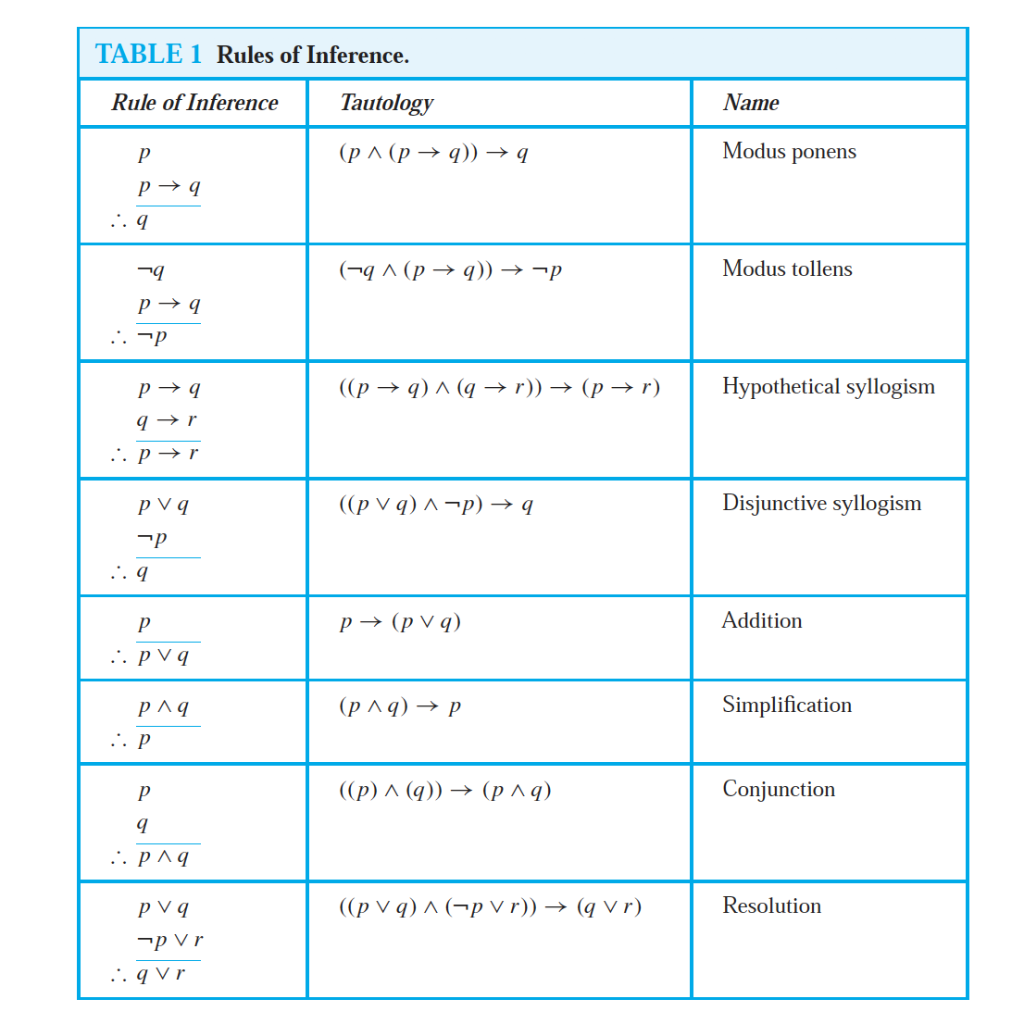
because they are sometimes very similar or have like here the same letters/symbols used and at least for me the information is hard to encode.
1 Like
Propositional logic is interesting as it’s the one aspect of mathematics I studied where verbal processing was more effective than visual processing.
By this, I mean that you can just read out the sentences in English (or your strongest language) to see what makes sense.
This is different to e.g. analysis, abstract algebra, graph theory, statistics, etc. where I would have visual ways to represent things in order to think about them.
So, how to study these? Usually I’d recommend not using memory palaces or mnemonic techniques for mathematics; if you actually understand how things work then they’ll stick easily in your memory without needing to add in abstract context (which is essentially what mnemonics are). This also means you can easily generalize them, which doesn’t readily happen with mnemonics.
However, for this list, it’s a fairly opaque list of terms (some of it is in Latin, and the shortest English word is 8 letters!) so it’s actually a good place to use mnemonics. I’d suggest some things:
-
The middle column can be easily created from the left column. You just add parentheses and arrows. So don’t even start to memorize that, but try computing the entries yourself then checking with the table.
-
Try to think why these names were given. Find out what the Latin and English words mean. If you don’t know, make something up. That is essentially a mnemonic. For example, Resolution says that if p is true, then q must be true, otherwise r must be true. So certainly at least one of q and r is true. Imagine two people arguing about whether p is true. Well they can reach a resolution that either q or r must be true. Call the people Quentin and Patrick if that helps.
-
Practise saying the statement in a sentence, either in terms of p, q and r, or with concrete examples. E.g. for resolution:
“If it rains I need my umbrella. Otherwise I need my sunhat. Regardless, I need to carry one of these items.”
3 Likes
Daniel Timms answered welll.
Graph
Alternatively I would start with graph. Knowing that graph present all combinations I would get memory hook. Then move to understending, i would try to replay several times proces of understending why each relation occur. Lastly understand how name is related to relation.
I would doddle along to represent meanings and relations during repetitions and understanding.

1 Like
Thank you for your reply and your good advice.